
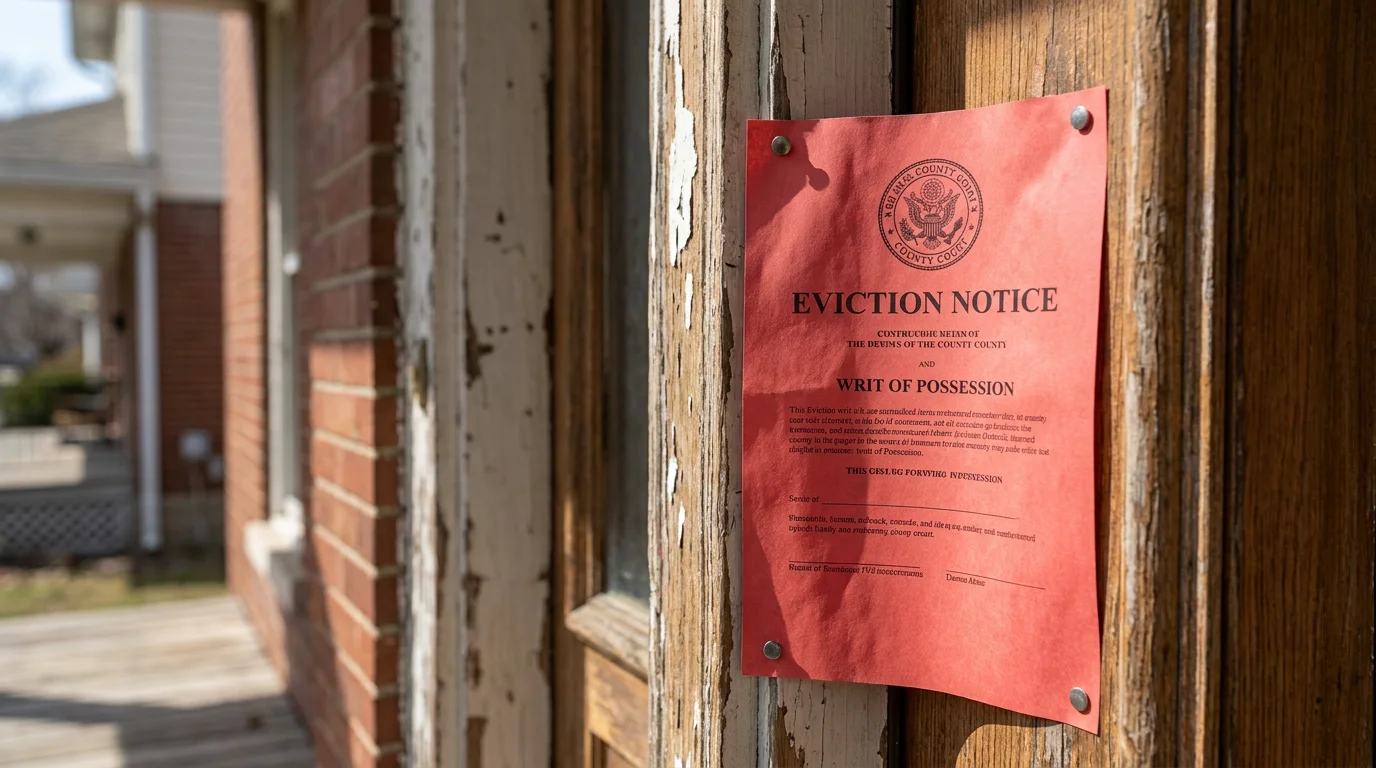
Rent is two weeks late and the tenant has stopped answering texts. The 3-day notice to leave the premises that Ohio law requires under R.C. 1923.04 is step one, and everything after it runs through a municipal court. Skipping that process and attempting a self-help eviction is precisely what gets landlords into serious legal trouble. Ohio appellate courts treat a defective notice as a jurisdictional failure that gets the case dismissed, and self-help removal exposed one landlord to nearly $50,000 in damages in a 2024 case.
What is an Ohio 3-day eviction notice?
The 3-day notice is the written demand to leave the premises that R.C. 1923.04(A) requires you to deliver "three or more days before beginning the action." You cannot file a forcible entry and detainer (FED) complaint without it. Ohio courts treat proper service of this notice as a condition precedent to the court's jurisdiction: in UMH Ohio Buckeye, II, L.L.C. v. DeCarlo (8th Dist., 2019), the DeCarlo decision held that compliance with R.C. 1923.04 is a precondition to invoking the court's power at all, and a notice signed by someone other than the prospective plaintiff fails that test.
Valid grounds for issuing a 3-day notice in Ohio
Chapter 1923 supports an FED action on several grounds, and the 3-day notice is the pre-suit step for the common residential ones:
- Nonpayment of rent, which R.C. 5321.03 preserves as a ground even against a retaliation defense.
- Material violation of the lease or rental agreement, such as unauthorized occupants or repeated rule breaches.
- Illegal drug activity on the premises under R.C. 1923.02(A)(6). These cases qualify for an expedited track under R.C. 1923.051, which requires service within three working days of filing and trial no later than the thirtieth calendar day after the tenant is served.
- Holding over after the tenancy term or a properly terminated month-to-month tenancy ends.
Some occupancy types carry different or longer pre-suit notice rules: manufactured home park residents, federally subsidized tenants, and land installment contract buyers. The special situations section covers those rules.
Occupants with no lease follow a different path; see removing a squatter in Ohio.
Required content and statutory warning language
For residential premises, R.C. 1923.04 requires that every notice contain the following language, printed or written in a conspicuous manner:
"You are being asked to leave the premises. If you do not leave, an eviction action may be initiated against you. If you are in doubt regarding your legal rights and obligations as a tenant, it is recommended that you seek legal assistance."
Defective notice language is a recurring reason Ohio FED complaints get dismissed. In Mularcik v. Adams (7th Dist., 2004), the appellate court reversed and dismissed the FED complaint because the notice did not conform to R.C. 1923.04. As recently as April 2026, the Fifth District in DNW Properties III, L.L.C. v. Tucker reproduced the mandatory warning verbatim when the Tucker decision confirmed what the statute requires.
Beyond the warning, the statute does not dictate a form, but in practice a defensible notice should identify the tenant and rental property address, state the grounds for asking the tenant to leave, give the service date, and carry the signature of the landlord or the party who will file the complaint. That last point comes straight from DeCarlo: Ohio courts do not treat a notice signed by a different party as service by the "party desiring to commence an action." The warning requirement applies to residential premises only; the Ohio Supreme Court in Maggiore v. Kovach (2004) held it does not extend to commercial tenants.
How to legally serve the 3-day notice in Ohio
R.C. 1923.04(A) authorizes exactly three service methods, confirmed as the complete list in Maggiore v. Kovach. Document whichever one you use:
- Method | What the statute says | How to document it
- Certified mail, return receipt requested | Mailed to the premises or last known address | Keep the certified mail receipt and the green return receipt card (PS Form 3811) or USPS tracking record
- Personal delivery | "By handing a written copy of the notice to the defendant in person" | Prepare an affidavit of service with the name, date, time, and location; bring a witness if you can
- Leaving at the premises or usual place of abode | "By leaving it at the defendant's usual place of abode or at the premises from which the defendant is sought to be evicted" | Photograph the notice posted at the door with the date and time, and keep an affidavit of service
Posting on the premises, that is, leaving the notice at the rental unit, is one of the three authorized methods under R.C. 1923.04. However, the broader "posting in a conspicuous place" language is a different concept entirely: it appears in R.C. 1923.06, which governs service of the summons and complaint after you file suit, not the pre-suit notice.
Franklin County Municipal Court requires a copy of the notice attached to the complaint, Cleveland Housing Court requires the same, and Hamilton Municipal Court requires three copies of the notice with evidence of service, warning that failure to provide both "may result in the dismissal of the Eviction."
How to count the 3-day notice period
R.C. 1923.04 sets the three-day floor but no counting method, so R.C. 1.14 supplies it: exclude the day of service, include the last day, and if the last day falls on a Sunday or a legal holiday, push to the next day that is neither. Legal holidays under R.C. 1.14 include New Year's Day, Juneteenth, Independence Day, Labor Day, Columbus Day, Veterans' Day, Thanksgiving, and Christmas. The Tenth District has held that Civil Rule 6(A) does not apply to FED actions (Wodzisz v. Bayes, 1997), so R.C. 1.14 is the controlling rule.
The Ohio State Bar Association gives more conservative guidance: do not count the day you give the notice or weekends and holidays, and wait until after the third day before filing. Follow the conservative version. Premature filing is a jurisdictional defect, so you will generally have to serve a fresh notice and refile.
In Midtown Apts. v. Davis (10th Dist., 1985), a three-day notice served on a Thursday could not support a Monday filing, because the third day fell on a Sunday. Under the bar association's counting, service on a Thursday makes Friday day one, skips the weekend, and lands day three on Tuesday. Serve on a Thursday and Wednesday is the earliest safe filing day.
What landlords cannot do: prohibited self-help methods
The notice period has run, the tenant is still there, and changing the locks looks like the fast fix. R.C. 5321.15 bars you from recovering possession by any means other than the court process, even after the 3-day notice expires. Subsection (A) forbids "any act, including termination of utilities or services, exclusion from the premises, or threat of any unlawful act" to recover possession. Subsection (B) forbids seizing the tenant's furnishings or possessions to recover rent without a court order. In practice, that rules out:
- Changing the locks
- Shutting off water, gas, or electricity
- Removing or holding the tenant's belongings
- Threatening to do any of it
A landlord who attempts a self-help eviction runs serious legal risk: R.C. 5321.15(C) makes a landlord who attempts a self-help eviction "liable in a civil action for all damages caused to a tenant... together with reasonable attorneys fees." In Burcica v. Ludy (1st Dist., 2024), the damages award reached $49,886.32, including $20,000 for intentional infliction of emotional distress and $24,943.16 in punitive damages, plus mandatory attorney fees. A locked-out tenant may also lawfully re-enter by reasonable means, such as hiring a locksmith. The only lawful physical removal is the court-ordered set-out carried out under a bailiff's supervision.
Filing the eviction complaint if the tenant does not leave
If the tenant is still in possession after the notice period runs, you file a forcible entry and detainer complaint with the municipal court that hears evictions for the property's jurisdiction. Most courts structure the complaint in two parts. The first cause of action seeks restitution of the premises, meaning possession. The second cause of action seeks back rent plus any late fees or damages. You can file the first cause alone, and the fee is usually lower if you do.
After filing, the clerk issues a summons. Under R.C. 1923.06, the tenant must receive the summons at least seven days before trial, and the court cannot hear the restitution claim sooner than the seventh day after service is complete.
If the tenant does not appear, the court can enter a default judgment awarding you possession of the premises. Default judgment resolves the restitution claim quickly and without a contested hearing. However, if the tenant does show up, they may ask the court for a continuance to prepare a defense or find counsel, which can delay the FED hearing by days or weeks. Plan for both outcomes.
Confirm the current amount with your clerk before you file. Published possession-only filing fees range from $94.00 or $130.00 in Hamilton County, depending on the court source, to $193.00 in Akron.
- Court | Possession-only fee | Money-claim fee | Note
- Hamilton County | $94.00 or $130.00 | Not listed | Conflicting court sources
- Akron | $193.00 | Not listed | Highest listed possession-only fee among these courts
- Franklin County | $133.00 | $170.00 | Money claim raises the bill
- Cleveland Housing Division | $110.00 for one defendant | Not listed | One-defendant amount
- Toledo | $132.50 | $147.50 | First and second cause amount listed separately
- Dayton | $160.00 | $200.00 | Two or more causes raise the bill
The eviction hearing, judgment, and set-out process
Expect the hearing roughly two to three weeks after filing. Cleveland Housing Court's FAQ puts it at about 21 days, Franklin County at 14–21 days depending on service type, and Toledo at least 14 days. Ohio Legal Help estimates the full process, from 3-day notice through move-out, at 4 to 6 weeks, in line with our state-by-state eviction timeline.
At the hearing, plan to present live testimony. In T & R Properties, Inc. v. Wimberly (10th Dist., 2020), the T & R Properties court held that Civ.R. 43 applies to FED actions and overruled prior precedent allowing judgment on affidavits alone. As a practical matter, bring the lease, rent ledger, notice, and proof of service.
Two defenses come up most often:
- Retaliation under R.C. 5321.02, if the eviction followed a complaint to a housing or health agency, a complaint to you about R.C. 5321.04 violations, or tenant organizing; R.C. 5321.03 preserves your right to evict for nonpayment or holdover anyway.
- Discrimination under R.C. 4112.02(H), which covers race, color, religion, sex, military status, familial status, ancestry, disability, and national origin, a broader list than the federal Fair Housing Act.
A contested case built on retaliation or discrimination defenses is the point where many landlords decide it is worth hiring an eviction attorney. A tenant raising a housing discrimination defense can also file a charge with the Ohio Civil Rights Commission within one year of the alleged discriminatory act; housing discrimination claims proceed separately from the possession question the FED hearing resolves.
The FED hearing decides possession only; the Twelfth District in Landings at Beckett Ridge v. Holmes (12th Dist., 2020) confirmed it resolves "the right to immediate possession of property and nothing else," so your money claim proceeds separately.
If you win, request a writ of restitution promptly. Under R.C. 1923.13, the court must issue a writ of execution at the plaintiff's request; this is the writ of restitution, commanding the executing officer to remove the defendant and restore possession to the plaintiff. Franklin County allows the request up to 30 days after judgment; Cleveland requires the writ within 60 days. A bailiff then posts the "red tag" notice on the door, and under R.C. 1923.14, the executing officer must act within ten days of receiving the writ. In these courts, court bailiffs rather than the county sheriff carry out ordinary landlord-tenant set-outs. If the tenant still has not left, you schedule a set-out. Franklin County gives you 90 minutes, and its bailiffs supervise without touching property; in Cleveland the movers are ones you hire and insure, working under bailiff supervision.
Red tag periods and disposal deadlines vary by county:
- County | Red tag period | Disposal allowed after
- Franklin | 5 days, including weekends and holidays | 48 hours after set-out
- Cleveland (Cuyahoga) | Five to 10 days per the writ | Three hours after move-out or by 5:00 p.m. that day, but City Ordinance 375.10 requires inventorying and storing possessions at least 30 days
- Toledo | 4 calendar days | 24 hours after placement at curb
- Hamilton | Typically until the following Friday | Removal within 24 hours; fines up to $2,000.00 for leaving property or litter on the premises or placing it in the public right-of-way
Rent acceptance waiver risk
Accepting future rent after serving the notice triggers a waiver of your eviction rights and voids it. The Third District in Premiere Mgt., L.L.C. v. Nutt put it plainly in the Premiere Management decision: "Courts have long held that a landlord waives notice to vacate where she accepts a partial or full payment of future rent after issuing the notice, and, thus, may not proceed with her forcible entry and detainer action."
Apply the rule by payment type:
- Payment or lease term | Effect on the notice
- Rent covering any period after the notice date | Waives the notice; serve a new notice before filing
- Rent that was already past due when you served the notice | Does not waive the notice (Graham v. Pavarini, 8th Dist., 1983)
- Government housing assistance payments | Not "rent" for waiver purposes under Premiere Mgt.
- Non-waiver clause in the lease | Approved in Graham as a backstop
A non-waiver clause helps, but the safer habit is refusing any payment beyond clearly past-due amounts once the notice goes out.
Special situations
Several occupancy types override or extend the standard 3-day rule:
- Section 8 Housing Choice Voucher tenants can receive Ohio's 3-day notice to leave the premises for nonpayment, unless the property is a CARES Act covered dwelling, in which case the 30-day notice below controls, but under 24 CFR 982.310(e) you must give the public housing authority a copy of the eviction notice at the same time you give it to the tenant, and you may only evict through a court action.
- CARES Act covered dwellings, including public housing and Section 8 properties, whether HCV or project-based, require a 30-day notice to vacate before filing. The Tenth District in Olentangy Commons Owner, L.L.C. v. Fawley (2023) held in the Olentangy Commons decision that skipping the 30-day notice deprives the court of jurisdiction.
- Project-based Section 8 and public housing carry HUD's 30-day written notice requirement before filing for nonpayment, running from the tenant's receipt and accompanied by an itemized statement of charges by month; that requirement remains in effect as of mid-2026.
- Manufactured home park residents get a 30-day written notice to cure a first material rule or code violation under R.C. 4781.45; a second material violation within six months permits immediate termination followed by the standard Chapter 1923 process. Nonpayment still takes the 3-day notice.
- Land installment contract buyers get a two-stage sequence under Chapter 5313: a 30-day default cure period, then a 10-day forfeiture notice, so roughly 40 days minimum before suit, and once the buyer has paid five years or 20% of the price you must foreclose instead.
- Commercial tenants still get a 3-day notice, but the statutory warning language is not required (Maggiore v. Kovach).
Protecting your rental during and after an eviction
An eviction usually hands you back a vacant unit with damage, and both conditions are underwriting problems. Vandalism and burglary exposure peaks while a unit sits empty, and most standard policies have vacancy clauses, often 30 to 60 days, after which some coverages may suspend unless you add vacant-property coverage.
Landlord insurance in Ohio is built for rental-property risks, including vacant and restoration properties (units under renovation). Steadily policies may cover some tenant-caused damage depending on the policy, but intentional tenant damage and normal wear and tear are excluded. Loss of rental income coverage pays fair rental value for up to 12 months after a covered loss, with the sub-limit scaling with your dwelling coverage. If you're heading into a turnover after a set-out, get an instant online quote at quote.steadily.com.
FAQ
These are the questions landlords usually ask before serving notice or filing. Check local court rules before relying on any county-specific deadline or fee.
What language must an Ohio 3-day notice contain to be valid?
The exact statutory warning quoted above, printed conspicuously, plus the tenant's name and property address, the grounds, the service date, and the signature of the party who will file. Courts have dismissed complaints where the notice failed to conform to R.C. 1923.04.
How can I serve the notice?
You have three options: hand it to the tenant in person, send it by certified mail with return receipt requested, or leave it at the tenant's usual place of abode or at the rental property itself. Keep proof of whichever method you use, since some courts require evidence of service at filing.
Do weekends and holidays count toward the 3 days?
R.C. 1.14 excludes the day of service and pushes the deadline if the last day is a Sunday or legal holiday. The Ohio State Bar Association goes further and tells landlords to skip weekends and holidays entirely, which typically adds two days to a notice served late in the week. Use the conservative count.
What grounds justify a 3-day notice?
Nonpayment of rent, material lease violations, illegal drug activity on the premises, and holding over after the term ends. Drug-offense cases follow an expedited trial schedule under R.C. 1923.051.
Can a tenant pay to stop the eviction?
Ohio has no statewide Pay to Stay law, so whether you can halt an eviction by paying everything owed before judgment depends on your local court's practices and what your lease says: some municipal courts do allow it, and you should check with the court clerk as soon as you receive a notice. If the landlord accepts a future rent payment after serving the 3-day notice, that acceptance voids the notice and the landlord must start over, so keep records of any payments and how they were received. Rent escrow, depositing rent with the court because of habitability disputes, is a separate remedy and cannot be used unilaterally to defeat a nonpayment eviction if you are actually behind on rent; a court will not treat escrowed funds as a substitute for rent you simply failed to pay. Your safest move is to pay the full amount owed as quickly as possible and get written confirmation from the landlord before any hearing date.
What happens after the notice expires and the tenant stays?
You file a forcible entry and detainer complaint with the municipal court clerk, pay the filing fee (roughly $94 to $193 depending on the court), and the court schedules a hearing no sooner than seven days after the tenant is served with the summons.
Can I change the locks or shut off utilities instead of going to court?
You cannot. R.C. 5321.15 prohibits lockouts, utility shutoffs, and seizing belongings, and makes you liable for all damages plus the tenant's attorney fees. A 2024 case produced a judgment of nearly $50,000 against the landlord.
How long until the hearing, and how long until the tenant is out?
Hearings typically land two to three weeks after filing in the major courts. After a judgment and writ, the red tag gives the tenant roughly 4 to 10 days depending on the county, so the full process from notice to set-out commonly runs 4 to 6 weeks.
Can a tenant seal the eviction record afterward?
Ohio has no statewide sealing statute; each municipal court sets its own policy. Cleveland seals dismissed or tenant-won cases immediately but makes tenants wait five years after a landlord judgment, while Franklin County restricts online access rather than the underlying record. Toledo and Dayton run their own programs, and Hamilton County and Akron have none. Three bills in the 136th General Assembly (S.B. 83, S.B. 204, H.B. 368) would change this but have not passed, so check the local court's current policy before relying on eviction record searches in screening.




.jpg)




.png)