
Say you own a rental in a Meridian subdivision, and the HOA board voted to ban short-term rentals. Can they enforce that against you? Not if you never agreed to the restriction in writing when the HOA adopted it, under Idaho Code § 55-3211. The Idaho Supreme Court reaffirmed that rule in January 2026, and it is part of a broader shift in Idaho HOA laws since 2022 that has given owners more room to push back when an association tries to add new limits after the fact.
What are Idaho HOA laws?
HOA laws in Idaho start with Chapter 32, officially titled the Homeowner's Association Act, §§ 55-3201 through 55-3213. The Homeowner's Association Act is the governing statute for HOAs in the state. The legislature created it in 2022 through House Bill 703, consolidating rules scattered across several code sections into a single chapter covering governance, financial disclosures, fines, liens, and protected homeowner rights.
The Idaho Nonprofit Corporation Act (Title 30, Chapters 21 and 30) governs corporate formation and recordkeeping for incorporated associations, and the Idaho Condominium Property Act (Title 55, Chapter 15) applies to condominium projects. Idaho regulates lightly: the state has no HOA agency or manager license, and it mandates neither mediation nor reserves.
How Idaho HOAs are formed and structured
An Idaho HOA is any incorporated or unincorporated residential association whose membership rests on owning an interest in real property and that can assess members and record liens under recorded governing documents, including covenants and bylaws. The developer records the declaration and plat against the property. If the organizers choose to incorporate the HOA, they file articles of incorporation with the Idaho Secretary of State for $30 online or $50 on paper. The initial directors then hold an organizational meeting to adopt bylaws, and the corporation files an annual report each year in its anniversary month; if it misses that filing, the Secretary of State administratively dissolves it 60 days after notice.
CC&Rs, bylaws, and governing documents
The developer records the declaration of covenants, conditions, and restrictions (CC&Rs) against the property, and the CC&Rs bind every owner in the community. Bylaws sit below the CC&Rs and govern elections and meetings, along with officer duties. Section 55-3204 limits what a board can add by rule: it "may not use its power to adopt rules governing the common property to expand the provisions of the restrictive covenants as they relate to a member's property."
Incorporated vs. unincorporated HOAs
Idaho HOAs may incorporate as nonprofit corporations under Idaho Code § 30-30-202, which requires articles stating the corporate name and purpose, the names and addresses of the initial directors and each incorporator, registered-agent information, whether the corporation will have members, and how the corporation will distribute its assets on dissolution. Incorporating gives the association capacity to contract and sue in its own name, and it exposes the entity to administrative dissolution if filings lapse.
Unincorporated HOAs still owe members statutory protections: bylaws must provide for at least one annual meeting, notice to all members, preserved minutes, a method for adopting and amending fees, and a rule that the association cannot increase fees or assessments without a majority of all members voting in favor.
HOA law vs. Idaho Condominium Property Act
The Condominium Property Act kicks in only when a declaration and plat are recorded with express intent to create a condominium project under § 55-1504. Chapter 32 covers residential associations generally, including single-family subdivisions and planned communities; Idaho has no separate planned community act, so non-condo HOAs rely on Chapter 32 plus their governing documents.
Idaho HOA board governance rules
Section 55-3204 sets the governance floor for every Idaho HOA. Board meetings "must be open to the members of the homeowner's association and any representative or agent designated in a signed writing by a member to represent the member." Executive sessions require a majority board vote and are limited to specified purposes, such as ongoing or potential litigation, mediation, arbitration, or administrative proceedings.
The association must also hold a membership meeting each calendar year, and that meeting "may be conducted in person or, with the approval of a simple majority of the members, through an electronic or hybrid meeting model." The association must take minutes and preserve them for a minimum of ten years. Through the Nonprofit Corporation Act cross-reference, members can also inspect minutes from the past three years, written communications to members within the past seven years, financial statements, and the current director and officer list. Chapter 32 sets no procedure for removing a director, so your removal path runs through the bylaws and, for incorporated associations, the Nonprofit Corporation Act.
For an HOA that developers form after July 1, 2025, § 55-3204A puts owners on the board sooner. The declarant must offer at least one-third of board positions for election by non-declarant owners within 180 days after conveying 75% of lots, and must transfer full control within 12 months once construction and occupancy reach 95% of the development. Section 55-3204B restricts board membership and proxy voting for those associations, and a member who prevails in a legal action over a violation of the chapter collects reasonable attorney's fees under § 55-3204.
HOA assessments, dues, and financial disclosures in Idaho
Under § 55-3204, an HOA must set assessments "in accordance with the governing documents or, in the event the governing documents do not include such language, with the approval of a majority of the members of the homeowner's association." Dues typically fund common-area maintenance, and Idaho caps fees at the amount the association disclosed for that calendar year: the association must disclose its fees for the coming calendar year by January 1, and fees for that year "shall not exceed the amount set forth on the annual disclosure." An HOA may charge a transfer fee only if the CC&Rs expressly authorize it, and no portion may go to a third party, including a board member or the association's manager. Miss an assessment and late fees and interest accrue, followed by a lien and then a court action, covered below.
Financial documents an Idaho HOA must provide
Review these records to determine whether the association collects enough to maintain its property and whether your lot carries unpaid charges. Section 55-3205 sets the deadlines.
- Document | Deadline | Fee allowed?
- Statement of your assessment account (outstanding assessments, charges, late fees, interest) | 5 business days after written request | No; charging for it violates the Idaho Consumer Protection Act
- Updated financial disclosure | 10 business days after request | Copying charges only
- Annual reconciled financial disclosure | The HOA must send it to all members within 60 days of fiscal year close | Not addressed
- Annual fee disclosure | The HOA must send it to all members by January 1 | Not addressed
- Annual financial statements (balance sheet, statement of operations) | Upon written demand under § 30-30-1105 | Reasonable labor and materials, capped at production cost
Idaho has no statutory resale certificate. Nothing compels the association to give a buyer a standardized package of budget, reserves, insurance, litigation, and special-assessment history, and no statutory rescission window attaches to document delivery. Request those records yourself and build the review into your inspection contingency.
Reserve funds and budgeting
Idaho law requires neither reserve funding nor reserve studies. It also sets no minimum balance or percent-funded target in Chapter 32, the Condominium Property Act, or the Nonprofit Corporation Act. In the absence of a state mandate, Community Associations Institute standards call for a reserve study update at least every third year and reserves at or near 100% funded. Association Reserves recommends contributions of 15%–40% of assessments.
Fannie Mae and Freddie Mac impose the reserve floor Idaho law omits, currently requiring condo projects to allocate at least 10% of their budgets to reserves or provide a qualifying reserve study. Fannie Mae and Freddie Mac will raise that reserve requirement to 15% for loan applications dated on or after January 4, 2027. If an underfunded Idaho condo project loses conventional-financing eligibility, prospective buyers may be unable to obtain conventional financing when you sell.
HOA fines, enforcement, and homeowner due process in Idaho
Idaho does not cap fine amounts in dollars. Instead, Idaho Code § 55-3206, which covers due process and notice, establishes procedural limits that give owners due process before a board can impose fines:
- The CC&Rs must clearly set forth fine authority; rules and regulations alone are not enough.
- The HOA must serve the member written notice by personal delivery or certified mail at least 30 days before the meeting where the board will vote on the fine.
- Before any fine takes effect, the board must approve it by a majority vote. This step follows the required 30-day notice and gives the owner a meaningful opportunity to respond before the board imposes the penalty.
- If the member begins resolving the violation before the meeting, the HOA may not impose a fine as long as the member continues addressing it in good faith until fully resolved.
- The HOA may not use any portion of a fine to increase the remuneration of a board member or board agent.
An HOA that skips the § 55-3206 process and goes straight to court cannot recover attorney's fees even if the CC&Rs authorize them: fees and costs "may not accrue or be assessed or collected by the homeowner's association until the homeowner's association has complied with the requirements of this section and the member has failed to address the violation."
HOA liens and foreclosure under Idaho law
Under Idaho Code § 55-3207, an HOA may claim a lien only for "reasonable costs incurred in the maintenance of common areas consisting of real property owned and maintained by the homeowner's association." The statute does not expressly authorize a lien for violation fines. Perfecting the lien takes three steps:
- Record a verified claim with the county recorder stating the amount due after credits and offsets, the owner's name, the association's name, and a property description.
- Serve a copy on the owner within five business days of recording, by personal delivery or certified mail; miss that window and the law treats the lien as never filed.
- After the HOA properly records the lien, it accumulates subsequent unpaid assessments without new filings.
The board must ask a court to enforce the lien by suing for the sums. It may instead accept a deed in lieu of foreclosure or take a money judgment without foreclosing. A statutory HOA lien is not a deed of trust, so nonjudicial trustee's sale under § 45-1503 isn't available and foreclosure proceeds judicially under Idaho Code § 6-101. Condominium associations differ: § 55-1518 authorizes sale "in the manner permitted by law for the exercise of powers of sale in deeds of trust," but that lien expires one year after recording unless enforcement begins or a written extension is recorded.
Idaho is not a super-priority state. Section 55-3207 contains no rule placing an HOA lien ahead of an earlier-recorded mortgage, and property tax liens come first under § 63-206. After a judicial foreclosure sale, § 11-402 gives the owner six months to redeem tracts of 20 acres or less and one year for larger tracts, on payment of the purchase price plus statutory interest and any taxes or assessments the purchaser paid. A nonjudicial trustee's sale, the kind a condo association can use, carries no post-sale redemption period.
Protected homeowner rights under Idaho law
Chapter 32 bars HOAs from restricting several uses outright, each with conditions. Four appear below; rentals and accessory dwelling units get their own subsection.
- No HOA may prohibit rooftop solar under § 55-3208. It can require panels parallel to the roofline and hardware painted to match the roofing. It may also set placement rules, but must allow an orientation to the south or within 45 degrees east or west of due south. The protection covers only rooftops the homeowner owns, controls, and maintains.
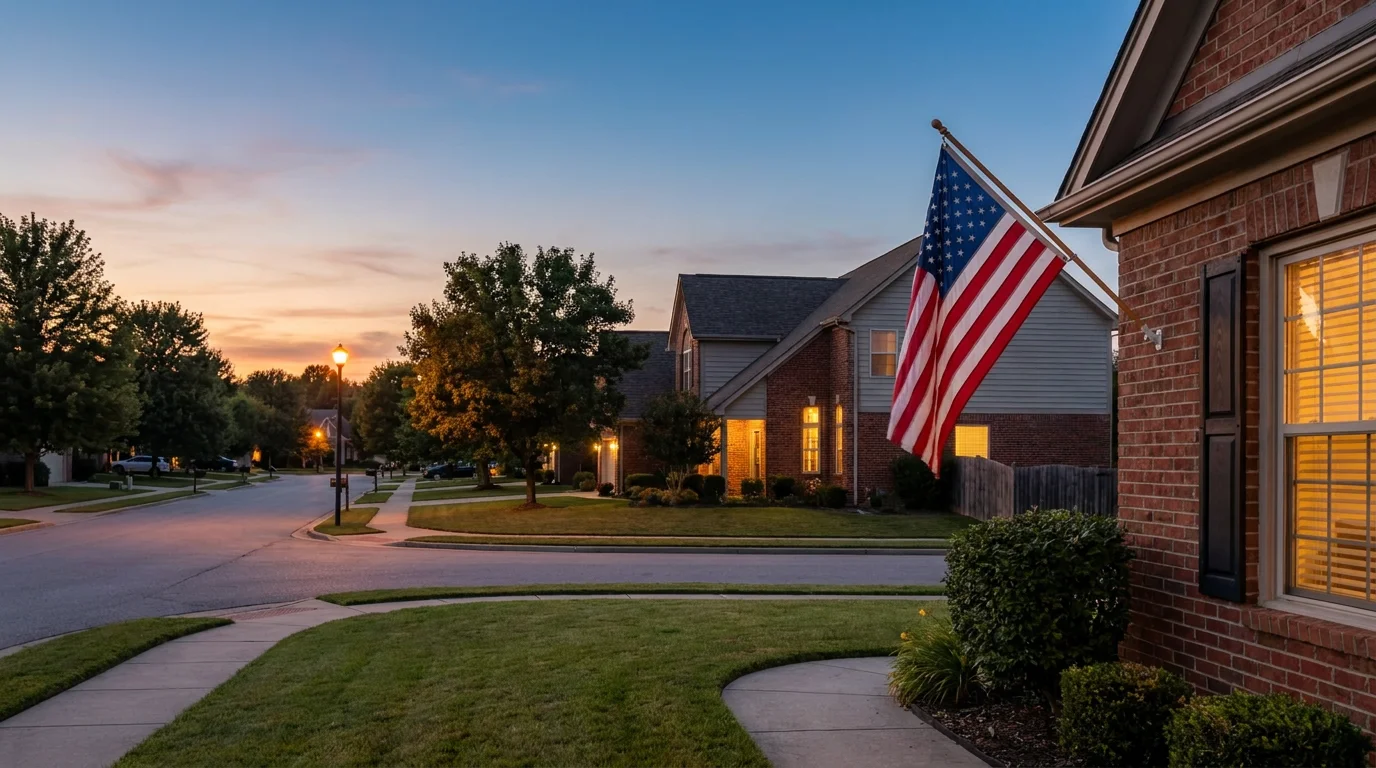
- Flags carry their own carve-out under § 55-3210: HOAs cannot ban the U.S. flag, Idaho state flag, POW/MIA flag, or official armed forces branch flags. The HOA may regulate pole materials and dimensions, along with illumination, but must allow at least one flagpole per property, either a freestanding pole up to 20 feet in the front yard or one attached to the residence. Removing a flag or fining an owner takes three days' written notice identifying the rule violated.
- Section 55-3209 protects political signs, so HOAs cannot prohibit fixed, ground-mounted signs supporting or opposing a candidate or ballot measure. They may set reasonable rules governing time and size, along with place, number, and manner. They may remove without liability only signs in common areas, signs threatening health or safety, signs violating law, or signs with sound or attachments. Anything else takes three days' written notice first.
- Since July 1, 2024, § 55-3213 bars an HOA from adding, amending, or enforcing a covenant that prohibits or effectively prohibits a family daycare home serving six or fewer children. HOAs may continue enforcing covenants adopted before July 1, 2024, and can require state licensing. They may also enforce generally applicable noise rules, plus rules on parking and landscaping.
Rental restrictions and accessory dwelling units
Section 55-3211 states that no HOA may add, amend, or enforce a covenant that "limits or prohibits the rental, for any amount of time, of any property" unless the owner of the affected property expressly agreed in writing when the association adopted the restriction. "For any amount of time" sweeps in short-term rentals, which Idaho defines elsewhere as stays of 30 days or less, and a supermajority membership vote cannot substitute for your individual consent.
The Idaho Supreme Court settled the hard question on January 6, 2026, in North Henry's Lake HOA, Inc. v. Norton: a rental restriction that an HOA adopted without the then-owner's written consent cannot bind a later purchaser, even one who bought with notice of the restriction. The court found "nothing in the plain language of the statute that creates a temporal limitation." An HOA may enforce a valid rental restriction that already applied when the current owner acquired the lot, so pull the CC&R amendment history before you buy.
In 2026, Idaho lawmakers extended the same treatment to ADUs. Section 55-3212 originally protected only internal ADUs; Senate Bill 1354, effective July 1, 2026, extends the written-consent requirement to every ADU type: internal and attached units, as well as detached units. Each ADU must include its own sanitation facilities and spaces for cooking and sleeping, and it must sit on the same lot as a single-family home. HOAs may still set reasonable rules on architectural design, size, height, setbacks, open space, parking, and bedrooms. HOAs may also enforce valid ADU covenants that applied when you acquired the property. Where no valid ADU or rental covenant applied when you acquired the lot, you can add a detached ADU and rent both units subject to local zoning and permitting and the association's design rules, and the board cannot impose a ban over your objection.
Resolving HOA disputes in Idaho
Idaho mandates no HOA mediation or arbitration; § 55-3204(2)(d) merely lets a board discuss "ongoing or potential litigation, mediation, arbitration, or administrative proceedings" in executive session. A written arbitration clause in your governing documents binds the parties because Idaho Code § 7-901 makes such clauses valid and enforceable. After you or the HOA files suit, a court can order mediation under Idaho Rule of Civil Procedure 37.1. The parties must select a mediator within 28 days of the order and hold the first session within 42 days after selection.
State resources are narrower than most homeowners expect:
- The Idaho Attorney General's Consumer Protection Division takes complaints and forwards them to the business for a voluntary response. It does not represent individual consumers or have the power to force a resolution. The Idaho Attorney General has targeted illegal HOA transfer fees, noting that management companies have no authority under Idaho law to charge them.
- The Idaho Real Estate Commission has no HOA jurisdiction. Its enforcement page states plainly: "The State of Idaho does not regulate property managers, homeowner's associations, or home inspectors."
- Idaho has no community association manager license, and lawmakers introduced no CAM licensing bill in the 2026 session, unlike the seven states (including Nevada and Florida) that require one.
Practically, your enforcement path is the § 55-3204 fee-shifting provision and the courts.
Recent Idaho HOA legislative changes
HB 703 created the current framework in 2022, passing the House 63–3 and the Senate 34–1 before Governor Brad Little signed it on March 31, 2022. In every session since, the Legislature has added owner protections without restructuring the chapter. In 2024, lawmakers enacted tighter disclosure and conflict-of-interest rules plus the family daycare protection. In 2025, HB 361 added §§ 55-3204A and 55-3204B, the declarant-control and board-composition rules for HOAs that developers form after July 1, 2025. In 2026, SB 1354 expanded ADU protection to all ADU types effective July 1, 2026.
Lawmakers also introduced a far more radical proposal in 2026, and it failed. Rep. Jeff Ehlers (R-Meridian) introduced House Bill 708, which would have put every Idaho HOA on a 10-year dissolution vote: associations 10 or more years old as of July 1, 2026 would have dissolved on July 1, 2029 unless a simple majority of eligible voters voted to keep them, with the vote recurring every decade. A dissolution plan would have controlled the disposition of common property. The plan could have transferred it to a successor entity or distributed it among the lot owners; a local government could also have received it. Community Associations Institute flagged unanswered questions about who maintains private roads and stormwater facilities afterward. The bill drew little committee discussion, missed the committee deadline, and died when the session adjourned April 2, 2026, so it has no legal effect, though the framing may return.
HOA pros and cons for Idaho buyers and investors
From 2022 through 2026, Idaho lawmakers expanded owner protections. They required individual written consent for rental and ADU restrictions and a 30-day notice with a good-faith cure window before fines. A prevailing member can also recover attorney's fees.
Idaho lawmakers have not required reserve funding or resale certificates. As a result, an underfunded association can defer maintenance until a special assessment hits. Years of deferred upkeep also visibly drag on property values at resale, often surfacing only after a buyer digs past the surface financials. Dues also affect financing calculations. FHA requires lenders to include HOA and condo fees in the total mortgage payment when calculating debt-to-income, while VA includes them in its DTI calculation against a 41% standard. Lenders may approve a smaller loan when high dues increase the buyer's debt-to-income ratio. Beginning January 4, 2027, Fannie Mae and Freddie Mac may reject a poorly funded project that does not meet their reserve requirements, putting conventional-loan eligibility at risk for condo investors.
A special assessment or a deferred-maintenance loss can land on you the same year you buy. Landlord insurance in Idaho is one cost you can price before closing with Steadily. Get a quote in minutes at quote.steadily.com, no phone call required.
FAQ
What statute governs HOAs in Idaho?
Idaho Code Title 55, Chapter 32, the Homeowner's Association Act (§§ 55-3201 through 55-3213), governs Idaho HOAs. Lawmakers enacted the act through HB 703 in 2022.
What financial documents can I demand from my Idaho HOA?
You can demand your assessment account statement within 5 business days free of charge, an updated financial disclosure within 10 business days, and the reconciled annual disclosure within 60 days of fiscal year end.
Can an Idaho HOA ban solar panels? What about flags or political signs?
No, but it may set reasonable placement and design rules, and it must give three days' written notice before pulling a flag or sign or fining you.
What must an HOA do before fining me?
The CC&Rs must authorize fines, you must get written notice at least 30 days before the board meeting where the vote happens, and a board majority must approve it.
Can an Idaho HOA foreclose on my home for unpaid dues?
A general HOA lien under § 55-3207 proceeds through court, but a condominium association may use the sale procedure authorized by § 55-1518. After a judicial sale, you have six months to redeem a tract of 20 acres or less; a nonjudicial trustee's sale carries no post-sale redemption period.
What meeting and record rules apply?
Boards must meet openly and may close a session only by majority vote for the statutory purposes. They must also convene members once each calendar year and keep minutes for ten years.
Can my HOA restrict rentals or ADUs?
An HOA may enforce a rental or ADU restriction if you consented in writing when the association adopted it, or if a valid restriction already applied when you acquired the property. Mere notice of an otherwise invalid restriction does not make it enforceable. The law covers every ADU type as of July 1, 2026, including internal and attached units as well as detached units.
Does an HOA have to be incorporated in Idaho?
No. Chapter 32 reaches unincorporated associations, whose bylaws must provide for annual meetings and preserved minutes. A majority of all members must also approve any fee increase.




.jpg)




.png)