
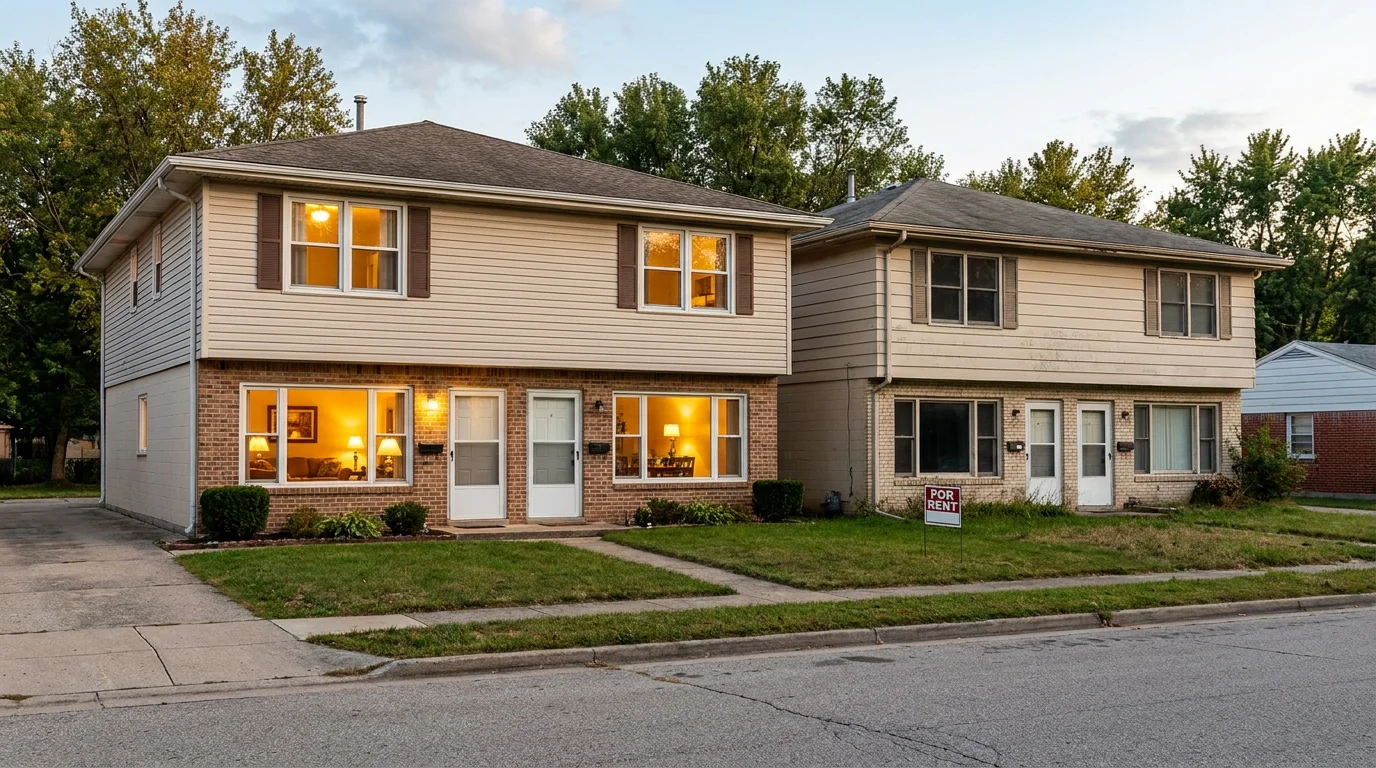
One of the biggest decisions you'll make as a landlord is whether to hire a property manager at all. It's a genuine trade-off. You can pay a manager to handle the work, but that means absorbing a stack of fees. Or you can self-manage and keep that money, but you're trading your own time and taking on real financial risk from long vacancies and costly mistakes involving repairs or tenants.
You can decide by asking one question: does the fee cost less than the value of your time and the risk you're taking on by going it alone? After comparing the costs, many landlords choose to hire help. But that only works if you understand what you're paying.
Property management pricing isn't a single number. The monthly management fee, typically 8–12% of collected rent for residential properties, is only the base layer. Leasing fees, renewal fees, setup charges, maintenance markups, and cancellation penalties can add thousands of dollars a year on top of it. This guide will help you budget the full cost and spot the red flags, then decide whether a manager earns their fee on your property.
What does a property manager do?
A property manager is a company or individual you hire to run the day-to-day operation of your rental so you don't have to. They market vacant units and screen applicants. They also sign leases and enforce their terms, then collect rent each month. Repairs don't fall on you either. Your manager coordinates maintenance and fields tenant calls. When situations escalate, the manager delivers legal notices. At the end of each period, they hand you a financial statement so you know exactly where your money went.
What are building management fees?
Building management fees are the charges a full-service property management company collects from an owner in exchange for handling every aspect of operating a rental: collecting rent, placing and screening tenants, coordinating maintenance, and handling the paperwork that comes with all of it. The term covers the whole fee stack, from the recurring monthly management fee down to one-time charges like tenant placement and account setup.
Bundled services can make two identical 10% quotes cost different amounts. Two companies can both advertise "10% of rent" while one bundles leasing and ongoing services such as renewals and inspections into that number and the other bills each separately. The National Association of Residential Property Managers (NARPM) described the standard model in an April 2026 comment letter to the FTC: "The property manager earns a management fee, typically eight to twelve percent of collected rent." Everything beyond that monthly percentage is where quotes diverge and surprises arise.
How much do property managers charge?
For residential properties, the national average management fee is 8.49% of monthly rent, based on an iPropertyManagement survey of 722 property management branches across 80 metro areas. The full market range runs from 3.75% to 14%, and 75.3% of companies price as a percentage of rent. The same researchers reported an average flat fee of $101.04 per unit per month, with a range of $49 to $250.
Rates vary by property type and market. Here are the current benchmarks:
- Property type | Typical fee | Source
- Single-family rental | 8–10% of collected rent, or $80–$300/month flat | ClearLead Digital; Home365
- Small multifamily (2–4 units) | 5–10% of monthly rental income | MRI Software
- Mid-size multifamily | 7–9% | ClearLead Digital
- Large multifamily | 4–7%, or $75–$125/unit/month flat | ClearLead Digital
- Multifamily flat-fee (general) | $50–$150/unit/month | Buildium
- Commercial property | Roughly 2–6% of collected rent per secondary sources; varies widely | PRPI; CapVeri
Small multifamily buildings (2–4 units) usually land in the 5–10% band; our guide to managing a multi-unit rental property covers the operational side of that tier.
Managers in high-rent metros across major coastal markets tend toward 6–9% because the dollar amount per unit is already high, while managers in lower-rent and rural markets charge 10–14%, as ClearLead Digital reports. Metro averages from iPropertyManagement's research include Phoenix at 8.7% and Houston at 8.3%. Miami also averages 8.7%.
Percentage-based vs. flat fee structures
Percentage-of-rent is the dominant model. NARPM's 2022 Financial Benchmark Study found 85–90% of firms use it, with 14–25% offering a flat-rate option.
Run the math on your own rent before choosing. A $2,200/month single-family rental at a 10% fee costs $220 a month, or $2,640 a year if tenants occupy it all year. The same property on the national average flat fee of about $101 a month costs roughly $1,212 a year, less than half. The gap widens as rent climbs, which is why LeaseRunner reports flat-fee models gaining popularity for high-rent properties.
The percentage model has one structural advantage: when the manager charges a percentage of collected rent, the manager earns nothing during vacancy, which puts their incentive where yours is. A manager charging a flat fee bills the same amount whether a tenant occupies the unit or it sits empty. Percentage fees also scale down automatically on lower-rent properties, where a $150 flat fee on $900 rent would work out to nearly 17%.
As a rough guide, percentage-based fees suit owners of lower- and mid-rent properties who want the manager motivated to keep units filled. Flat fees suit owners of high-rent single-family homes and portfolio investors who want predictable per-unit costs across dozens of doors.
What the base management fee includes
Confirm whether the monthly fee includes rent collection and disbursement, tenant relations, lease enforcement, maintenance coordination, routine inspections, and monthly financial reporting. Any contract that describes the scope vaguely instead of listing services is a problem; Buildium's management agreement guidance flags undefined service descriptions as a warning sign.
Tenant screening
Screening covers background checks, credit reports, income verification, and rental history. Each company decides whether to include screening in the base fee or wrap it into the tenant placement fee, so ask which bucket it lands in before signing. It's work worth paying for: in a 2023 Zillow survey of over 1,000 landlords, 71% ranked tenant screening among their top three most burdensome responsibilities.
Rent collection and disbursement
The manager collects rent and enforces the lease's late-fee policy. On a set schedule, usually monthly, the manager disburses your share after deducting their fee and any approved repair costs. Confirm the disbursement date in the contract and how the manager handles partial payments and nonpayment escalation. Because most fee structures charge on collected rent, a good agreement ties the manager's paycheck to delivering yours.
Inspections and financial reporting
Confirm whether the contract includes move-in/move-out and periodic inspections with documented condition reports. These records can support security deposit disputes and insurance claims. On the financial side, the base fee should include monthly owner statements and, come January, the records you need for tax filing. If the manager holds tenant funds, state rules typically govern trust accounting; Colorado's real estate regulator, for example, requires written consent for markups and four years of recordkeeping.
Additional fees to expect
Beyond the monthly fee, residential contracts commonly list charges such as leasing, renewal, setup, and advertising fees. Each charge can be reasonable, but it should appear in writing with a fixed number attached:
- Fee | Typical range | Notes
- Leasing / tenant placement | 50–100% of one month's rent | National average ~70.6% (about $556) when a manager bundles placement with ongoing management; ~81.8% (about $670) for placement-only service, per iPropertyManagement
- Lease renewal | $100–$500 | National average $211.92, with outliers from $32 to $1,000 (iPropertyManagement; DoorLoop)
- Setup / onboarding | $200–$500 one-time | National average $185.24; current guides from LeaseRunner and Home365 cluster at $200–$500
- Advertising | $100–$300 per vacancy when a manager bills separately | Other managers bundle advertising into the placement fee instead (Roomsys)
Setup fees are among the easiest to challenge: SparkRental pegs the typical charge around $300 and recommends negotiating it to zero. Ask whether the manager will waive it to win your account. Renewal fees deserve the same scrutiny. SparkRental's guidance is blunt: "As renewing an existing rental agreement requires virtually no work on the part of the property manager, you should negotiate to eliminate this fee."
One regulatory shift affects who pays placement costs. Landlord-tenant laws in some markets now bar landlord-hired brokers from passing leasing fees to tenants, including New York City's FARE Act (effective June 11, 2025) and a Massachusetts law (effective August 1, 2025). If you own in those markets, that cost lands on you.
Hidden and red-flag fees
Some charges reflect standard practice at a fair price; others quietly drain returns. Full written disclosure and client approval determine whether a fee meets the governing ethical standard. NARPM's Code of Ethics requires managers to disclose commissions, rebates, profits, discounts, and other benefits fully and obtain the client's approval.
Maintenance markups are the most common flashpoint. Bluefield Group identifies a 10–20% markup on vendor invoices, or a flat $20–$100 per work order, as typical. NextGen Properties draws the line clearly: disclosed markups of 10–15% on actual invoices are standard, while undisclosed markups of 30–50% are red flags. A manager who earns a percentage of repair costs profits when repairs cost more. Colorado regulators have enforced the disclosure standard: in January 2024 they secured a consent judgment requiring $1,000,000 in payment and banning undisclosed vendor invoice markups, and in January 2025 they filed a complaint against Greystar alleging it collected more than $100 million in hidden fees between 2019 and 2022.
Watch for these other patterns in the contract:
- Vacancy fees: If a manager charges the full monthly fee during a vacancy or bills on scheduled rent rather than collected rent, you pay the manager even when no tenant pays you. BiggerPockets advises negotiating so the manager feels the pain of an empty unit alongside you.
- Eviction charges: RIOO identifies a $200–$500 administrative fee for coordinating an eviction as standard, with the manager passing court and attorney costs through at actual cost. Lost rent and the legal or turnover expenses drive the total; a National Apartment Association survey puts the average all-in eviction at $6,767. Review the tenant eviction process before you need it, which helps you judge whether a manager's eviction fees and any protection-plan add-ons are worth the price.
- Early cancellation penalties: Flat cancellation fees in documented examples range from $100 to $3,000. Thirty days' notice is the standard period, which Buildium and NextGen Properties both treat as the industry norm. A 90-day notice window tied to auto-renewal is a red flag. Bear PMC explains why: "A ninety-day window means you have to predict, three months ahead, that you'll want to leave; and if you miss it, you're locked in for another full year." Termination clauses charging all remaining months of fees are worse; Georgia attorney Michael Rome calls that structure potentially illegal and says "a typical liquidated damages amount would amount to something like one or two months' worth of fees."
- Open-ended fee language: Any contract reading "fees may include but are not limited to" gives the manager room to invent charges later. NextGen Properties flags this phrasing specifically; insist on a complete written fee schedule instead.
Commercial vs. residential building management fees
Managers structure commercial building fees differently from the residential percentages above, and the widely repeated 4–8% commercial benchmark is weaker than it looks. No major industry association publishes it. BOMA declined to collect management-fee data in its 2024 benchmark report over antitrust concerns, and IREM reports fees in dollars per square foot rather than percentages: $0.68/SF/year for office and $0.36/SF/year for industrial in its 2024 national summary.
Secondary sources sketch the percentage picture by asset class. PRPI cites 4–6% of gross collected rents for retail centers and 2–4% for industrial, while CapVeri puts office at 3–5% of collected revenue. Retail adds a wrinkle: ICSC materials note that tenants with bargaining power limit combined management and administrative fees to 5–15% of common area costs, a different denominator entirely. CapVeri also reports that single-tenant triple-net leases sometimes negotiate the management fee out altogether when the tenant self-manages. If you're evaluating a commercial property, negotiate per-property against IREM's per-square-foot data rather than anchoring to a percentage rule of thumb.
Are property management fees tax-deductible?
Yes. On the 2025 Schedule E (Form 1040), the IRS labels Line 11 "Management fees." The IRS instructions state it directly: "You can deduct all ordinary and necessary expenses, such as taxes, interest, repairs, insurance, management fees, agents' commissions, and depreciation." IRS Publication 527 lists management fees among the most common deductible rental expenses.
The rest of the fee stack has homes on Schedule E too. Advertising costs go on Line 5 and leasing commissions on Line 8. Eviction attorney fees and lease drafting go under Line 10, legal and other professional fees. Because you can deduct the fee, you pay less after taxes than the sticker price suggests. This general information cannot address your specific tax situation, so confirm the details with your own advisor.
Self-management vs. hiring a property manager
Compare the fee against your time and financial risk, because self-management still carries costs. In Zillow's 2023 landlord survey, 92% ranked repairs and maintenance among their top three most demanding responsibilities, and 40% called it the single most burdensome. Landlords are closely split: a 2024 Harris Poll of over 750 residential investors found 52% currently use professional management, and the leading reasons others don't are cost (54%) and desire for control (43%).
After accounting for vacancy costs, you may reach a different conclusion. NARPM's August 2025 Residential Resource illustrates vacancy loss, the income a landlord forfeits while a unit sits empty, with a concrete example: a home listed at $1,750 per month loses about $58 per day while vacant, and 45 days of sitting costs over $2,600 in unrealized income. That single vacancy episode can exceed a full year of management fees on the same property. Property managers appear to shorten the gap; investors using a manager reported a 4-week average vacancy versus 4.6 weeks for self-managers in the 2024 trends survey. In the same Harris Poll research, nearly 75% of investors using professional management said the services justified the fees, and 71% reported increased overall profitability.
A rough break-even test: total the annual monthly and renewal fees, then add the placement fee based on your expected tenancy. Compare that sum with the value of your time. Then estimate the vacancy loss and repair overpayments a professional would likely avoid. You may choose self-management if you have one local property and flexible time. Remote owners and landlords with growing portfolios may choose a manager instead, especially when the owner's day job pays more per hour than the fee costs. For a fuller breakdown of both sides, see our guide on when to hire a property manager.
How to negotiate fees and vet a contract
Several parts of the fee stack are negotiable, even when the headline rate stays fixed. More management-company executives also plan to raise fees: Buildium reports 38% of property management companies planned to increase client-paid fees over the following two years, which makes locking terms in writing now more valuable.
Tactics that work, based on industry sources:
- Bundle your units. The Property CEO reports that a 1–2% rate discount for three or more properties is common, and SparkRental confirms clustered or multifamily owners can often negotiate down to 8% from a typical 10%.
- Simplify the stack. SparkRental recommends insisting on only two fee types, tenant placement and a percentage of collected rent, and eliminating setup and renewal charges entirely.
- Cap the markup. REI Prime recommends locking maintenance markups at 10%. It also recommends asking for a placement fee of 75% when a manager quotes a full month's rent and adding a re-leasing guarantee that waives the next placement fee if the manager's tenant leaves early.
- Add performance terms. TrueDoor cites a leasing guarantee that waives the fee if the manager does not fill a vacancy within 30 calendar days.
On the contract itself, four clauses deserve line-by-line attention. Require a 30-day no-cause termination right, which NextGen Properties lists as non-negotiable, and a maintenance approval threshold, with MRI Software suggesting pre-approval for repairs over $500. Also require a written cap on vendor pass-through markups and a complete fee schedule with no open-ended language.
A management contract does not cover property damage or liability claims, so insurance remains a separate recurring cost. You control management fees and insurance premiums directly, and both flow straight to net operating income. Landlord insurance premiums for standard rental properties typically range from $800 to $3,000 per year nationally, according to 2026 industry data, so a mispriced policy can erase what a hard-won 2% fee reduction saves. Steadily writes landlord insurance in all 50 states and prices each policy by property, with deductible options that cut premiums 12–15% when you move from $1,000 to $5,000. Get a quote in minutes at quote.steadily.com. No phone call required.
FAQ
These answers summarize the fee benchmarks and cover the contract and negotiation questions landlords ask about most.
How much does property management cost per month?
Most residential managers charge 8–12% of collected rent, with a national average of 8.49% or roughly $101 per unit per month on flat-fee plans. On a $2,000 rental, you will pay $160–$240 monthly at percentage rates before one-time charges such as placement and renewal fees.
Is a flat fee or percentage fee better?
Percentage fees tie the manager's income to yours: no rent collected, no fee. Flat fees cost less on high-rent properties and keep per-unit costs predictable across a portfolio. Roughly 85–90% of firms use the percentage model, so flat-fee options may take more shopping to find.
What services does the base management fee cover?
Typically rent collection and disbursement, lease enforcement, maintenance coordination, routine and move-in/move-out inspections, and monthly owner statements. Tenant screening may sit in the base fee or in the placement fee. Get the exact service list in writing; vague scope language is a warning sign.
What hidden fees should I watch for?
Watch for undisclosed maintenance markups above the 10–20% norm and fees that managers charge on vacant units. Reject 90-day cancellation notice windows tied to auto-renewal or termination penalties equal to all remaining contract months. Also reject any "fees may include but are not limited to" language.
Are property management fees tax-deductible?
Yes, on Line 11 of Schedule E. Related costs deduct on their own lines. Advertising goes on Line 5, and commissions go on Line 8. Legal fees go on Line 10. See IRS Publication 527 for the full list of deductible rental expenses.
Is hiring a property manager worth it over self-managing?
Your available time and distance from the property matter, and vacancy risk can change the answer. A $1,750/month rental loses about $58 a day vacant, and property managers fill vacancies roughly half a week faster on average. Nearly 75% of investors using professional management say the fees are justified, but 54% of holdouts cite cost as their reason.
Can I negotiate property management fees?
Yes. Common wins include a 1–2% rate cut for bundling three or more properties, eliminated setup and renewal fees, placement fees reduced from 100% to 75% of a month's rent, and a written 10% cap on maintenance markups.
Should I pay a management fee while my unit is vacant?
Push back on it. When managers charge fees on collected rent, the standard structure, you pay nothing during vacancy and the manager stays motivated to fill the unit. A contract billing on scheduled rent regardless of occupancy removes that incentive.



.jpg)




.png)