
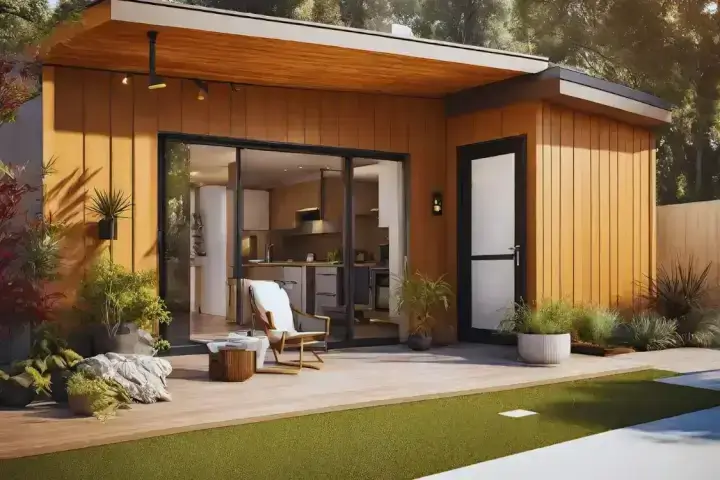
Irvine has become one of the more active ADU markets in Orange County, driven by high land values, strong rental demand, and California's state-level push to expand housing supply. An accessory dwelling unit (ADU) is a secondary housing unit built on the same lot as a primary residence. These smaller units go by many names, including granny flats, in-law suites, backyard cottages, and carriage houses. Landlords and homeowners build them to generate rental income, house family members, or simply add long-term value to a property.
What it actually costs to build an ADU in Irvine
Building an ADU in Irvine isn't cheap, but the numbers are predictable enough to plan around. Design and architectural fees typically run $5,000 to $15,000 depending on complexity. Permit fees vary by project scope, but budget $3,000 to $8,000 for city processing and associated impact fees. Construction is the big line item: expect $150,000 to $300,000 for a detached unit, with attached conversions and garage conversions coming in lower. That puts a finished detached ADU somewhere between $175,000 and $350,000 all-in for most Irvine properties.
Several factors push costs up or down. A sloped lot, poor soil conditions, or a location far from existing utility hookups will add to the budget. Choosing a simple rectangular footprint, matching materials already on the primary home, and working with a designer experienced in Irvine's review process will keep costs closer to the lower end. Pre-approved plan sets can also reduce design fees and shorten permit timelines.
One offset worth knowing: California waives certain impact fees for ADUs under 750 square feet, which can shave thousands off your permit costs. The CalHFA ADU Grant Program has offered up to $40,000 to reimburse predevelopment costs for eligible homeowners, covering architectural fees, soil reports, and permit costs before construction begins. Check current program availability since funding cycles open and close.
ADU types Irvine allows
Irvine recognizes three categories. A detached ADU is a freestanding structure separate from the main home. An attached ADU shares a wall or roofline with the primary residence. A Junior ADU (JADU) is a converted space within the existing home's footprint, capped at 500 square feet. Each type has different size limits, setback rules, and utility requirements, so the right choice depends on your lot, your budget, and what you're trying to accomplish. Garage conversions are among the most cost-effective options because the shell already exists, which reduces framing and roofing costs significantly.
Zoning, setbacks, and size limits
Not every Irvine residential zone permits ADUs, so your first stop should be the City of Irvine zoning map to confirm your parcel qualifies. Once you've cleared that hurdle, the key dimensional rules are:
- Detached ADUs: 1,200 square feet maximum
- JADUs: 500 square feet maximum
- Attached ADUs: must remain proportionate to the primary dwelling
- Setbacks: generally 4 feet from side and rear property lines for detached ADUs
Setback and lot placement rules also interact with utility easements and fire access corridors. Confirm exact requirements for your parcel through the City of Irvine's ADU guidelines before finalizing a design. Front setbacks follow the primary dwelling's zoning rules, and lot shape can affect what's actually buildable.
Design standards
Irvine requires ADUs to match the primary residence in architectural character. Roofing materials, siding, window style, and exterior colors should be compatible with the main home. This isn't purely aesthetic: non-conforming designs get flagged during permit review, adding delays and revision costs. Keeping material and finish selections close to the primary structure is one of the easiest ways to move through review faster and avoid back-and-forth with the city.
Parking requirements
Most ADUs require one off-street parking space. Exceptions apply when the unit is within a half-mile of public transit, sits within a historically or architecturally significant district, or is created through conversion of an existing structure. If your project qualifies for an exemption, document it early. The permit review will flag parking as a checklist item, and having the supporting documentation ready prevents unnecessary delays.
The permitting process
Irvine processes ADU applications ministerially, meaning there's no discretionary public hearing or design board approval. You submit plans, pay fees, and the city reviews for code compliance. The Development Assistance Center handles questions about timelines, required documents, and inspection scheduling. State law requires local agencies to act on ADU applications within 60 days of a complete submission, and Irvine generally meets that timeline. Incomplete applications or missing drawings reset the clock, so submitting a full package the first time matters.
Plan review covers the California Building Code, fire and life safety requirements, and local zoning standards. ADUs must have independent utility infrastructure, including separate shut-off valves for water and gas, plus smoke and carbon monoxide detectors in each room. Emergency access pathways of at least 3 feet must remain clear to all entrances and exits.
Rental rules and owner-occupancy
ADUs in Irvine cannot be rented for periods shorter than 30 days. The city prohibits their use as short-term vacation rentals, keeping them oriented toward long-term housing rather than the short-term rental market.
California's state law temporarily eased owner-occupancy requirements, with that provision expiring January 1, 2025. After that date, Irvine may require the property owner to occupy either the primary dwelling or the ADU. Confirm the current status with the city before purchasing a property specifically to rent both units without residing on-site, since the answer could affect your investment strategy.
State law and local compliance
Irvine's ADU ordinance operates within California's statewide framework, which sets minimum standards that all local governments must meet. State law requires ministerial approval, prohibits excessive fees, and mandates that cities update non-compliant ordinances. Where Irvine's local rules are stricter than state minimums, the local rules apply. Where local rules fall short of state requirements, state law controls. If the city cites a restriction that seems inconsistent with what you've read in state guidance, ask them to point to the specific ordinance section. It's a reasonable question and often clarifies things quickly.
Financing and insurance
Common financing routes include home equity loans, home equity lines of credit (HELOCs), cash-out refinances, and construction loans. Each carries different rate structures and qualification requirements. The CalHFA grant is worth pursuing first since it's a reimbursement program, not a loan, and it stacks on top of other financing. Talk to a lender familiar with California ADU projects before committing to a draw schedule, since construction loans have specific disbursement triggers tied to inspection milestones.
Once the ADU is generating rental income, your property coverage should reflect the added liability and dwelling value. California landlord insurance through Steadily can be structured to cover both the primary residence and the ADU, so you're not left with a gap if something goes wrong with either unit.
Frequently asked questions
What's the setback requirement for a detached ADU in Irvine?
Generally 4 feet from the side and rear property lines. Front setbacks follow the primary dwelling's zoning rules. Confirm your specific parcel's requirements with the Development Assistance Center, since easements and lot shape can affect the calculation.
Can I use a pre-approved ADU plan in Irvine?
Yes. Pre-approved plans can speed up review since standard code questions are already resolved. The plans still need to be confirmed compliant with your specific lot's zoning, setbacks, and utility connections before the city will issue a permit.
Are impact fees waived for smaller ADUs in Irvine?
California law prohibits impact fees on ADUs under 750 square feet. For larger units, fees are charged proportionally based on the ADU's size relative to the primary dwelling. This makes smaller detached ADUs and most JADUs significantly cheaper from a fee standpoint, and it's one reason many Irvine owners size their projects to stay under that threshold.
How does Irvine's ADU regulation differ from the rest of Orange County?
Each city in Orange County sets its own local ordinances within California's state framework. Irvine's design standards and zoning overlay requirements are specific to Irvine. Neighboring cities like Anaheim or Santa Ana have their own rules, so don't assume what applied to a project elsewhere will apply here.
What drives ADU construction costs higher in Irvine specifically?
Irvine's design compatibility requirements mean you often can't use the cheapest available materials if they don't match the primary home's finish level. HOA restrictions in many Irvine neighborhoods add another layer of review. And the high cost of local labor and subcontractors pushes base construction costs above state averages, particularly for finish work in detached units.


.jpg)




.png)