
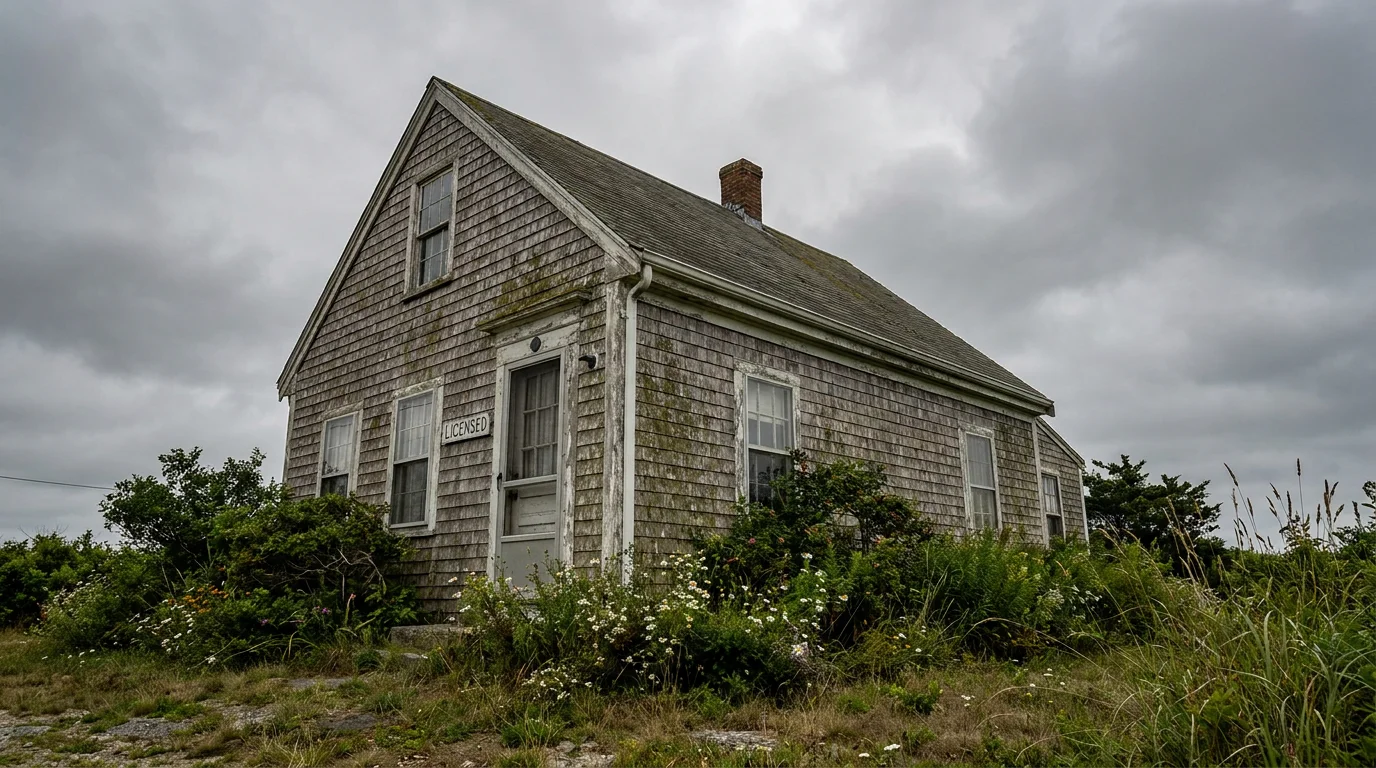

Start hosting your property on Airbnb
Receive a $115 bonus if you list your property within 180 days!
New Hampshire has no statewide short-term rental permit. The state's only universal requirement is a Meals and Rooms tax license. Municipalities decide everything else, including zoning, permits, inspections, and occupancy caps, town by town under RSA 674. That split makes New Hampshire short-term-rental regulations a patchwork: an operation that runs legally in Conway can be a zoning violation in Portsmouth, and hosts who assume one town's rules travel with them get caught.
The upside is that STRs remain available in many municipalities, providing homeowners an avenue for supplemental income if they clear the right local hurdles first.
What counts as a short-term rental in New Hampshire?
Under RSA 78-A:3, XXIII, a short-term rental is "the rental of one or more rooms in a residential unit for occupancy for tourist or transient use for less than 185 consecutive days." The 185-day line comes from the companion definition of "permanent resident": a guest who has occupied a room for at least 185 consecutive days. Anyone below that threshold is a taxable transient, even on a one-night stay.
Two other definitions in the same statute matter for hosts. "Operator" expressly includes rental facilitators and room facilitators, which is how Airbnb ends up with collection duties. "Rent" means the full retail price charged. That includes cleaning and service fees. It also includes any charges a room facilitator requires, so tax applies to the whole booking, not just the nightly rate.
The 185-day definition governs taxes only. RSA 78-A:4-a states that nothing in the tax statute changes the nature of a property's use "for the purpose of determining compliance with a local zoning ordinance." Zoning authority sits with municipalities under RSA 674:16, and towns set their own, usually much shorter, definitions: Laconia draws the line at fewer than 28 consecutive days, and Meredith caps individual rentals at fewer than 30. RSA 48-A, the state's minimum-housing-standards statute, cannot itself be used to regulate vacation rentals, leaving RSA 674 as the operative authority towns rely on. Holding a state tax license proves nothing about your zoning status.
How New Hampshire regulates short-term rentals
The state handles taxation; your town handles everything else. The NH Vacation Rental Trade Association puts it plainly: "Short-term rental regulations are primarily handled at the local level, with no statewide permitting or licensing requirements at this time." Compliance therefore has two layers, and you need both.
State Meals and Rooms (Rentals) Tax license
Every STR operator must register with the NH Department of Revenue Administration before offering accommodations. The Meals and Rooms (Rentals) Tax rate is 8.5%, effective for taxable periods beginning October 1, 2021, and it applies to every rental under 185 consecutive days.
Registration works two ways. The DRA prefers applications through Granite Tax Connect; the paper alternative is Form CD-3, mailed to the DRA Collections Division in Concord, with a separate CD-3 required for each property location. Once the DRA issues the license, ongoing obligations stack up:
- Post the license conspicuously on the premises and include the license number in every advertisement, including your Airbnb or VRBO listing.
- File monthly returns (Form DP-14) by the 15th of the following month, even zero-dollar returns for months with no bookings.
- File electronically if your taxable revenue was $25,000 or more in the prior calendar year; paper filers who should have filed electronically forfeit the 3% timely-filing commission.
- Keep records for 3 years from the tax due date or filing date, whichever is later.
- Renew on the state cycle: all licenses expire June 30 of every odd-numbered year and renew automatically unless ownership changed, the business ceased, the DRA revoked the license, or returns or taxes are outstanding.
Airbnb has collected and remitted this tax on hosts' behalf since November 1, 2017, on reservations of 184 nights or shorter. Airbnb calculates the tax on the listing price, including cleaning and guest fees (Airbnb Help Article 2316).
Note that the 8.5% Meals and Rooms Tax is entirely separate from New Hampshire's Business Profits Tax (BPT). Hosts operating short-term rentals at a sufficient scale may find that their STR income triggers BPT obligations on top of the rooms tax, creating a distinct filing and payment requirement. If your rental activity resembles a business rather than occasional hosting, it's worth consulting a tax professional to determine whether BPT applies to your situation. That does not shrink your license and posting duties or your monthly filing obligation, and it covers only Airbnb bookings. Direct bookings and VRBO reservations put the 8.5% collection burden back on you. The same applies to any other channel where no facilitator collects.
Local permits, special exceptions, and zoning approvals
Towns regulate STRs through whatever land-use tools their ordinances provide, and the tool varies.
- Town | Local process
- Meredith | Requires this approval sequence: (1) a ZBA special exception, (2) an annual town license, and (3) a fire department inspection
- Gilford | Routes hosts through a conditional use permit (a form of site plan review) from the Planning Board, with a $200 non-refundable application fee, $8 per abutter for notification, and 13 plan sets
- Lincoln | Runs a registration program: $100 per tax parcel, payable by mail or in person only
- Sunapee | Adopted zoning section 4.95 in March 2023; an NH Business Review report says the town charges a $350 permit fee per rental property through its special-exception registration process
The count of regulating towns keeps growing. As of 2024, 64 NH communities regulated STRs, with 15 adding definitions or rules that year alone. Before you list, get the current zoning ordinance text from your town and check whether "dwelling unit" or "residential use" addresses transient occupancy, because municipal officials and courts use that wording to determine whether you can operate at all.
Safety and property compliance
New Hampshire adopted the 2024 editions of NFPA 1 and NFPA 101 as its state fire code effective August 13, 2024, and RSA 153:10-a requires automatic fire warning devices in all rental units, plus CO detectors unless the unit has no attached garage and no combustion appliance. State law bars the state fire code from requiring sprinklers in qualifying detached one- or two-family dwelling units whose owners use them only for residential purposes, and state fire inspectors have no authority over single-family and two-unit homes under RSA 153:14. Towns fill that gap: Meredith's fire inspection checklist requires hard-wired interconnected smoke and CO detectors, a 3A 40B:C extinguisher, posted floor and escape plans, 4-inch address numbers, and a 12-foot width for driveways over 150 feet.
Septic capacity is an easy compliance item to overlook. RSA 485-A:38 requires NHDES approval before any change of use that increases the load on a sewage disposal system, and NHDES design flow runs 75 gallons per day per person. Converting a seasonal camp to a year-round STR, or sleeping more guests than the approved bedroom count supports, can trigger a new approval. Towns layer their own rules on top: Conway requires an inspection within the preceding 5 years for septic systems more than 10 years old, and Meredith requires NHDES operational approval or an evaluation by a licensed evaluator.
Two more property items show up in local applications. Meredith requires a Lead Safe Certificate under RSA 130-A:5-d for properties built before January 1, 1978. And while no state law mandates water testing for private wells, towns can require it; Springfield's 2026 permit packet demands lab analysis for E. coli, arsenic, lead, copper, and total coliform. Property managers must account for these local safety layers when following broader New Hampshire rental property requirements.
Occupancy, contact, and operational rules
Most NH towns tie guest caps to bedroom count, which in turn ties back to the septic approval. Meredith allows 2 persons per permitted bedroom plus 2 overnight, with daytime occupancy at 150% of the overnight figure. Sunapee allows 2 per approved bedroom plus 1, with an absolute ceiling of 16 persons. Historical Laconia application materials set an occupancy limit of 4 persons for the first 400 square feet plus 1 per additional 200; hosts should verify whether this occupancy limit remains current with the city. Freedom and Jackson both use the 2-per-septic-bedroom-plus-2 formula.
Responsiveness rules are just as concrete. Lincoln requires a local contact person who can respond within 45 minutes; Meredith requires an owner or agent serving as the local contact to remain reachable 24 hours a day and arrive on-site within 2 hours on any rental day. Parking typically runs 1 space per bedroom (Meredith and Sunapee both require off-street overnight parking on that basis), and Gilford caps the number of people on the property between midnight and 8 a.m. at sleeping capacity.
Short-term rental rules by New Hampshire town
The same property faces different legal footing depending on which town line it sits behind. Here is how six frequently searched municipalities compare:
- Town | Permit type | Owner-occupancy | Key restrictions
- Portsmouth | Prohibits STRs in residential zones following Working Stiff Partners (2019); the city offers no permit there | N/A | The city allows hotel use only in MRB/CD5 by right and CD4, GB, G1, G2 by special exception; each continuing day of violation is a separate offense
- Conway | Rental permit per property under Chapter 72; Conway opened registration September 2, 2025 | Not required | 1–2 family: self-affidavit (1 yr) or town inspection (3 yrs); 3+ units: mandatory inspection; septic systems over 10 years old need inspection within prior 5 years; new certificate of occupancy if advertising above approved occupancy
- Laconia | Prohibits STRs in residential districts (Ordinance 2026-235-41, 70, March 9, 2026); allows them by right in UC and C and by special exception elsewhere | Requires the unit to be the owner's primary residence for a special exception | 120 days/year max under special exception; annual report to Planning Department; M&R license displayed; Laconia's ordinance grandfathers existing legal operators
- Gilford | Conditional use permit from Planning Board; $200 fee plus $8 per abutter | The retrieved proposal and application materials do not specify an owner-occupancy rule; the retrieved records do not confirm full enactment of Article 22 | Midnight–8 a.m. headcount capped at sleeping capacity; 1 parking space per sleeping area; proof of septic capability
- Lincoln | Registration, $100 per tax parcel, effective November 18, 2022 | Not required; three STR types cover owner-occupied, non-owner-occupied, and part-time | Applicants must hold a valid M&R license, confirm working smoke/CO detectors, and name an emergency contact who can respond within 45 minutes; the town offers a free life-safety inspection
- Meredith | ZBA special exception + annual $400 town license + $50 fire inspection (program began September 1, 2025) | Not required, but day caps differ: 120 days/year owner-in-residence, 90 days/year owner-not-in-residence | 2 per bedroom + 2 overnight; 1 vehicle per bedroom off-street; the town bars ADUs from STR use and requires a lead-safe certificate for pre-1978 homes
How NH short-term rental rules fit the wider picture
Owner-occupancy is the axis most towns regulate around. Sunapee allows owner-in-residence STRs in every zoning district but restricts owner-not-in-residence rentals: the town permits them in mixed-use and village districts, as well as residential districts; requires a special exception in Rural-Residential; prohibits them in Rural Lands; and caps them at 120 rental days per year in residential districts. Laconia goes further and makes primary residence a condition of its special exception, also requiring an annual report to the Planning Department and, under RSA 540:1-b, the designation of a local contact person whose information the owner must provide to the town. For a portfolio investor holding non-owner-occupied properties, the practical map of viable NH towns is much smaller than the map of towns that "allow" STRs.
ADUs sit in an unresolved conflict. HB 577, effective July 1, 2025, requires municipalities to allow one accessory dwelling unit by right in every district that permits single-family homes. Meredith's March 2025 amendment prohibits ADUs from being used as STRs anyway, and Jackson voted for a similar limit. State law guarantees the right to build the unit, while local ordinances may prohibit nightly rentals.
Private restrictions add a third layer that town approval cannot cure. Gilford's 2026 town meeting ballot included proposed amendments addressing HOA-required conditional use permits, though the retrieved records do not confirm whether voters approved them. A recorded covenant or association rule barring transient rentals binds you regardless of zoning, so check the deed and HOA documents before checking the ordinance. The same diligence applies to the state's baseline landlord-tenant framework, which sets expectations for property owners and potential renters alike.
Municipal officials and voters have adopted many local rules in response to housing-affordability concerns, though the NH Housing Finance Authority's analysis undercuts the broadest claims about statewide rent effects. The NH Housing Finance Authority's October 2023 study found no statistically significant effect on statewide median rent levels from the increase in STRs, while attributing roughly 14% to 23% of the 2014–2021 decline in rental vacancy rates to STR growth. The authority found that most listed properties already served as short-term or seasonal units, though a small number came from long-term stock and some communities felt more of the effects.
What's next for New Hampshire short-term rental law
Recent attempts to enact statewide STR rules, from registration limits to an STR property-tax surcharge, have all failed.
- Bill | Proposal | Status
- SB 249 (2022) | Bar towns from prohibiting STRs while preserving local authority over parking, noise, safety, and registration | Passed the Senate in February 2022; died when the House Municipal and County Government Committee voted 17–2 for interim study that April
- HB 410 (2025) | Limit local authority over residential property restrictions | Went to Senate interim study 6-0 in January 2026
- HB 1068 (2026) | Redefine STRs for Meals and Rooms tax purposes | Sits in Senate interim study as of August 2026
- HB 1707 (2026) | Impose an STR property-tax surcharge | The House killed it in February 2026
Governor Sununu opposed SB 249 as a threat to local control.
With the legislature deadlocked, the NH Supreme Court has set the operating rules, and every decision turns on ordinance wording:
- In Working Stiff Partners, LLC v. City of Portsmouth, 172 N.H. 611 (September 27, 2019), the court upheld Portsmouth's prohibition because the city's ordinance defined "dwelling unit" to expressly exclude "such transient occupancies as hotels, motels, rooming or boarding houses."
- Town of Conway v. Kudrick (May 2, 2023) went the other way: Conway's ordinance contained no transient-occupancy exclusion and no durational requirement, so the ordinance included STRs within the residential definition and permitted them. The Court wrote that "the duration for which a property is used does not impact whether the property is used for residential purposes."
- Appeal of Hoekstra (May 14, 2024) held that Sunapee's own ordinance language independently permitted a travel trailer as temporary sleeping quarters, including compensated rentals, for up to 90 days per 12-month period. The NH Municipal Association warned afterward that "any amendment to a zoning ordinance must be clear and unambiguous."
Courts construe ambiguity in the property owner's favor, which is why towns keep tightening definitions. The next test is Andrews v. Kearsarge Lighting Precinct. The NH Supreme Court heard arguments on May 19, 2026, over a KLP ordinance requiring the owner to stay overnight for every night a transient guest stays; plaintiffs filed a federal suit in August 2025 challenging the same ordinance on Commerce Clause grounds. A separate 2024 suit by the Mt. Washington Valley Association for Responsible Vacation Rentals challenges Conway's inspection program. Hosts in affected towns should track these dockets before making acquisition decisions.
Fines, penalties, and enforcement
Non-compliance carries costs at both layers. On the state side, the DRA's 2025 penalty schedule for the Meals and Rooms Tax runs:
- Violation | Penalty
- Failure to pay | 10% of the underpayment; 50% if due to fraud
- Failure to file | 5% of tax due or $10 (whichever is greater) per month, capped at 25% of the balance or $50
- Late returns | Interest at 10% per annum
Local penalties bite harder because they can end the operation. Meredith fines unlicensed operators up to $500 per day after two written warnings, and a licensed property with three prior offenses faces a $750 fine plus license revocation. Lincoln's 2020 ordinance runs a graduated scale: written warning, then $100, then $500, then $1,000 per subsequent offense, and $1,000 per 10-day period for operating after revocation. Lincoln's revocation process requires police validation of at least 3 incidents within one year, with appeal to the Board of Selectmen within 30 days and a hearing within 45. In Portsmouth, where the city prohibits residential STRs outright, each continuing day of violation counts as a separate offense.
Sunapee shows how enforcement can be tighter than the published text suggests. Its adopted section 4.95 sets occupancy at 2 per approved bedroom plus 1 with a 16-person maximum, bans travel trailers and RVs from STR use, and requires compliance "with any registration process set forth by the Board of Selectmen," but no per-day fine amount appears in the town's retrieved official documents. The Selectmen grandfathered STRs that existed before December 1, 2022, by a vote on April 17, 2023, a reminder that timing your entry into a town can determine whether the rules apply to you at all.
Insuring your New Hampshire short-term rental
Securing every permit does nothing for you at claim time if your policy excludes transient guests. The Insurance Information Institute states that regular homeowners insurance "typically does not cover losses from commercial activities," including short-term rentals, and the 2022 ISO homeowners form added home-sharing host activities to the business-pursuits exclusion by name. Insurers typically design landlord DP3 policies for long-term leases. Their treatment of frequent short-term guests and guest-caused damage varies by policy, as does their treatment of liability and extended unoccupied periods.
A landlord policy covers the structure and its dwelling components, but not the income side of the operation. Hosts track depreciation on the building and its furnishings separately on their tax returns, entirely outside what any insurance claim addresses. An insurer's claim payment and a host's accounting for depreciation are distinct concerns, and hosts should not assume that resolving one has any bearing on the other. Non-disclosure makes it worse; insurers who discover undisclosed STR activity can deny claims or cancel the policy.
Airbnb's AirCover does not fill the hole. Its $3M Host Damage Protection states in its own terms, "This is not an insurance contract," and it "does not take the place of insurance obtained or obtainable by you."
- It excludes normal wear and tear plus mold and mildew. HDP also excludes acts of nature and guest injuries.
- You must pursue the guest within 14 days of checkout and file a formal request within 30 days.
- Both HDP and the $1M Host Liability Insurance cover only bookings guests make through Airbnb.
Every direct booking and VRBO stay falls outside it. Vacant nights between guests also fall outside it. Hosts with 6 or more active listings face a further limit: since March 1, 2025, HLI may apply only as excess coverage over other insurance.
A policy that an insurer writes for STR occupancy closes these gaps. Steadily writes short-term rental insurance in New Hampshire for short-term-rental occupancy that names Airbnb and VRBO use as covered occupancy, with liability options from $100K to $1M+ for guest injuries, coverage for furnished contents rather than the bare structure, loss of rental income up to 12 months of fair rental value, and no vacancy trap during booking gaps because Steadily designed the policy around guest turnover. Steadily's national average runs about $1,478 per year. Available forms include DP1 and DP2. DP3 provides broader peril coverage when the property warrants it. Get a quote in minutes at quote.steadily.com. No phone call required.
FAQ
These answers cover state taxes and municipal compliance, including permits and enforcement.
What law defines a short-term rental in New Hampshire?
RSA 78-A:3, XXIII defines an STR as the rental of one or more rooms in a residential unit for tourist or transient use for fewer than 185 consecutive days. That definition controls taxation only; RSA 674 gives municipalities authority over zoning, and towns use shorter thresholds (28 days in Laconia, 30 in Meredith).
Do I need a state license to run an Airbnb in New Hampshire?
Yes. Every operator must obtain a Meals and Rentals Tax Operator's License from the NH DRA before renting, even when Airbnb collects the tax. Apply online through Granite Tax Connect or by paper Form CD-3, one application per property, then post the license on the premises and put the number in every listing.
Who pays the Meals and Rooms Tax, me or Airbnb?
Airbnb collects and remits the 8.5% tax on reservations guests book through its platform. You remain responsible for filing monthly DP-14 returns (including zero-dollar months). You must also collect and remit the tax yourself on direct bookings and VRBO stays, as well as any other off-platform channel when VRBO or another facilitator does not collect and remit it.
Can my town ban short-term rentals?
Yes, if the town writes its ordinance clearly enough. The NH Supreme Court upheld Portsmouth's prohibition in Working Stiff Partners (2019) because the ordinance expressly excluded transient occupancies, and permitted STRs in Conway in Kudrick (2023) because that ordinance contained no such exclusion. Courts read ambiguous ordinance language in the property owner's favor.
What permits do I need at the town level?
It depends entirely on the municipality. Meredith requires a ZBA special exception, an annual $400 license, and a fire inspection; Gilford requires a $200 conditional use permit; Lincoln requires a $100 registration per parcel; Conway requires a rental permit with inspection or affidavit; Laconia bars new STRs in residential districts. Read your town's current zoning ordinance before listing.
What safety requirements apply to NH short-term rentals?
State law requires smoke alarms per NFPA standards and CO detectors in most rentals under RSA 153:10-a, but no statewide STR inspection exists. Towns add the teeth: fire department inspections in Meredith, septic documentation in Conway and Meredith, water quality testing in Springfield, and lead-safe certificates for pre-1978 properties in Meredith.
What happens if I operate without a permit?
Local fines escalate fast: up to $500 per day in Meredith after two warnings, a graduated $100/$500/$1,000 schedule in Lincoln, and per-day separate offenses in Portsmouth. Towns can also revoke permits, with Lincoln requiring police validation of three incidents in a year before revocation and offering a 30-day appeal window. State tax violations carry their own penalties, up to 50% of unpaid tax for fraud.
Why do the rules differ so much between towns?
New Hampshire has never enacted statewide STR permitting, and bills to limit local control (SB 249 in 2022, HB 410, HB 1068, HB 1707) all failed. RSA 674 leaves zoning to each municipality, so 64 communities had adopted their own STR rules as of 2024, each with its own definitions and caps, along with its own fees.



.jpg)




.png)