Embedded insurance estimates for property marketplaces
Steadily powers marketplaces with an API that returns instant insurance estimates by property address. Real estate marketplaces use the integration to surface coverage costs alongside listing data, helping users understand their total cost of ownership and make informed insurance decisions. Users that start a quote route back through the co-branded flows, all within your user experience.

.png)

.png)
.png)
.png)
.png)


How Steadily handles insurance estimates for property marketplaces
Show insurance estimates on every listing
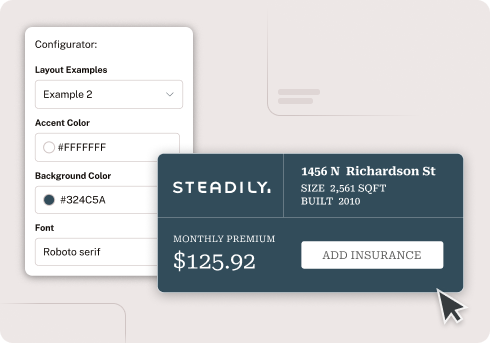
Steadily's API returns an instant landlord insurance estimate from a property address, so marketplaces can display monthly or annual coverage cost inline with taxes, HOA fees, and other carrying costs. The estimate updates in real time based on property details that already live in the listing (square footage, year built, property type), giving marketplace users a complete monthly cost view without extra clicks or third-party redirects.
Hand off to a co-branded quote flow
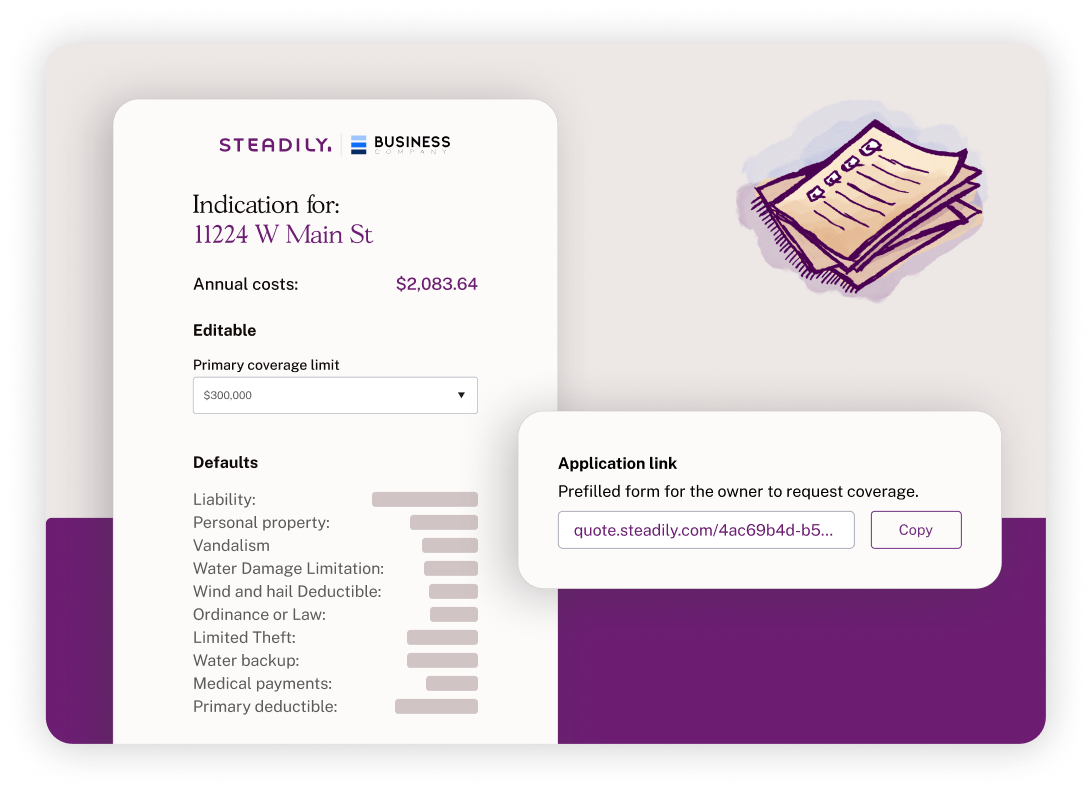
When a marketplace user clicks the estimate or chooses to act on it, they land on a co-branded Steadily quote flow that picks up where the marketplace left off. Property details and contact information pre-fill from the listing context, so the user can review coverage, ask a licensed agent questions, and bind a policy without re-entering data. Branding stays consistent through the funnel, so the experience feels like a native marketplace feature.
Earn on every referred property
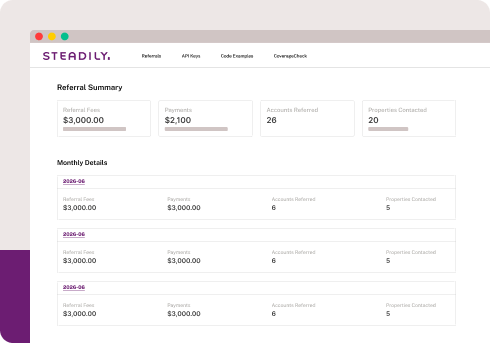
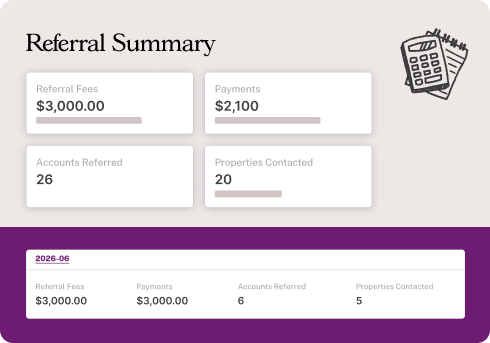
Every property referred through your marketplace generates a referral fee. Payment terms are spelled out in the partner agreement, with real time reporting available in your portal.
The revenue scales with marketplace traffic and the prominence of the insurance estimate inside the listing experience, so marketplaces with deeper integrations consistently see higher attribution.
Start with a referral link
For marketplaces that want to launch without a build cycle, Steadily provides a co-branded referral link that earns the same compensation on referred properties. Share it through marketplace emails, place it inside listing detail pages, or hand it to your customer success team for one-off outreach.
The deeper API integration is optional and can be added later, depending on how your engineering and product teams prefer to roll it out.


.webp)

Why marketplaces use Steadily

Show the full cost of a property, insurance included
Users already see taxes and HOA fees on your listings, so insurance shouldn't be the one number they leave to go find. Steadily returns a live landlord insurance estimate from the property address and the details already in the listing, so the monthly cost shows up inline without an extra click.
A quote flow that feels native, not bolted on
When a user acts on an estimate, they land in a co-branded flow with their property and contact details already filled in. There's no jarring handoff to a third-party site and nothing to re-enter, so it reads as part of your product instead of someone else's.
Earn on every referred property, not just each individual property owner
Every property referred through your marketplace pays referral compensation, and it doesn't stop at the first sale. Renewals and premium-raising endorsements keep accruing, and the more visible the estimate sits in your listings, the more it earns.
How Landlord Studio increased conversions by 3% thanks to Steadily
Frequently Asked Questions
In which states does Steadily provide landlord insurance estimates?
All 50 states plus DC. The API returns estimates anywhere a marketplace user is looking at a property, with the same response time across states.
Are these estimates for landlord insurance only, or also primary-residence insurance?
Landlord insurance only. Steadily writes coverage for non-owner-occupied properties, which means estimates returned by the API are priced for rental use. Marketplaces that list properties intended for both owner-occupants and investors should only surface the estimate on listings where the buyer is likely to rent out the unit.
What data does the API need to return an instant estimate?
The minimum is a property address. The estimate gets more accurate as your marketplace passes additional context: property type, year built, square footage, and intended use are the four fields that most affect the rate. If your listing data already includes those, send them in the API call and the estimate tightens significantly.
What property types does the insurance API support?
Single-family rentals, multifamily up to four units, condos, ADUs, and short-term rentals all return estimates. Vacant restoration and fix-and-flip properties are supported through a separate product. Commercial multifamily over four units sits outside the embedded estimate path and would require a manual quote flow.
How accurate are the embedded insurance estimates?
The estimate the API returns comes from the same underwriting engine that prices a real policy, so the number is close to what the user would actually pay if they bound. Edge cases where the final bound rate differs are usually about property details that weren't passed to the estimate, like a wood-shake roof, a pre-1950 build, or a non-standard occupancy, that the customer fills in later in the quote flow. For most listings, the estimate and the bound rate land within a few percent of each other.
Ready to become a
Steadily partner?
.png)