

Start hosting your property on Airbnb
Receive a $115 bonus if you list your property within 180 days!
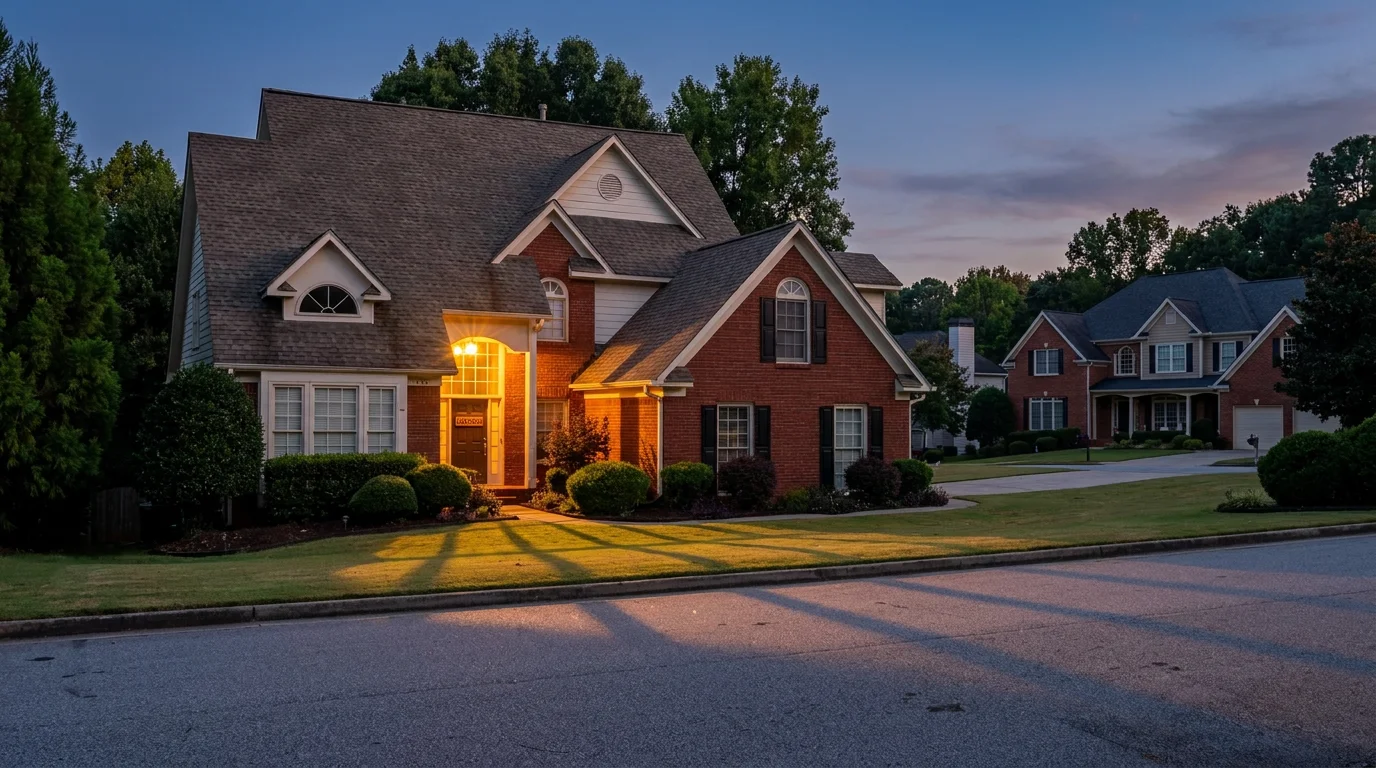
Your Atlanta guest throws a party. Once the municipal court fully adjudicates the resulting noise citation, the city records the first violation against your short-term rental. A single adjudicated code violation costs $500, each day it continues counts again, and three violations at the same property inside 12 months cost you the license there for a year. Atlanta ties each $150 annual STR license in 2026 to the applicant's primary residence. The regulations cap occupancy at two adults per bedroom. A pending bill would also cap unhosted stays at 90 nights per calendar year.
What is the Atlanta short-term rental ordinance?
Ordinance 20-O-1656 is the current law governing short-term rental properties in Atlanta. The City Council adopted it on March 15, 2021, by a 13-1 vote, and after a December 2021 amendment delayed the start date, it took effect March 1, 2022. Full enforcement, with penalties, began March 5, 2023. Atlanta codifies the ordinance at Part 20, Section 20-1001 of the Atlanta Code of Ordinances.
The Department of City Planning administers the STR license program. Every STR in the city needs a license before it operates, and the license number must appear on every online listing. The city's hotel-motel excise tax defines the covered use as "a residential dwelling unit provided for lodging for a period not to exceed 30 consecutive days."
Who qualifies: primary residence and ADU rules
Atlanta ties STR licensing to where you live. The city's STR page says an owner may license their primary residence plus one additional dwelling unit "without any additional requirements, fees, permits, licenses, zoning, or related restrictions." The ordinance does not enumerate what that second unit has to be. Long-term tenants can also apply with the owner's notarized consent.
For a portfolio investor, this structure is the binding constraint. There is no license path for a stack of non-owner-occupied Atlanta properties under the current ordinance. Atlanta councilmembers and neighborhood groups have focused their proposed restrictions on unhosted, investor-owned STRs.
South Fulton incorporated in 2017 and annexed the Fulton Industrial District in 2021, so virtually no unincorporated Fulton County remains. Official Fulton County materials identify no adopted Fulton County STR ordinance, and the county issues business licenses only for the Fulton Industrial District. Nearby cities license separately:
- City | Requirements
- South Fulton | Charges a $200 STR application fee
- Sandy Springs | Requires a business license plus STR permit and has sued non-compliant operators
- Roswell | Requires registration and annual fire-marshal inspections
Confirm your parcel's municipality before applying. For the rules beyond the city limits, see our overview of Georgia's short-term rental laws.
How to apply for an Atlanta short-term rental license
Applications go through the city's Citizen Gateway portal. You create an account, complete the STR application, upload your documents, and pay the $150 non-refundable fee. Review takes about 10 business days. The license remains valid for 12 months from issuance.
The document checklist depends on who applies:
- Applicant or property type | Required documents
- Owner applying | A notarized STR Primary Residence Homeowner's Affidavit; a notarized STR Agent Authorization Affidavit; a government-issued ID for the owner that matches the STR address; and a government-issued ID for the STR agent
- Long-term tenant applying | A notarized Long-Term Tenant Homeowner's Affidavit and the notarized agent affidavit. The city requires government-issued IDs from both the owner and tenant. The agent must provide a separate ID. Include a rental or lease agreement.
- Agent applying on behalf of an owner or tenant | The applicable notarized homeowner or tenant affidavit and the notarized STR Agent Authorization Affidavit, plus IDs for all parties
- Proof of residency and ownership or tenancy | A utility bill for electricity or water dated within the past six months and showing the street address; a gas bill also qualifies. Owners and entity-owned properties provide a copy of the deed as proof of ownership, while tenant applicants provide a rental or lease agreement and the applicable residency documents
- Entity-owned property | A Certificate of Organization with current annual registration, plus a notarized Entity Ownership Affidavit
- Multifamily unit | An evacuation plan map showing the exit path from the unit, plus a homeowner affidavit that the building owner or property manager signs to grant STR permission
A notary must notarize every affidavit. Both affidavits acknowledge that false swearing is subject to O.C.G.A. §16-10-71. The Primary Residence Homeowner's Affidavit attests that you own the property and that it is your primary residence. It also confirms that your use will comply with City Code §20-1001.
Neighbor notification is separate. Send certified-mail notice to every adjacent property and submit the stamped PS Form 3800 receipts with your application.
Atlanta STR license fees and annual renewal
Hosts pay the non-refundable $150 annual license fee at each renewal. Ordinance 20-O-1656, §20-1005(a) sets the $150 annual license fee, and licensing the one permitted additional unit adds no surcharge. Because the license runs 12 months from issuance, you reapply through the Citizen Gateway portal each year. Operating after it expires puts you in the same position as any unlicensed operator, which is City Planning zoning enforcement rather than APD Code Enforcement. A December 2025 Office of Revenue notice created a $500 failure-to-file fee for late business-license renewals but states explicitly that the change does not affect short-term rental accounts.
Under §20-1008(c), when an agent accumulates three violations for the same property, the city revokes any pending licenses and rejects all applications "for that particular property for a period of 12 consecutive months." The 12-month bar applies only to that particular property; other properties on the same license stay valid unless they independently reach three violations in 12 months. Separately, §20-1007 makes false statements on an application grounds for revocation and denial of future applications, with no fixed waiting period specified.
Taxes every Atlanta STR host must collect
Atlanta STR stays carry a combined 16.9% in percentage taxes plus a flat nightly fee. Here is the current breakdown:
- Tax | Approximate rate | Notes
- Georgia state sales tax | 4% | Part of the combined rate; applies to reservations of 89 nights or fewer
- Local option sales taxes (Fulton/Atlanta) | 4.9% | County taxes plus Atlanta MOST and MARTA; TSPLOST also applies. The combined city rate totals 8.9%
- City of Atlanta hotel-motel excise tax | 8% | Applies to stays of 30 consecutive days or fewer; codified at §20-1010
- Georgia state hotel-motel fee | $5.00 per night | Flat fee covered in the state fee FAQ and charged on the first 30 nights of a stay
If you list on Airbnb or Vrbo, the platform handles most of this. Airbnb collects and remits applicable state and local sales taxes. It also collects the $5 nightly state fee and locally imposed occupancy taxes, which covers Atlanta's 8% excise tax. Vrbo remits the same categories. Georgia law treats qualifying platforms as marketplace innkeepers, and when the platform remits, you no longer owe that remittance obligation.
Platform collection does not end your filing duties. You still must register with the Georgia Department of Revenue for a tax identification number. Follow the Georgia filing guide for each assigned period and file zero-dollar returns when the platform remitted everything. If a platform does not collect and remit for your bookings, the city requires an ATLCORE account and monthly excise-tax payments.
Insurance for short-term rentals in Atlanta
Atlanta's license requires liability coverage, and short-term rental insurance in Atlanta covers the guest injuries and property damage a standard homeowners policy excludes.
Atlanta STR operational rules and agent duties
The ordinance caps occupancy by formula. Section 20-1005(b)(1)(b) states that "the maximum occupancy of a short-term rental unit is limited to two adults per bedroom," with no separate square-footage or total-person cap. Your posted license must display the unit's maximum occupancy, and exceeding it is a code violation that counts toward the three-strike rule.
Atlanta regulates STR noise under the city's general ordinance, Chapter 74, Article IV. These noise restrictions set firm limits at a residential receiving property line: 55 dBA during daytime (7:01 a.m. to 9:00 p.m.) and 50 dBA at night (9:01 p.m. to 7:00 a.m.). The city measures each limit as a six-minute average. The noise restrictions apply to STRs the same as any residential property, and an alternative plainly-audible standard also applies: sound may not be plainly audible 200 feet from the property line by day or 50 feet at night. Noise violations carry fines up to $1,000 and up to 10 days confinement. A court may also impose up to 180 days probation, with each day a separate offense. The STR ordinance requires hosts to post written rules in the unit that acknowledge the noise code. It encourages, but does not require, a noise-monitoring device.
Every license also names an STR agent. The ordinance defines the agent as a person or organization who "shall be available for and responsive to contact at all times." Anyone may serve, including the owner or tenant. Under §20-1006(b), the agent must:
- Be available to handle any problems arising from use of the unit
- Keep their name and emergency contact number posted in a readily visible place inside the unit
- Receive and accept service of any notice of violation
- Monitor the unit for compliance with the ordinance
- List the STR license number on each online listing
The application captures the agent's name and address, along with a phone number and email, as 24-hour contact information. You must notify the city within 10 business days if the agent changes. The current ordinance imposes no residency or proximity requirement on the agent. It also sets no minimum age. A 2024 proposal to require metro-county residency for agents expired without passing.
Georgia state law and the fire code supply the safety-equipment requirements. O.C.G.A. §25-2-40 requires approved smoke detectors, one per floor including the basement. Georgia bases its minimum fire prevention code on the 2024 International Fire Code, and the code governs fire extinguishers to NFPA 10 standards. Atlanta Fire Rescue advises placing carbon monoxide detectors outside sleeping areas. The STR application checklist omits equipment certification.
HOA rules and host risk management
A city license does not override private covenants. The city's own application process reflects this: multifamily applicants must submit an affidavit that the building owner or property manager signs to grant STR permission. Your HOA or condo declaration may restrict or bar paid short-term stays, so read it before you spend the $150, because a license for a unit your association bans buys you nothing but a dispute.
City Planning does not ask what insurance you carry, and the license says nothing about your coverage. An insurer may issue an owner-occupancy policy that does not cover paid guests. Ask your carrier whether you need a landlord policy or endorsement that expressly permits short-term rental use. Airbnb provides AirCover host protection for bookings guests make through its platform. You still need a landlord insurance policy for the property. Steadily covers short-term rentals in Georgia; get an STR quote at quote.steadily.com before your first booking.
Guest screening is your front line against the three-strike rule. Verifying IDs and matching guest counts to your two-adults-per-bedroom cap reduces the odds of the noise citation or oversized gathering that starts the violation clock. The ordinance already requires the agent to use best efforts to keep guests from disrupting the neighborhood. State the posted maximum occupancy in your house rules. Include the noise-code acknowledgment the ordinance already requires.
Atlanta STR enforcement and neighbor complaints
Each fully adjudicated code violation at an STR carries a $500 penalty, and each day a violation continues counts as a separate offense. Violations include noise beyond Chapter 74 limits and occupancy over the cap. Missing license numbers on listings and neighborhood disruption also count. The police department must notify both the owner and the agent whenever guest nuisance behavior results in a citation. Accumulate three violations at the same property within 12 months and the city revokes any pending licenses and imposes a one-year waiting period during which all applications for that particular property are rejected.
Section 20-1008(e) governs the STRL appeal process and directs your appeal to the Chief Operating Officer or a Department of City Planning designee. You must file in writing within 30 calendar days of the adverse action and include a concise statement of reasons. The COO must respond in writing within 30 days. That determination is final. You may seek further review only by filing a petition for certiorari in the Superior Court of Fulton County. The ordinance does not state that filing an appeal tolls the 12-month bar.
Any complaint, regardless of channel, can trigger a code inspection or police response, and an adjudicated citation counts as one strike toward the three-violation threshold that revokes a license and bars reapplication for 12 months. APD Code Enforcement and Department of City Planning zoning inspectors divide responsibility by licensure status: APD Code Enforcement handles complaints against licensed STRs, while Department of City Planning zoning inspectors pursue unlicensed ones. The primary intake portal, atl311.com, operates 24/7 with a two-business-day response commitment, meaning a neighbor can file at midnight on a Saturday and an inspector may be at the door by Tuesday.
Neighbors have several complaint paths, and hosts should know all of them:
- Dial 311 inside the city or 404-546-0311 outside it; for an active noise disturbance, option 2 routes to police non-emergency.
- File online at atl311.com, which runs 24/7 with responses within 2 business days.
- Email the STR Division at STR@atlantaga.gov or call 404-546-7990.
- Email CodeBusters at CodeBustersDCP@atlantaga.gov or call 404-330-6178; the zoning-enforcement team operates seven days a week.
APD Code Enforcement handles licensed STRs, and City Planning zoning inspectors pursue unlicensed ones. A separate track applies to event houses. The City Council rewrote the Party House Ordinance on April 21, 2025 as Ordinance 2025-10. It defines a party house as a dwelling "used for a commercial event which includes a ceremony, reception, large scale gathering, or party that charges a fee for the use of the property or an entry fee, donation, or operation cost from its attendees to gain entry." The ordinance bans party houses across a long list of residential districts. Elsewhere, it allows them only with a special permit and at least 150 feet of separation from residentially zoned property. That prohibition applies whether or not you hold an STR license, so a licensed host who charges admission for events in an R-4 neighborhood violates zoning law regardless of STR compliance.
What's next for Atlanta STR regulations
District 3 Councilmember Byron D. Amos introduced Ordinance 26-O-1084 on January 25, 2026. The proposed ordinance would cap unhosted short-term rentals at 90 nights per calendar year, effectively limiting unhosted operation to 90 days a year. It would also require a permanent resident to occupy the unit at least 275 days per year. The bill is still pending.
The proposal would also create an Office of Short-Term Rentals within City Planning and require platforms to hold an STR Platform Permit. Platforms would have to verify every listing at least every 30 days and carry $1 million in liability insurance. They could face civil fines of $1,000 per listing per day for facilitating illegal listings. The Community Development/Human Services Committee held the bill 5-0 on March 24, 2026, so it remains in committee.
The Council has recently pursued neighborhood-level restrictions rather than a citywide cap. The Council banned new STRs in Home Park in August 2025 by a 12-2 vote while letting existing licensed operators continue. A proposed ban in north Buckhead lost in the District 7 vote in November 2025. Councilmember Jason Dozier has staked out an enforcement-first position: "I'm not going to support any new short-term rental legislation until we make an attempt to enforce the existing legislation that's on the books." The enforcement gap he's pointing at is wide. As of May 2025, only about 2,200 people had applied for licenses while the AJC investigation found that thousands more operated without one. Holding a license removes the unlicensed-operator exposure; it does not remove you from enforcement, which is where APD Code Enforcement comes in.
FAQ
Do I need a license to run an Airbnb in Atlanta, and how do I apply?
Yes. Every STR in the city needs a license from the Department of City Planning before operating, and the license number must appear on your listings and inside the unit. Apply through the Citizen Gateway portal with your notarized affidavits and IDs. You must also provide proof of residency; expect roughly 10 business days for review.
Does my Atlanta STR have to be my primary residence?
Under Ordinance 20-O-1656, you can license your primary residence plus one additional dwelling unit, such as an ADU. The current ordinance offers no path to license a portfolio of non-owner-occupied properties inside the city.
What taxes do Atlanta hosts remit?
Stays carry Georgia's 4% state sales tax within an 8.9% combined city sales-tax rate and the city's 8% hotel-motel excise tax. They also carry Georgia's flat $5-per-night hotel-motel fee. Airbnb and Vrbo collect and remit these automatically, but you still register with the Georgia DOR and file returns each period, including zero-dollar ones.
What happens if I operate without a license?
Operating unlicensed is unlawful, and City Planning zoning inspectors handle enforcement against unlicensed properties. Code violations at an STR bring $500 fines, with each continuing day counted as a separate offense.
What affidavits does the application require?
Owners submit a notarized STR Primary Residence Homeowner's Affidavit and a notarized STR Agent Authorization Affidavit; tenant applicants swap in the Long-Term Tenant Homeowner's Affidavit. O.C.G.A. §16-10-71 punishes false swearing, as both affidavits acknowledge.
What does the local STR agent do?
The agent is the 24-hour contact who handles problems at the unit and posts their emergency number inside it. The agent also accepts service of violation notices and monitors compliance. The agent must put the license number on every listing. Anyone can serve, including you, and agent changes must reach the city within 10 business days.
Can my HOA block my STR even if the city licenses me?
Yes. Private covenants operate independently of the city license, and multifamily applicants must already submit written permission from the building owner or property manager.
How do neighbors report a problem STR?
For general complaints, they can dial 311 (404-546-0311 from outside the city) or file at atl311.com. For STR-specific help, they can email STR@atlantaga.gov or CodeBustersDCP@atlantaga.gov. They can also call the STR Division at 404-546-7990. Three adjudicated violations at one property inside 12 months trigger the 12-month reapplication bar for that address.



.jpg)


.png)