
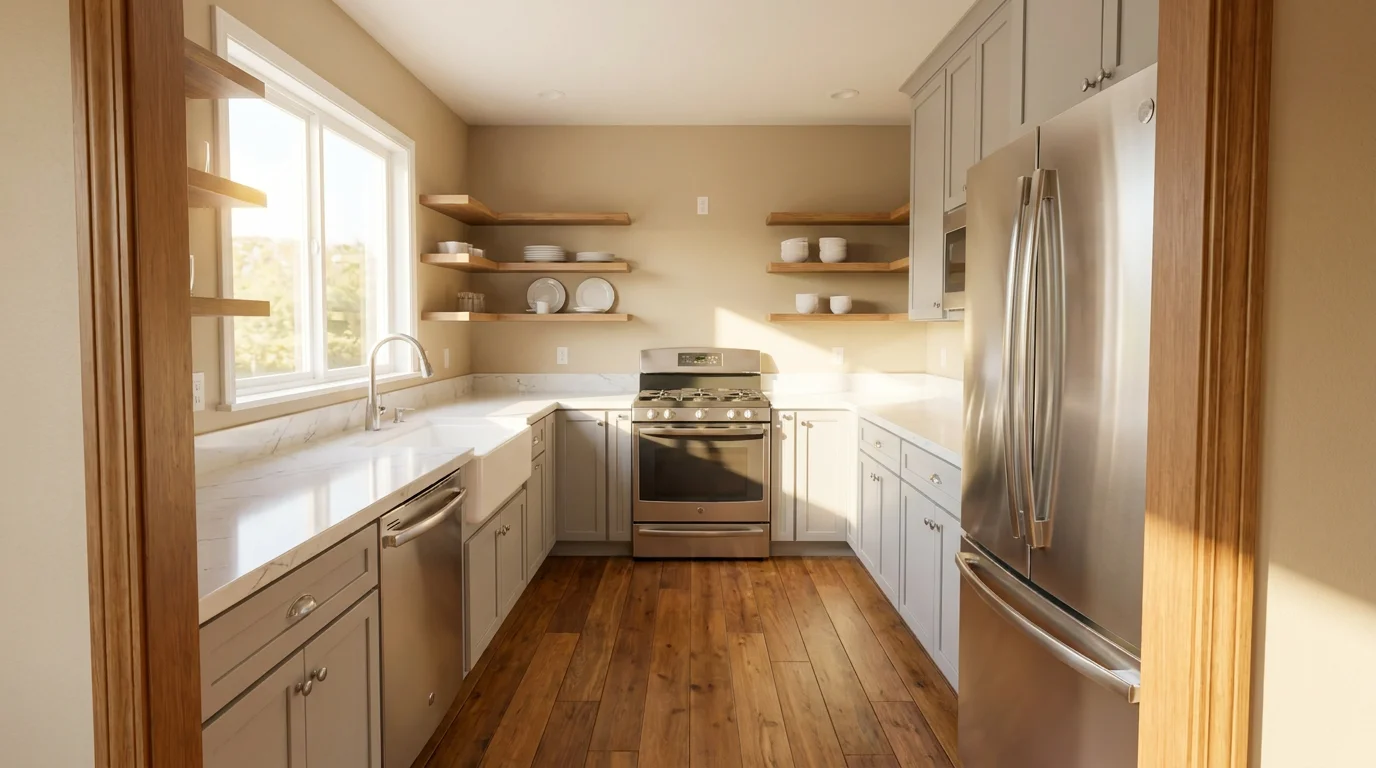
The house you are about to rent out was your home a month ago, and that familiarity trips up first-time landlords.
Converting it requires a sequence of legal filings, insurance changes, pricing choices, and tenant-facing steps. Skip one item and the fallout shows up later.
A missed filing can make rent hard to collect, while mishandling a deposit can leave you owing triple the amount. An insurance gap may surface only when the carrier denies a claim.
Learning how to rent out a house means working that sequence in order, starting before the listing goes live.
Before you list: legal and financial groundwork
Fair housing law governs your screening criteria and your ad copy before a single applicant exists. The Fair Housing Act (42 U.S.C. § 3601 et seq.) bars you from refusing to rent, setting different terms, or advertising a preference based on race, color, religion, national origin, sex, familial status, or disability. Familial status covers households with children under 18, pregnant applicants, and anyone in the process of gaining custody of a minor. The statute fixes those seven classes.
HUD's enforcement posture on sex is not: HUD withdrew its 2021 guidance covering sexual orientation and gender identity on September 17, 2025 (HUD withdrawal notice), and a proposed rule published April 28, 2026 would define "sex" as an individual's biological classification (Federal Register). No final rule had issued as of September 2026.
State and local law usually reaches further than the federal statute. Twenty-four states and more than 110 localities protected source of income as of 2025 (NLIHC), so a "no vouchers" line in your listing is illegal across much of the country. Age, marital status, sexual orientation, and student status are common state additions. Write your criteria to satisfy the strictest layer that applies to your address.
Cities and states generally control zoning laws and habitability rules, though federal requirements may apply to subsidized housing and discrimination-related accommodations. Confirm with your city planning department that your local zoning code permits a long-term rental at your address, and if you intend nightly stays or an ADU, confirm each of those uses separately, because many cities allow one and not the other.
The warranty of habitability is the duty state law places on you to deliver and maintain a unit fit to live in: working heat, plumbing, electrical, locks, and freedom from pests. You cannot draft it out of the lease.
Tell your lender before the first tenant moves in
Your mortgage note contains an occupancy covenant, and its terms depend on the loan type. VA loans generate the most confusion. Federal law requires you to certify at closing that you intend to occupy the home (38 U.S.C. § 3704(c)), and lenders read "a reasonable time" as moving in within 60 days (Military.com).
After that, the VA does not require continued occupancy; its VALERI rule states that "the basic program requirements do not require continued occupancy in order for the guaranty to remain in effect" (VA VALERI Final Rule). Most VA lenders impose the 12-month figure through their loan documents. They typically have you sign documents saying you'll live in the home as your primary residence for at least 12 months, with flexibility for a reason the lender approves (Veterans United).
Renting the house without transferring title does not constitute a "transfer" that triggers the due-on-sale clause. It does change your refinance options. A VA IRRRL only asks you to certify prior occupancy (VA.gov), while a VA cash-out refinance requires current or intended occupancy and is off the table once the home is a rental (VA.gov). For a conventional loan, read the occupancy covenant in your own note and tell the servicer in writing when the conversion happens.
Register the rental with your city
Most rental registration programs are municipal, and in several large cities an unregistered landlord cannot collect rent or file an eviction. Rhode Island and New Jersey run the notable statewide programs. Rhode Island requires annual re-registration by October 1 with no fee and penalties starting at $50 per month for failing to register (R.I. Gen. Laws §34-18-58; RI DOH). New Jersey's Landlord Identity Law requires an amended filing within 20 days of any change, with penalties up to $500 per offense (N.J.S.A. 46:8-27). Everywhere else, search your city or county housing department's site for "rental registration" or "rental license" before you list. A sample of city programs shows the range:
- City | Fee | Cycle | Penalty for not registering | Source
- Philadelphia, PA | $69/unit | Annual | No right to collect rent or recover possession; $300/day fine | Philadelphia Code Section 9-3902
- Los Angeles, CA | $38.75/unit RSO + $67.94/unit SCEP | Annual | Cannot collect rent without a valid registration statement | LAHD
- Seattle, WA | $126 first unit + $31.50 each additional | 2 years | $150/day for the first 10 days, then $500/day | SMC Ch. 22.214
- Baltimore, MD | $30/unit (1-2 units) | Annual, license every 2 years | Cannot evict or collect rent without a license | Baltimore DHCD
- Denver, CO | $50 for one unit | Every 4 years | $150 first fine; $999 by the third citation | Denver Renter's Handbook
- Boston, MA | $25/unit first time; $15/unit renewal | Annual (July 1) | $300/month | Boston.gov
Check whether a rent cap applies
Three states now cap rent increases statewide, and roughly 32 states preempt local rent control (NAA, Fall 2025). Oregon caps annual increases at the lesser of 10% or 7% plus CPI, which works out to 9.5% for 2026, requires 90 days' written notice, and has no single-family exemption (Oregon DAS).
California's AB 1482 caps increases at 5% plus local CPI or 10%, whichever is lower, but exempts single-family homes and condos when the owner is not a REIT, corporation, or LLC with a corporate member and the tenant has received the required written notice (Cal. Civ. Code §1947.12). Washington's HB 1217, effective May 7, 2025, caps increases at the lesser of 7% plus CPI or 10% (9.683% for 2026) and exempts owner-occupied homes where the owner rents two or fewer units or bedrooms, provided the rent-increase notice states the supporting facts (WA Department of Commerce).
Cities layer more on top. New York City's Good Cause Eviction law treats increases above 10% or 5% plus CPI as presumptively unreasonable but excludes landlords who own 10 or fewer units statewide (NY AG). Los Angeles's RSO holds increases to 3% through June 30, 2027 (LAHD). Some jurisdictions exempt individually owned single-family homes, but the conditions vary. California requires statutory notice, Oregon has no general single-family exemption, and Washington's exemption applies only to qualifying owner-occupied properties.
How to set the right rental price
Use comparable listings to estimate your market ceiling and your expense sheet to calculate the minimum rent you can accept. A rent that clears one and not the other is the wrong number. Pull active listings near your address on Zillow, which averaged 2.4 million active rental listings per month in 2025 (Zillow 10-K), and on the Apartments.com network.
Match bedrooms, bathrooms, square footage, parking, and finish level, then note both the asking rent and how long each comp has been live. Listings that have sat for weeks are priced above the market. Adjust down from those and up from the ones that disappeared within days.
Net operating income (NOI) is rent minus operating expenses before you pay the mortgage. Use it to determine whether the comp-based rent works. Suppose the comps put you at $2,200 per month. The figures below are illustrative except for the landlord insurance line, which uses Steadily's national average premium of about $1,478 per year:
- Line item | Annual amount
- Gross scheduled rent ($2,200 x 12) | $26,400
- Vacancy allowance (one month) | ($2,200)
- Effective gross income | $24,200
- Property taxes | ($3,600)
- Landlord insurance | ($1,478)
- Maintenance reserve | ($2,000)
- HOA dues | ($1,200)
- Net operating income | $15,922
- Mortgage principal and interest ($1,200 x 12) | ($14,400)
- Cash flow before taxes | $1,522 (about $127/month)
If a water heater replacement costs $1,522, it erases that $127 a month for a year. That is the number to sit with before you sign a lease, and it explains why a maintenance reserve and a vacancy allowance belong on the sheet even when the house is new and the applicant pool is deep. Some owners rent at zero or negative cash flow deliberately, for appreciation and for the tax deductions covered later in this guide; do it knowingly. In a rent-cap state, you also can't fix an underpriced rent quickly, because the caps described above limit each year's correction. Read your HOA covenants too: some associations cap the number of rentals or require board approval before you can lease at all.
How to prepare your house to be rent-ready
Applicants judge the house in the first two minutes of a showing, and inspectors judge it on smoke and carbon monoxide alarms. Handle the alarms first because the code most cities have adopted is specific. The International Residential Code requires smoke alarms in each sleeping room, outside each sleeping area, and on every level including basements. When the code requires more than one alarm, it requires you to interconnect them. New work requires hardwired power and battery backup (IRC R314).
The IRC requires CO alarms when the home has a fuel-fired appliance or an attached garage. Place them outside each sleeping area (IRC R315 summary). CPSC's January 2025 guidance adds installation on every level, monthly testing, and sealed 10-year batteries or annual battery replacement (CPSC). Several states write landlord-specific duties on top of the code:
- State | Landlord obligation | Statute
- California | Landlords must provide operable CO devices when tenants take possession; violations are infractions up to $200 after a 30-day notice to correct | HSC Section 17926.1
- Illinois | At least one approved CO alarm within 15 feet of every sleeping room; willful failure is a Class B misdemeanor | Illinois CO alarm statute
- Massachusetts | CO alarms on every level and within 10 feet of bedroom doors in any unit with a CO source | M.G.L. c.148, Section 26F-and-a-half
- Maryland | Battery alarms must be sealed 10-year units; a change of tenant triggers the upgrade | Maryland SB 969
- Oregon | No new rental agreement for a unit with a CO source unless alarms function; provide testing instructions to new tenants | ORS 90.316
- Washington | CO alarms outside each sleeping area and on each level | RCW 19.27.530
The rest of the prep list is less regulated but every applicant sees it:
- Rekey every exterior lock, garage keypad, and mailbox, and account for every copy. You have no way of knowing how many keys the past few years produced.
- Deep clean to a hotel standard: inside the appliances, grout lines, window tracks, HVAC returns, and the top of the refrigerator.
- Fix the cosmetic items you stopped noticing. Patch and paint in one neutral color, replace cracked outlet covers, re-caulk tubs, tighten loose hardware, and change every burned-out bulb.
- Boost your curb appeal before anything else. Mow, edge, trim shrubs away from the siding, and power-wash the walk, then finish with a fresh mat at the door. Buyers form their first impression from that front-of-house photo in your listing, so make it count.
- Stage lightly or not at all. An empty, spotless room photographs better than a half-furnished one and lets applicants picture their own furniture.
Landlord insurance: what coverage you actually need
Your tenant leaves for a long weekend in January, the furnace quits, and a supply line bursts behind the kitchen wall. The burst ruins the floors and cabinets and requires drywall repair. If the policy on the house is still the HO-3 you bought as an owner-occupant, the adjuster's first question is who lives there, and your answer can end the claim.
The Insurance Information Institute puts it plainly: "Depending on the rental scenario, your standard homeowners policy may not cover losses incurred while your home is rented out," and for a lease of six months or longer "you will likely need a landlord or rental dwelling policy" (Triple-I). The Texas Department of Insurance adds that failing to notify your insurer of the change can mean denied claims, reduced liability coverage, higher deductibles, or cancellation, and that a vacancy of often 60 days can void coverage on its own (Texas DOI).
Insurers sell landlord insurance as a dwelling fire policy for a home you own but don't occupy. The most limited form, DP1, covers fire, lightning, and internal explosion. DP2 adds a list of named perils, while DP3 covers structural losses unless the policy specifically excludes them and is the form most landlords should carry.
Expect to pay more than you did for the HO-3; Triple-I estimates landlord policies run about 25% higher (Triple-I). Steadily's premium ranges by dwelling coverage give a sharper benchmark: $500-$1K per year at $100K of dwelling coverage, $900-$1.8K at $300K, $1.4K-$2.8K at $500K, and $2.5K-$5K+ at $1M and above. Moving your deductible from $1K to $5K reduces the premium by roughly 12-15%.
Every landlord policy rests on dwelling coverage plus two other principal coverages. Dwelling coverage pays to repair or rebuild the structure after a covered peril, at replacement cost on a DP3. It does not include your tenant's belongings; the personal property coverage you had under the HO-3 disappears on a landlord form (NC DOI). The other principal coverages answer different questions you'll ask at claim time:
- Liability coverage: This pays legal defense and damages when a tenant or guest is injured on the property and holds you responsible. Steadily writes limits from $100K to $1M+.
- Loss of rental income: This replaces the fair rental value while a covered loss makes the unit unfit to live in. The ISO DP 00 03 form pays for "the shortest time required to repair or replace" the property (ISO DP 00 03); Steadily caps the benefit at 12 months of fair rental value, subject to a sub-limit tied to your dwelling coverage, and Policygenius puts the typical limit near 20% of the dwelling amount (Policygenius). The form excludes "loss or expense due to cancellation of a lease or agreement," so a tenant who stops paying or a unit sitting empty between leases is not a covered loss.
Read the exclusions against your own property before you bind. Steadily's forms exclude flood, earthquake, intentional tenant damage, normal wear and tear, vacancy beyond a set window without a vacant coverage add-on, tenant belongings, sewer backup, mold outside limited triggers, pest infestations, and certain dog breeds. Because standard landlord policies exclude flood, owners who want flood coverage need a separate flood policy or endorsement. A house you expect to sit empty for two months between tenants needs the vacancy add-on, or the turnover period itself becomes the gap.
Short-term rental use changes the occupancy the carrier is pricing. Triple-I's 2026 STR report tells hosts to "notify their existing homeowners insurance carrier, broker, or agent" and, in some cases, to obtain the carrier's explicit authorization by endorsement (Triple-I, March 2026). Many carriers decline STR occupancy outright. Steadily covers short-term rentals in all 50 states as a named occupancy type, along with ADUs, vacant properties, and renovation projects.
Because the landlord policy never covers the tenant's property, make renters insurance a lease condition and collect proof before you hand over keys; Triple-I recommends the same (Triple-I). Get a quote in minutes at quote.steadily.com, with no phone call required. The Landlord Hub has guides on coverage types, state-specific requirements, and how to evaluate your options.
How to market your rental and attract qualified tenants
At the $2,200 rent from the pricing example, each week of vacancy costs about $500. Your goal is to fill the unit fast with applicants who already meet your criteria.
Reach comes first. Zillow averaged 33 million monthly unique visitors to its rentals marketplace in 2025 (Zillow 10-K), Realtor.com reports 58 million unique users a month (Realtor.com), and CoStar's Homes.com and Apartments.com network averaged 108 million monthly unique visitors in 2025 (CoStar). Landlord-side pricing on those platforms is mostly free:
- Zillow Rental Manager lists for free; a premium upgrade is a $39.99 one-time fee good for up to 90 days (Zillow).
- Apartments.com gives 1-4 unit properties a free basic listing with 21 days of standard visibility across six network sites, shared to Homes.com at no cost (Apartments.com).
- Avail's free plan syndicates to 19 sites and includes state-specific leases and rent collection; the Plus tier is $9 per unit per month (Avail).
- TurboTenant's Premium plan runs $149 per year as a single all-inclusive price since January 12, 2026 (TurboTenant).
- Craigslist is free in most markets and $5 per post in the Boston, Chicago, and New York City areas (Craigslist).
- Facebook Marketplace still allows free rental posts from personal profiles, while paid housing ads must run through Meta's Special Ad Category with its HUD-compliance restrictions (Meta).
Applicants often decide whether to read the description based on the photos. Shoot in daylight with every light on and blinds open, hold the camera level at chest height, and cover every room, the exterior, the yard, and the parking. Simple technique goes a long way. Bright, level, wide shots are the goal.
If your phone can't get you there, investing in professional photography is worth considering. Use the vacancy cost above to judge whether a week of delay costs more than hiring a photographer. More often than not, it doesn't.
The description should lead with the facts an applicant filters on: rent, bedrooms and bathrooms, square footage, available date, pet policy, what's included (utilities, appliances, parking), and a one-line summary of your screening criteria. Publishing the criteria up front lets unqualified applicants self-select out, which spares you the adverse action notices covered next. Describe the property, never the people you imagine living in it. "Great for young professionals" or "family-friendly neighborhood" describes tenants by age and familial status, and both phrases have generated fair housing complaints for years.
How to screen tenants legally and effectively
Write your criteria before the first inquiry arrives, apply them identically to every applicant, and keep a copy with each file. That single habit does more to protect you from a discrimination complaint than any other. The process itself runs in a fixed order:
- Collect a written rental application from every adult who will live in the unit, including consent to pull reports.
- Order a credit, criminal, and eviction report through a screening service. Zillow charges the applicant $35 (LandlordStudio review); TurboTenant charges $45 for upgraded accounts and $55 for free users (TurboTenant). Watch fee caps on the rental application fee you collect: California limits application fees to $30 per applicant (Cal. Civ. Code §1950.6), Washington limits them to your actual cost (RCW 59.18.257), and Colorado bars any fee when the applicant supplies a qualifying portable screening report (HB23-1099).
- Verify income and employment by requesting recent pay stubs and conducting an employment verification call with the applicant's employer, or review tax returns for self-employed applicants. Then measure the confirmed income against the income-to-rent ratio outlined in your written criteria.
- Call the current and prior landlord. The prior one has no reason to shade the truth.
- Decide, and send the required notice to anyone you turn down or approve on different terms.
Tenant screening reports are consumer reports under the Fair Credit Reporting Act. Your permissible purpose is the transaction the applicant started (15 U.S.C. §1681b), and you must certify to the screening company that you'll use the report only for housing (FTC).
Denying an applicant is one type of adverse action. Requiring a co-signer, a larger deposit, or higher rent also triggers a notice, and the FTC states the notice "is required even if information in the consumer report wasn't the primary reason for the decision."
The notice must give the reporting agency's name, address, and phone number. It must state that the agency did not make the decision and can't explain it, then inform the applicant of the right to a free copy of the report within 60 days and the right to dispute its accuracy. If you used a credit score, include the score, its source, its date, the score range, and the key adverse factors.
Willful violations carry statutory damages of $100-$1,000 per violation plus punitive damages and attorney's fees (15 U.S.C. §1681n). When you're done with a report, shred the paper or erase the file (FTC Disposal Rule).
Screening companies can report inaccurate records. In October 2023 the FTC and CFPB required TransUnion to pay $15 million for including inaccurate and incomplete eviction records in tenant screening reports (FTC). CFPB advisory opinions issued January 23, 2024 bar agencies from reporting arrests without dispositions, sealed records, or expunged records, and limit each adverse item to its own seven-year window (CFPB). Confirm each reported record with the applicant before deciding.
Criminal history is where fair housing law and screening collide. HUD's 2016 guidance applies the FHA's disparate-impact framework: an arrest record alone cannot support a denial, a blanket ban on anyone with any record likely violates the Act, and you need an individualized assessment weighing the nature of the offense, time elapsed, evidence of rehabilitation, and rental history (HUD OGC Guidance). The statute's one carve-out is a conviction for manufacturing or distributing a controlled substance, and it does not extend to possession.
Beyond HUD guidance, landlord-tenant laws at the local level layer on additional requirements through fair chance ordinances. Cook County, Illinois lets you look at criminal history only after the applicant prequalifies on other criteria and only for records under three years old (Cook County), and New Jersey bars any criminal inquiry before a conditional offer (NJ Fair Chance in Housing Act).
How to draft a residential lease agreement
Start your lease agreement from a state-specific template rather than a generic form. Deposit terms, entry notice requirements, and required disclosures are all shaped by each state's landlord-tenant laws, and a clause that overstates your rights can trigger the statutory penalties in the next section. Avail's free plan includes state-specific leases (Avail). Whatever template you use, these clauses carry the weight:
- Rent, due date, grace period, late fee, and accepted payment methods. Spelling out the exact day rent is late and what it costs removes the argument you'd otherwise have on the fifth of the month.
- Term and renewal. A fixed 12-month term that converts to month-to-month, with a stated notice period for non-renewal on both sides, gives you a clean date to reprice or exit.
- Security deposit amount, where it's held, and the return process. Set the amount at or under your state cap, name the account if your state requires a separate one, and mirror the statutory deadline and itemization rules exactly.
- Entry rights. State the notice you'll give for non-emergency entry, in the hours or days your state specifies, and the emergency exception. A tenant who knows the rule rarely fights the inspection.
- Pet policy and pet deposit. If you allow pets, stay within the pet-deposit limits where they exist: Colorado allows up to $300 (HB25-1249), Washington, D.C. allows up to 15% of the deposit (DC Code §42-3505.10), Kansas allows half a month's rent, and Nebraska a quarter month. Assistance animals for a disability are a reasonable accommodation under the FHA, not pets, and your pet policy cannot exclude them.
- Maintenance responsibilities. Require the tenant to report problems promptly and in writing, assign routine items like smoke alarm batteries and furnace filters where your state permits (Illinois, Oregon, and Washington commonly place battery replacement on tenants), and keep systems and structure on your side.
- Renters insurance. Require an active policy with proof at move-in and at renewal, for the reason the insurance section explained.
- Occupancy and use. Name every adult occupant, prohibit subletting and short-term listings without written consent, and bar any business use that changes the occupancy your carrier priced.
- Required attachments. Every lease agreement comes with jurisdiction-specific documents that landlords must include. Illinois landlords must attach the Summary of Rights for Safer Homes as the first page of every written lease agreement as of January 1, 2026 (IL DHR). Chicago requires the RLTO summary with each lease agreement since May 1, 2024 (Chicago DOH). New York's Good Cause law mandates its own disclosures, and California's single-family rent-cap exemption applies only if the tenant receives the statutory notice in the lease agreement.
Move-in day: deposits, inspections, and rent collection
Security deposit law is where first-time landlords pay the most for a small mistake, because several states multiply a wrongfully withheld deposit by two or three and add attorney's fees. Your state statute controls the cap and account rules. It also starts the return clock, and the Colorado, Maryland, and D.C. rules changed in 2024-2026:
- State | Cap | Separate account required? | Return deadline | Penalty for wrongful withholding | Statute
- Massachusetts | 1 month | Yes, separate interest-bearing Massachusetts bank account | 30 days | 3x deposit plus 5% interest and attorney's fees | Mass. Gen. Laws c.186 Section 15B
- New York | 1 month | Yes, interest-bearing, for buildings with 6+ units | 14 days | Forfeiture of right to retain; 2x deposit if willful | N.Y. GOL Section 7-108
- California | 1 month for most landlords; 2 months for natural persons owning 2 or fewer properties with 4 or fewer units | Not required; deposit remains tenant's property | 21 days | Up to 2x deposit plus actual damages for bad faith | Cal. Civ. Code Section 1950.5
- New Jersey | 1.5 months | Yes, trust account with no commingling | 30 days | 2x wrongfully withheld plus costs | N.J.S.A. 46:8-19
- Colorado | 2 months plus up to $300 pet deposit | Not required | 30 days, extendable by lease to 60 | Treble damages for bad faith, presumed if you keep 125% or more of actual damages | C.R.S. Section 38-12-102 et seq., as amended eff. Jan. 1, 2026
- Illinois | No cap | Not required | 30 days with itemization; 45 without | 2x deposit plus attorney's fees for bad faith | 765 ILCS 710/1
- Florida | No cap | Not required | 15 days if no claim; 30 days' notice if claiming deductions | Prevailing party recovers attorney's fees | Fla. Stat. Section 83.49
- Georgia | 2 months for leases on or after July 1, 2024 | Not required | 30 days | None specified | OCGA Section 44-7-30 et seq.
- Ohio | No cap | 5% annual interest on the qualifying excess when the deposit exceeds $50 or one month's rent, after 6 months' possession | 30 days | Amount withheld plus an equal amount plus attorney's fees | Ohio Rev. Code Section 5321.16
The move-in inspection is your only defense when you deduct from that deposit a year later. Walk every room with the tenant, photograph each wall, floor, fixture, and appliance with a visible date, and record existing scratches, stains, and worn items on a checklist that both of you sign. Store everything with the lease.
That signed checklist and those photos are what any itemized deduction rests on, so a thorough move-in inspection matters. Colorado's presumption of bad faith kicks in when you retain 125% or more of your actual damages, and California requires full documentation of any deduction, and in both cases, your paperwork is the difference between keeping a deduction and losing it.
Collect rent by bank transfer from the first month and never by cash. Avail's free plan charges the tenant $2.50 per bank transfer, its $9-per-unit Plus plan makes ACH free, and cards cost 3.5% on both (Avail). Zillow Rental Manager offers free ACH, $9.95 for debit cards, and 2.95% for credit cards (LandlordStudio review). TurboTenant offers its own collection tools. DoorLoop and RentSpree do too.
Whichever platform you pick, set autopay as the default and route the deposit and every rent payment into an account you use for nothing else. That dedicated account becomes the backbone of your bookkeeping: a clean ledger that makes tax time straightforward and keeps any deposit dispute easy to resolve.
Should you self-manage or hire a property manager?
Full-service management for a single-family rental costs 8-12% of monthly rent plus a leasing fee. Decide whether to hire a manager by comparing the fees with the value of your time. The most rigorous fee survey, iPropertyManagement's 2022 study of 722 branches across 80 metros, found a national average of 8.49% of monthly rent, with 75.3% of companies pricing as a percentage and a flat-fee average of $101.04 per unit per month (iPropertyManagement). Industry commentary in 2025 places the full-service range at 8-12% with most providers near 10% (Belong). Single-family homes tend toward the higher end of that range; multifamily runs 5-10% because of scale (MRI Software). The monthly percentage is not the whole bill:
- Fee | Typical range | Source
- Setup or onboarding | $200-$500 | Baselane, 2025
- Leasing or tenant placement | 50-100% of one month's rent | Baselane, 2025
- Lease renewal | $100-$300 | Baselane, 2025
- Maintenance markup | 5-15% of repair cost | Baselane, 2025
- Eviction handling | $200-$500 plus legal costs | Baselane, 2025
Apply that to the $2,200 rent: a 10% fee is $220 a month, or $2,640 a year, plus a $1,100-$2,200 leasing fee in year one. Set against the $1,522 of annual cash flow in the pricing example, a manager turns a thin positive into a loss.
No probability-sample survey of self-management hours exists in the sources for this guide, so run your own: list the tasks (advertising, showings, screening, lease signing, rent follow-up, maintenance calls, annual inspection, renewal) and assign hours. If you value your time at $50 an hour, the $2,640 base fee buys back about 53 hours a year; below that many hours, self-managing pays, and above it the manager does. Distance and temperament count too. A landlord three time zones away or one who dreads a late-rent conversation should weight those hours heavily.
Short-term rentals use a different management pricing model. STR managers charge a share of gross booking revenue, typically 20-30% for full service (PriceLabs, 2026) and 15-25% for a typical Airbnb arrangement (AirDNA).
Ongoing responsibilities: maintenance, late rent, and eviction
Once the tenant is in, your habitability duty becomes a response-time problem. Log every repair request with the date received and the date fixed, address heat, water, and lock failures within a day, and schedule one annual inspection with the notice your lease promised. Replace or test smoke and CO alarms at every change of tenancy; Oregon and California make that an explicit landlord duty at the start of each tenancy, and most states follow the same pattern. The log is your evidence if a tenant later claims you ignored a problem.
When rent is late, the sequence is fixed by your state, and every step happens in writing. Send a reminder the day after the grace period ends. If that fails, serve the pay-or-quit notice your state requires, in the form and by the method the statute specifies.
Only after the notice period expires do you file the eviction case, attend the hearing, obtain a judgment, and have the sheriff or constable execute the writ. Changing the locks, shutting off utilities, or removing belongings before that writ exposes you to damages in every state. The notice periods vary widely:
- State | Pay-or-quit notice | Statute | Recent change
- California | 3 days, excluding weekends | CCP Section 1161(2) | None
- Texas | 3 days | Prop. Code Section 24.005 | None
- Florida | 3 days, excluding weekends | Fla. Stat. Section 83.56(3) | The Florida Legislature did not enact SB 716 (2026), which would have extended the period to 5 days
- Georgia | 3 business days | OCGA Section 44-7-50(c) | Statute expires Jan. 1, 2027
- Illinois | 5 days | 735 ILCS 5/9-209 | None
- Arizona | 5 days | A.R.S. Section 33-1368(B) | None
- Colorado | 10 days | CRS Section 13-40-104(1)(d) | None
- Pennsylvania | 10 days | 68 P.S. Section 250.501 | Philadelphia requires Eviction Diversion first
- New York | 14 days | RPAPL Section 711(2) | Good Cause disclosures now required
- Washington | 14 days | RCW 59.12.030(3) | None
- Minnesota | 14 days | Minn. Stat. Section 504B.321 | New requirement eff. Jan. 1, 2024
- Virginia | 14 days | Va. Code Section 55.1-1245(F) | Extended from 5 days eff. July 1, 2026
- New Jersey | No notice required for nonpayment | N.J.S.A. 2A:18-61.2 | None
- Missouri | No pre-filing notice | Mo. Rev. Stat. Section 535.020 | None
Total time from notice to lockout depends on the court, and no official series tracks it for every state. The best available estimates: Arizona's statutory minimum to a writ is about 13-16 days (Maricopa County Justice Courts); an uncontested Florida case runs roughly 3-6 weeks (LegalClarity); Cleveland's housing court estimates about 5 weeks uncontested (Cleveland Housing Court); Indiana runs 30-60 days (Fritch Law); and Washington, D.C. averaged 12-16 months before its 2025 reforms (NAA). Landlords filed 1.23 million eviction cases across the sites Eviction Lab monitors in 2025, about one filing for every 13 renter households (Eviction Lab), and tenants in 17 cities, 5 states, and 2 counties now have a right to counsel in those cases (NCCRC). Budget for an attorney of your own from the first missed payment.
Renewal is cheaper than turnover, and the offer should go out 90 days before the lease ends. That window is not arbitrary: Oregon, Washington, and Montgomery County, Maryland all require 90 days' written notice of a rent increase, and a renewal offer that arrives later than that in those jurisdictions cannot carry an increase on the first day of the new term. Send the offer with the new rent and term, plus a deadline to respond, and start the marketing clock the day that deadline passes without a signature.
Taxes and business structure
Depreciation is the deduction first-time landlords most often miss, and it is not optional: the IRS reduces your basis by allowable depreciation at sale whether or not you claimed it. Residential rental property depreciates straight-line over 27.5 years using a mid-month convention, and for a converted primary residence the depreciable basis is "the lesser of its adjusted basis or its FMV when you change it to rental use," minus the land, which never depreciates (IRS Publication 527).
You claim it on Form 4562 and report the rental on Schedule E. When you sell, federal tax law taxes accumulated depreciation as unrecaptured §1250 gain at a maximum 25% rate (IRS Topic 409), so track it from year one.
Beyond depreciation, Publication 527 and the IRS rental real estate tips page treat these as ordinary rental expenses on Schedule E:
- Mortgage interest and property taxes, with the property taxes falling outside the Schedule A SALT cap because they're business expenses.
- Landlord insurance premiums, prorated if you prepaid more than a year (IRS Publication 527).
- Repairs, plus items under $2,500 per invoice under the de minimis safe harbor, and building work up to the lesser of 2% of unadjusted basis or $10,000 under the small-taxpayer safe harbor (IRS Tangible Property Regulations).
- Management fees, leasing fees, tenant screening costs, and legal or tax preparation fees tied to the rental.
- Mileage to the property at 70 cents per mile for 2025, then 72.5 cents for January through June 2026 and 76 cents for July through December 2026 (IRS IRB 2026-29); routine commuting from home doesn't count unless your home qualifies as a principal place of business.
- HOA dues, and up to $5,000 of start-up costs in the year the rental becomes active, with the remainder amortized over 180 months (The Tax Adviser).
- Separately purchased appliances depreciate over 5 or 7 years and qualify for the 100% bonus depreciation that P.L. 119-21 restored for qualifying property acquired after January 19, 2025 (IRS Form 4562 Instructions); the building itself does not qualify for bonus depreciation.
Two limits shape whether those deductions reach your return this year. If expenses exceed rent, you can deduct up to $25,000 of the loss against other income as long as you actively participate and your modified AGI is under $100,000; the allowance phases out to zero at $150,000, and excess losses carry forward until the property earns income or sells (IRS Publication 925). On the income side, the 20% qualified business income deduction under §199A became permanent under P.L. 119-21 in July 2025 (CRS), and rental income qualifies under Rev. Proc. 2019-38 if you log 250 or more hours of rental services a year with contemporaneous records (IRS).
The dedicated bank account mentioned in the move-in section is also your tax filing system. If you form an LLC, the account also helps keep the entity standing. A single-member LLC is a disregarded entity for federal tax purposes and changes nothing on your return; income still lands on Schedule E (IRS).
An LLC offers a liability wall between the rental and your personal assets, with no dollar ceiling, which an umbrella policy can't match. For a converted primary residence, transferring the deed can trigger the due-on-sale clause in your mortgage, state transfer taxes, and a title insurance review (Summit Law). Nolo reports that a landlord policy on a single-family home held in an LLC can cost roughly twice what it would in your own name (Nolo).
State-specific consequences add another layer. Florida owners forfeit homestead creditor protection on transfer (Florida Bar Journal), and California charges an $800 minimum annual franchise tax (CA FTB). Commingle funds or skip the separate records, and a court can pierce the veil anyway.
For one or two properties, a personal umbrella policy is the common alternative: $1-$5 million of liability for roughly $500-$1,500 a year, generally covering up to four rental units (BiggerPockets). If you do form the LLC and transfer title, tell the lender before recording the deed and tell the insurer the same day. Your personal policy may not cover an LLC that now owns the house.
FAQ
These answers summarize the legal, financial, insurance, and management decisions first-time landlords ask about most often. Check the applicable state and local rules before acting.
What laws do I need to check before renting out my house?
Start with four: the Fair Housing Act and your state's added protected classes (source of income is protected in 24 states), your city's rental registration or licensing rule, your state's security deposit statute, and any rent cap that applies to a single-family home in your state or city. Then read the occupancy covenant in your mortgage note and notify the servicer and your insurer of the conversion in writing.
How do I calculate rent for my house?
Price from comparable active listings on Zillow and Apartments.com matched on bedrooms, bathrooms, square footage, and condition, then test that rent against a cash flow sheet that subtracts a vacancy allowance, property taxes, landlord insurance, a maintenance reserve, HOA dues, and the mortgage payment. If the result is near zero, decide in advance whether you're holding for appreciation and tax benefits or whether the rent needs to be higher than the comps support.
How do I screen tenants legally?
Apply the same written criteria to every applicant, pull reports only for the housing transaction, and send an adverse action notice with the reporting agency's contact details and the applicant's dispute rights whenever you deny, require a co-signer, or change terms based on the report. Evaluate criminal history individually rather than with a blanket ban, ignore arrests without convictions, and check whether your city has a fair chance ordinance or an application fee cap.
Do I need landlord insurance if I already have homeowners insurance?
Usually. For a lease of six months or longer, you will likely need a landlord or rental dwelling policy, but confirm the occupancy terms with your insurer. An HO-3 is written for an owner-occupant, and once a tenant lives there the insurer can deny a claim, reduce liability coverage, or cancel the policy. A DP3 landlord policy covers the structure on an open-peril basis, carries landlord liability, and replaces lost rent while a covered loss keeps the unit empty. According to 2026 industry data, premiums for standard rental properties typically range from $800 to $3,000 per year nationally, with higher-risk locations reaching $2,200 to $4,600 or more.
What clauses must a residential lease include?
Rent amount and due date with late terms, the lease term and renewal mechanics, deposit handling that matches your state statute, entry notice, pet rules within your state's pet-deposit limits, maintenance responsibilities, a renters insurance requirement, occupancy and subletting limits, and any disclosures your state or city mandates as a lease attachment.
Should I manage the property myself or hire a property manager?
Expect a manager to charge 8-12% of monthly rent plus a leasing fee of half to a full month's rent, roughly $2,600 a year in fees on a $2,200 rental before placement costs. Estimate your own hours across advertising, showings, screening, rent collection, repairs, and renewals, price them at your hourly value, and hire out when the manager's fee comes in under that number or when distance makes showing up impractical.
What do I do if my tenant stops paying rent?
Send a written reminder when the grace period ends, serve the pay-or-quit notice your state requires (three days in California, Texas, and Florida; 14 days in New York, Washington, Minnesota, and Virginia), and file in court only after the notice period runs. Never change locks or cut utilities yourself. Loss-of-rent coverage on your landlord policy does not pay for nonpayment, so the deposit and a prompt filing are your financial backstops.




.jpg)




.png)