
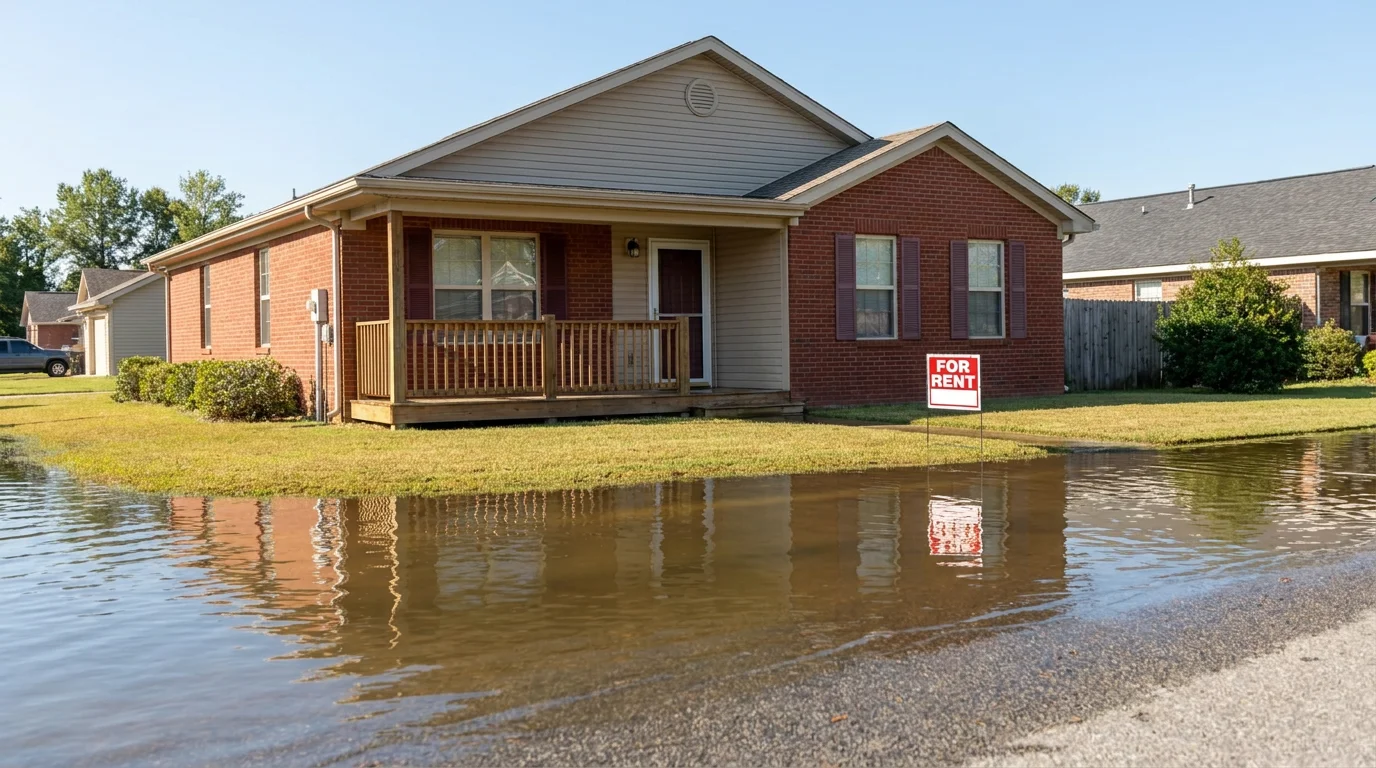
Say you close on a Tampa duplex and keep the HO3 that came with the house. Once the first tenant signs a lease, the occupancy change can give the carrier grounds to deny a claim or decline renewal under the policy's occupancy or business exclusions. Renting out a Florida property takes it outside homeowners coverage: Citizens and most carriers treat tenant-occupied homes as ineligible.
You need landlord insurance in Florida written on the appropriate dwelling fire form plus a separate flood policy. All three dwelling fire forms exclude flood, and RentalRealEstate's 2026 estimate ranks Florida as the most expensive state in the country for landlord insurance, ahead of Louisiana and Texas.
What is investment property insurance in Florida?
Investment property insurance in Florida is landlord insurance: an insurer writes a dwelling fire policy (DP1, DP2, or DP3) for a non-owner-occupied rental of one to four units and pairs it with liability coverage and loss of rental income coverage. The policy insures the structure against covered perils. It also pays your legal costs if a tenant or guest is injured and replaces rent while a covered loss leaves the property uninhabitable.
Anyone renting out a Florida property needs coverage suited to the occupancy. That applies whether you own a single-family rental or multi-unit properties and whether your tenant stays twelve months or three nights. It also applies whether you hold title personally or through an entity. If you are still choosing a property, our guide to buying a rental property in Florida walks through the numbers. Three-night stays require short-term-rental-specific coverage rather than an unendorsed standard DP3. Florida law does not require landlords to carry it under Chapter 83, but most mortgage lenders will. Fannie Mae, for example, imposes open-peril coverage requirements on a replacement-cost basis with a deductible no higher than 5% of the coverage amount.
Landlord insurance vs. homeowners insurance in Florida
An HO3 homeowners policy assumes you live in the house. Citizens Property Insurance, Florida's state-backed insurer, states in its eligibility rules that tenant-occupied homes generally do not qualify for a homeowners policy. The current ISO HO3 form goes further, defining "business" to include home-sharing host activities, so even part-time Airbnb use falls under the business exclusions.
Here is how the two policy types differ on the questions that matter to a landlord:
- Question | Homeowners (HO3) | Landlord (DP3)
- Eligible occupancy | Owner-occupied only | Tenant-occupied, 1–4 units
- Tenant overflows a tub, ruins the subfloor | Carrier may deny the claim once a renter occupies the home | Covers accidental water discharge
- Loss of rental income | The 2022 ISO HO3 excludes fair rental value from home-sharing host activity | Fair rental value, typically up to 12 months
- Theft from a rented portion of the home | ISO HO3 excludes it | DP3 covers it, subject to vacancy limits
- Liability for a tenant or guest injury | Business-activity exclusion applies | Insurer includes premises liability or agent adds it, $100K–$1M+
Adjusters often discover the coverage gap at claim time. Once an adjuster finds a tenant on the lease, the carrier can deny the water claim or reduce liability coverage. It can also decline to renew the policy.
DP1 vs. DP2 vs. DP3 policies for Florida rentals
Florida landlord policies use one of three dwelling fire forms, and the form determines both which perils the insurer covers and how it pays a loss:
- Form | Perils | Valuation | Best for
- DP1 (basic) | Named perils: fire and lightning, plus internal explosion; wind and hail require endorsements, as does vandalism | Actual cash value (repair cost minus depreciation) | Vacant homes, older properties, minimal budgets
- DP2 (broad) | 16 named perils, adding burst pipes, falling objects, freezing, burglar damage | Replacement cost (80% coinsurance) | Mid-tier properties that don't qualify for DP3
- DP3 (special) | Open peril on the dwelling: everything covered except listed exclusions | Replacement cost (80% coinsurance) | Most Florida rentals
DP3 is the standard recommendation for Florida rentals. A Florida-licensed agency puts it plainly: DP1 is an option for landlords on a minimal budget or for vacant homes, but DP3 is usually better because of its open-peril structure and replacement-cost payout. The ACV math stings in practice: a storm tears off a 15-year-old roof, and the insurer depreciates it before writing the check.
DP2 and DP3 forms carry an 80% coinsurance requirement: if you insure the dwelling for less than 80% of its full replacement cost, the insurer applies a coinsurance penalty and pays only a proportion of a partial loss (or actual cash value, whichever is greater), so under-insuring to save on premium can sharply cut your payout at claim time. The base dwelling forms do not include liability or medical payments coverage. Ask your agent to add liability coverage or buy it separately, then confirm it appears on your declarations page.
DP1 and DP2 still have a place. Florida underwriters use roof age to determine DP3 eligibility, with thresholds commonly beginning at 15 years and tightening at 20 or 25 years. Older properties and homes mid-restoration therefore tend to land on a DP1 until the owner replaces the roof.
Core coverages every Florida rental policy needs
Dwelling coverage should equal the cost to rebuild the structure at current prices. Lenders enforce this: Fannie Mae requires coverage equal to the lesser of 100% of replacement cost or the loan balance (where the balance is at least 80% of replacement cost).
Liability typically starts at $100,000 and runs to $1 million or more per occurrence. Florida agencies describe $100,000 as the floor, with $300,000 to $1,000,000 common for investors.
Loss of rental income pays the fair rental value of the property while a covered loss makes it uninhabitable. Insurers typically pay for up to 12 months and cap the coverage at a sub-limit tied to dwelling coverage. Citizens sets its DP3 fair rental value at 10% of Coverage A, which is $30,000 on a $300,000 dwelling limit. Check the sub-limit against your actual annual rent, because a $30K cap on a property that rents for $3,500 a month leaves you short before the 12 months run out.
Florida-specific risks: hurricane, windstorm, flood, and sinkhole
Florida is exposed to more natural disasters than any other state. The Florida OIR reports that Florida has 8,436 miles of shoreline and calls it the most catastrophe-prone state in the country, which means peril-specific coverage matters more here than almost anywhere else. Each major peril gets handled differently by a landlord policy:
- Peril | In a standard DP3? | What you need
- Hurricane wind | Covered, but with a separate percentage deductible | Understand the deductible math before a storm
- Windstorm/hail (non-hurricane) | Covered under open peril | Standard AOP deductible applies
- Flood | A standard DP3 always excludes it | Separate NFIP or private flood policy
- Sinkhole | Florida law includes only catastrophic ground cover collapse | Sinkhole loss endorsement for lesser damage
Flood insurance in Florida
Lenders require flood coverage on any property inside a Special Flood Hazard Area, and it has to come from a separate policy. The NFIP caps building coverage at $250,000 for a 1–4 family dwelling and contents at $100,000. The NFIP also pays nothing for lost rental income, which is exactly the loss a landlord feels longest after a flood.
Private flood insurers fill those gaps. Neptune Flood writes residential building coverage up to $15 million, offers optional loss of rental income up to $50,000, and carries a 10-day waiting period against the NFIP's standard 30 days. Wright National Flood offers primary residential coverage up to $5 million with a 7-day wait on non-loan policies. Federally regulated lenders must accept private policies that meet the Biggert-Waters definition.
If your property ends up with Citizens, note its phased flood mandate: policies with wind coverage inside the SFHA must carry flood now, and outside the SFHA the requirement extends to all policies by January 1, 2027.
Windstorm and hurricane deductibles
Your landlord insurer covers hurricane wind but calculates a separate deductible as a percentage of your dwelling coverage rather than a flat dollar amount. For owners who insure homes below $250,000, state law requires insurers to offer $500, 2%, 5%, and 10% options. At $250,000 and above, insurers need not offer the $500 option. For homes insured from $1 million to under $3 million, insurers may substitute 3% for 2%; above $3 million, they need offer only 5% and 10%.
Calculate the percentage by multiplying it by your Coverage A limit. On a $300,000 dwelling limit, a 2% deductible means $6,000 out of pocket. A 5% deductible means $15,000, while 10% means $30,000. The deductible triggers when the National Hurricane Center issues a hurricane warning for any part of Florida and stays in effect until 72 hours after the last watch or warning ends. It applies once per calendar year across all hurricanes, so a second storm in the same year draws the greater of your remaining hurricane deductible balance or your all-other-perils deductible.
Wind mitigation features cut the premium side of this equation.
Sinkhole coverage
Florida law requires every property insurer to include catastrophic ground cover collapse, but the bar is high: the ground must abruptly collapse and the depression must be visible. The building must also suffer structural damage that includes the foundation. A government agency must also condemn the structure and order occupants to leave. Settling and cracking that stop short of condemnation don't qualify. For that, you need a sinkhole loss endorsement, which insurers must make available for an additional premium, with deductibles of 1%, 2%, 5%, or 10% of dwelling limits.
The risk concentrates inland. Insurers call Hernando and Pasco counties, along with Hillsborough County, "sinkhole alley," and they account for 66% of Florida sinkhole claims. USGS analysis flags Marion, Polk, Lake, Jackson, and Alachua counties for high susceptibility. When you buy, check that sellers disclose paid sinkhole claims before closing and state whether they used the proceeds for repairs. The insurer can bar any sinkhole claim unless you notify it within 2 years of when you knew or should have known about the loss.
Optional coverages and endorsements worth adding in Florida
Beyond the core three, several endorsements close gaps that Florida makes expensive:
- Ordinance or law coverage pays the added cost of rebuilding to current code after a loss. Florida's statutory 25% default inclusion applies only to homeowners policies, not dwelling fire policies, so landlords must add it by endorsement. Code-upgrade costs run roughly 1% to 2.5% of rebuild cost for every year of building age, and Florida's 50% substantial-damage rule can force full code compliance, including elevation, on older coastal homes.
- Water backup coverage addresses sewer and drain backup, which standard policies exclude even though the resulting damage looks identical to a covered pipe burst.
- Add a vandalism and malicious-mischief endorsement to a DP1; both DP1 and DP3 forms restrict this coverage after extended vacancy.
- The sinkhole loss endorsement adds sinkhole coverage that matters most in the central Florida counties where settling damage is common but condemnation is rare.
- An extended fair rental value limit makes sense when the standard sub-limit falls short of 12 months of your actual rent.
- Umbrella liability stacks $1 million or more above your underlying limits, cheap protection in a state that generated more than 72% of the nation's homeowners claim litigation in 2023 while producing only 10% of the claims, based on Insurance Information Institute data.
How much does investment property insurance cost in Florida?
No single authoritative source publishes a verified statewide average for Florida landlord premiums, and estimates use different coverage bases and methodologies. Insurance.com calculates $2,288 from NAIC dwelling-fire data at a $300K–$400K coverage basis, while RentalRealEstate's 2026 estimate is $4,509 and ranks Florida as the most expensive landlord insurance state in the country, ahead of Louisiana and Texas. Whichever benchmark you use, quotes for investment property insurance in Florida run above the national norm. Because those figures vary by methodology, a landlord insurance calculator gives you a property-specific Florida estimate rather than a statewide average.
Insurers give the greatest pricing weight to roof age. Deductible selection and documented wind mitigation features also drive price. Roof age carries particular weight because an OIR-commissioned study found roofs over 10 years old have roughly a 50% probability of damage in high wind gusts, and most insurers require an inspection once a roof passes 20 years. Steadily puts the savings from raising your all-other-perils deductible from $1,000 to $5,000 at about 12–15%.
Florida's overall market is stabilizing, with Citizens approving an 8.7% average decrease for personal lines effective July 2026. Citizens raised its average DP3 rate by 10.4% in its 2025 filing even as homeowners rates softened, so don't assume headlines about falling Florida premiums apply to your rental.
Short-term rentals, vacant properties, and other special situations
Short-term listings and extended vacancy each break assumptions a standard Florida landlord policy is priced on. Holding title through an LLC or trust can do the same, and each situation has a specific fix.
Airbnb and VRBO coverage
A standard landlord policy prices risk on a long-term tenant, and short-term rental (STR) activity breaks that assumption. The Insurance Information Institute's March 2026 outlook warns that undisclosed STR use can bring denied claims or cancellation, along with reduced liability coverage or higher deductibles. Even where a DP3 pays, its loss of rental income calculation uses fair market rent for a long-term tenant, which sits below your nightly rate. Citizens draws a hard line: it rejects a property when its owner rents it to guests more than three times in a calendar year for stays under 30 days.
Platform protection doesn't close the gap. Airbnb's AirCover includes $1 million in host liability insurance, but its Host Damage Protection is explicitly "not insurance". It excludes storm and flood damage to the building, as well as plumbing damage. You need an insurer to write a policy for STR use. A dedicated STR policy typically runs $2,000–$3,000 per year, and Steadily offers Florida STR coverage for Airbnb and VRBO properties with stays as short as one night.
Vacant and renovation coverage
Standard landlord policies restrict coverage once a vacant property has sat empty for 30 to 60 days. The current ISO DP3 form cuts vandalism, theft, glass breakage, burglar damage, and accidental water discharge after more than 60 consecutive days of vacancy, and some carriers use a 30-day threshold. A vacancy permit from your insurer preserves fire and wind coverage but typically still leaves a vacant property exposed to theft and glass breakage. Water damage also remains a risk.
Fix-and-flip projects sit in a harder gap. Traditional carriers commonly decline vacant, mid-renovation properties at the point when your capital is committed and rental income is zero. Steadily's Vacant & Restoration product covers properties in this window, including fix-and-flip and renovation projects that traditional carriers decline.
LLC and trust ownership
Transferring a rental into an LLC without updating the policy is one of the most common Florida underwriting errors. If you transfer the property, your personal-name policy will not respond to claims against the LLC; the insurer must add the entity or issue a new policy in the entity's name. Carriers handle this differently. Under Citizens trust rules, the trustee's name must precede the trust as named insured, and corporate or LLC trustees may only qualify for dwelling policies without liability coverage. Several Florida carriers strip personal liability from entity-named policies entirely, which defeats the asset-protection purpose of the LLC.
Confirm before you bind that the entity is the named insured and that liability coverage survives the entity structure. Expect the carrier to ask for entity documents and any property management agreement. Steadily writes dwelling fire policies in LLC names with premises liability available, though personal and personal-injury liability generally is not, and land trusts fall outside its underwriting guidelines.
How to lower your Florida landlord insurance premium
The single biggest lever in Florida is a wind mitigation inspection. Florida law requires insurers to give actuarially reasonable credits for wind-resistant features, documented on the OIR-B1-1802 inspection form, which stays valid for up to 5 years. The credits apply to the hurricane-wind portion of the premium, which in coastal Florida is most of it.
Homes that comply with the 2001 Florida Building Code or a later edition qualify for a minimum 68% discount on the wind portion, a package baseline for code-compliant construction. Legacy OIR tables show individual features like a hip roof earning up to 47% and roof-to-wall double wraps up to 57%. Individual feature credits are not cumulative, so the 47% and 57% figures cannot be added together or stacked on the 68% baseline. Citizens confirms these credits apply to its rental-dwelling DP3 policies as well as owner-occupied homes. Any licensed home inspector or contractor with the required certification can perform the inspection, as can an engineer or architect with that certification.
Beyond wind mitigation, insurers offer several additional ways to reduce premiums:
- Replace an aging roof before renewal. Roof age drives both eligibility and pricing, and a reroof triggers mandatory deck-attachment and secondary water barrier upgrades under the Florida Building Code that themselves earn credits.
- Raise your deductible from $1,000 to $5,000 for roughly 12–15% off the premium if your reserves can absorb the gap.
- Install safety devices. Burglar alarms and fire-protection or motion-detection systems may earn carrier discounts.
- Insure multiple properties with one carrier for multi-property discounts, which also consolidates renewal dates.
- Require tenants to carry renters insurance in your lease. Renters insurance shifts a tenant's own contents and some liability claims off your landlord policy, keeping your loss history cleaner.
- Build a documented tenant screening process; consistent tenant screening reduces claim frequency and gives carriers a cleaner loss history to work with at renewal.
Get a quote in minutes at quote.steadily.com; no phone call required.
FAQ
Is landlord insurance legally required in Florida?
No state law requires it. Florida's Residential Landlord and Tenant Act imposes maintenance and habitability duties but no insurance mandate. Your mortgage is the practical requirement: lenders following Fannie Mae guidelines demand open-peril, replacement-cost coverage with a deductible capped at 5% of the coverage amount, plus flood insurance in Special Flood Hazard Areas.
What is a DP3 policy?
A DP3 is the special dwelling fire form: it covers the structure against all perils except those specifically excluded, including flood and earth movement, along with wear and tear and similar causes. It settles losses at replacement cost, subject to 80% coinsurance. It's the broadest of the three dwelling fire forms and the standard choice for Florida rentals that qualify.
Do I need separate flood and hurricane policies in Florida?
Flood always requires a separate policy through the NFIP or a private carrier like Neptune or Wright. Your landlord policy covers hurricane wind, but it carries its own percentage deductible. The required options are generally 2%, 5%, or 10% of dwelling coverage, with different statutory options for homes insured at $1 million or more. The hurricane deductible applies instead of your regular deductible whenever damage occurs during a declared hurricane event.
What is Citizens Property Insurance and when should I use it?
Citizens is Florida's state-backed insurer of last resort. You're eligible only if you receive no comparable private-market offer or every offer runs more than 20% above the Citizens premium. Its DP3 caps dwelling coverage below $700,000 statewide ($1 million in Miami-Dade and Monroe), and its depopulation program has moved hundreds of thousands of policies back to private carriers, shrinking Citizens from a peak of 1.4 million policies in September 2023 to 278,246 by mid-2026. Shop the private market first.
Can I insure a Florida rental with an older roof?
Often, yes. Under Fla. Stat. § 627.7011(5), an insurer can't refuse to write or renew a policy solely because of roof age if the roof is under 15 years old. At 15 years and older, you're entitled to an inspection at your expense, and the insurer can't refuse on age alone if the roof shows 5 or more years of useful life remaining. Citizens accepts shingle roofs up to 25 years and tile or metal up to 50 before requiring replacement documentation. Expect ACV roof endorsements on older roofs, which pay depreciated value for wind and hail losses.
What's the difference between replacement cost and actual cash value?
Replacement cost (RCV) pays what it costs to repair or rebuild with no deduction for depreciation; actual cash value (ACV) subtracts depreciation first, so older components pay out well below repair cost. DP1 policies settle at ACV by default, while DP2 and DP3 settle the dwelling at replacement cost provided you insure to at least 80% of full replacement value. On a Florida rental, where roofs and exterior components take the brunt of storm losses, the RCV forms earn their higher premium at the first serious claim.


.jpg)




.png)