
Pennsylvania pet laws give landlords broad contractual freedom, then take a large piece of it back. You can ban pets outright in a lease, but a tenant's emotional support animal is not a pet under the Fair Housing Act, and denying one wrongly invites a discrimination complaint. The ground shifted again when HUD withdrew its main assistance-animal guidance in September 2025, which makes 2026 a good year to know exactly where your legal footing is.
What Pennsylvania pet laws cover for rental properties
No single statute covers pets on rental property in Pennsylvania. The Dog Law (3 P.S. § 459-101 et seq.) handles licensing. It also sets rules for dangerous dogs and kennels through the Bureau of Dog Law Enforcement. The Crimes Code (18 Pa.C.S. Chapter 55), which Libre's Law rewrote in 2017, covers cruelty, neglect, tethering, and prohibited surgeries. The Rabies Prevention and Control Act mandates vaccination for dogs and cats, and the Game and Wildlife Code restricts exotic species. A separate track, the federal Fair Housing Act plus Pennsylvania's Assistance and Service Animal Integrity Act (Act 118), governs assistance animals in housing.
State law sets the floor. Municipalities can add breed-neutral rules, such as running-at-large ordinances and limits on the number of dogs per household, and Pennsylvania courts have upheld both. What they cannot do is ban or restrict specific breeds: 3 P.S. § 459-507-A(c) abrogates local dangerous-dog ordinances and bars any local ordinance from limiting a specific breed. Your lease can be stricter than state law on ordinary pets, consistent with your other landlord obligations, with one major exception: assistance animals, where federal and state law override the pet policy.
When can a landlord refuse an emotional support animal in Pennsylvania?
A landlord may deny an ESA request only on specific, documented grounds. Those grounds include no qualifying disability-related need or an unmitigable direct threat. An undue burden may also justify denial. HUD withdrew Notice FHEO-2020-01 in September 2025, so landlords should treat its standards as a benchmark and seek counsel in contested cases.
Legal grounds to deny an ESA request
The Fair Housing Act (42 U.S.C. § 3604(f)(3)(B)) requires housing providers to make reasonable accommodations in rules and policies, including pet restrictions, when necessary to give a person with a disability equal opportunity to use and enjoy the dwelling. HUD's regulation at 24 C.F.R. § 100.204(a) says the same, and Act 118 codifies parallel requirements in Pennsylvania law. Tenants may keep an ESA as a companion animal; the animal needs no training and may be any species. The tenant must have a disability and a disability-related need for the animal.
HUD withdrew its detailed assistance-animal guidance, Notice FHEO-2020-01, on September 17, 2025. The Fair Housing Act obligations it interpreted remain in force, and the notice is still the most recent authoritative benchmark. In a contested accommodation dispute, the open question of how much weight the withdrawn guidance now carries makes counsel worth the fee.
The HUD/DOJ framework supports each of the following grounds. The withdrawn HUD guidance and Pennsylvania statute provide additional support:
- Denial ground | When it applies
- No qualifying disability or need | A landlord may deny a request when a person without a qualifying disability makes it, or when the person has no disability-related need for the animal.
- Unreliable documentation | Act 118 requires written and reliable documentation. It must rest on direct knowledge of the person's disability and describe the disability-related need. Act 118 does not treat an internet-purchased ESA letter alone as sufficient documentation. In Furbee v. Wilson, a court upheld a denial where the letter said the tenant was disabled but never identified the disability or any limitations.
- Direct threat to health or safety | You may refuse if the specific animal poses a direct threat that mitigation cannot reduce to an acceptable level. The assessment must rest on that animal's documented conduct, never on speculation or breed.
- Substantial physical damage to property of others | The FHA does not require accommodation where the tenancy would cause substantial physical damage that the tenant cannot adequately mitigate.
- Undue financial and administrative burden, or fundamental alteration of operations | Courts assess both grounds case by case. Before denying the request, you must engage in the interactive process and look for an effective alternative accommodation.
- Exempt property | The FHA's reasonable-accommodation duty does not reach owner-occupied buildings with four or fewer units under the "Mrs. Murphy" exemption. It also does not reach single-family houses rented without a broker by an owner holding no more than three such houses. The ban on discriminatory advertising under § 3604(c) applies even to exempt properties, and Section 504 obligations still attach if you receive federal financial assistance.
- Unique or uncommon animals | A tenant requesting a non-household animal carries a substantial burden of demonstrating a disability-related therapeutic need for that specific animal or type.
Act 118 also protects landlords directly. A tenant who misrepresents a disability to obtain an ESA accommodation commits a third-degree misdemeanor. A person who provides false ESA documentation or outfits a non-ESA animal with ESA gear commits a summary offense carrying a fine up to $1,000. The statute further provides that a landlord "shall not be liable for injuries caused by a person's assistance animal or service animal permitted on the landlord's property as a reasonable accommodation."
What a landlord cannot do
The prohibitions are as concrete as the denial grounds:
- You may not charge a deposit or surcharge for an assistance animal. You also may not charge a fee for processing the accommodation request. You may still bill for actual damage the animal causes if charging for damage is your standard practice, the same way pet deposits and damage charges work for ordinary pets.
- You may not impose breed or size limits on an ESA. Restrictions must rest on the individual animal's conduct.
- You may not demand a specific diagnosis or detailed medical records. You also may not require a particular form or a notarized statement. Nor may you require a statement under penalty of perjury from the tenant's healthcare provider.
- You may not request documentation when you already know about the disability and the disability-related need or when both are obvious.
The Pennsylvania Human Relations Commission accepts housing complaints, and a wrongful denial constitutes housing discrimination under both federal and state law, alongside the other tenant rights Pennsylvania enforces against landlords.
Assistance and guide dog protections
Service animals and ESAs sit under different statutes with different rules, and confusing the two causes most accommodation mistakes. The distinctions break down as follows:
- Feature | Service animals (ADA) | ESAs / assistance animals (FHA)
- Species | Dogs only | Any animal
- Training required | Yes, for individually trained tasks | No
- Emotional support qualifies? | No | Yes
- Applies in housing? | Yes, but the FHA is broader | Yes
The ADA's definition at 28 C.F.R. § 36.104 states that "the provision of emotional support, well-being, comfort, or companionship do not constitute work or tasks for the purposes of this definition." Guide dogs for tenants with visual impairments receive individual training and qualify as service animals under that standard. For housing, though, HUD is explicit that the ADA's narrower definition does not limit a housing provider's duty to accommodate assistance animals under the Fair Housing Act. If you operate any space open to the public, ADA guidelines apply on top of your FHA obligations.
Dog licensing and rabies requirements in Pennsylvania
Owners must license every dog in Pennsylvania at three months of age or upon transfer to a new owner, whichever comes first, under 3 P.S. § 459-201. Pennsylvania law allows owners to transfer dogs at eight weeks, so a pet addendum requiring proof of licensing should trigger at move-in for any dog over eight weeks old. The fees below reflect the December 1, 2025 increase that Act 18 of 2023 authorized and apply to the 2026 license cycle:
- License type | Standard fee | Senior (65+) or disability fee
- Annual | $10.80 | $8.80
- Lifetime | $52.80 | $36.80
Act 18 eliminated the old spay-neuter discount, so no separate rate exists for altered dogs. Lifetime licenses require permanent identification by microchip or tattoo. The state puts annual licenses on sale December 1, and they expire December 31 of each year regardless of purchase month. Tenants can buy licenses through the Pennsylvania dog-license portal, which adds a $2.00 convenience fee. They can also buy them from the county treasurer's office in person or by mail. State-authorized agents such as farm-supply stores sell them with a $0.50 surcharge.
Rabies vaccination rules run on a parallel clock and cover both dogs and cats. Owners must complete the initial rabies vaccination within four weeks after the animal reaches 12 weeks of age, with a booster between 12 and 14 months after the initial shot. Owners must produce proof of rabies vaccination within 48 hours when police request it. State dog wardens may also make the request. Municipal animal control officers have the same authority. Noncompliance is a summary offense with fines up to $300 per violation, and each day counts as a separate offense.
Bites carry their own procedure. The treating medical professional must report any animal bite to a human within 24 hours, and health officials require a 10-day quarantine for a healthy dog or cat that bites someone under 28 Pa. Code § 27.162. The animal's owner or custodian pays the quarantine and veterinary examination costs. For a landlord, this matters whenever a tenant's dog bites another tenant or a guest. It also matters when the victim is a maintenance worker on the property.
Dog owner responsibilities and liability
Pennsylvania makes dog owners primarily responsible for licensing and vaccination requirements. Owners must also control their dogs. State dog wardens, tenants, or injured parties may still involve you when a tenant fails to comply. State dog wardens enforce laws against dogs running at large, and municipalities layer breed-neutral ordinances on top. Courts have upheld both running-at-large rules and per-household dog limits like Philadelphia's in Muehlieb v. City of Philadelphia.
The practical move is to write compliance into the lease. A pet addendum in your rental agreement can require proof of a current license and rabies vaccination at move-in. It can also obligate the tenant to control the dog and clean up waste. The addendum can hold the tenant responsible for animal damage and make violation of state law or local ordinance a lease violation. Since the owner or custodian bears bite-quarantine costs by regulation, the lease can also confirm that those costs never shift to you.
Dog tethering rules and outdoor confinement standards
Pennsylvania regulates tethering through 18 Pa.C.S. § 5536, which operates as a factor in a "neglect of animal" determination under § 5532. Libre's Law added the section in 2017, and lawmakers have not amended it since. Because authorities cannot enforce § 5536 independently, police and Humane Society Police Officers prosecute tethering violations under § 5532's neglect-of-animal standard. Tethering an unattended dog outdoors for less than nine hours in a 24-hour period creates a rebuttable presumption against neglect of animal, but only if all four conditions hold:
- The tether is at least three times the dog's body length or 10 feet, whichever is longer, and of a type suited to the dog's size and breed
- The tether uses an anti-entanglement device, such as a swivel anchor or swivel latch, and attaches to a well-fitted collar or harness
- The dog has access to potable water and shade
- The dog is tethered no longer than 30 minutes when temperatures exceed 90°F or fall below 32°F
The presumption flips against the owner when inspectors find excessive waste in the tethering area or open sores and wounds on the dog. The use of a tow or log chain, or a choke, pinch, prong, or chain collar, also triggers the presumption. Exceptions exist for lawful hunting and field training, breeds where tethering is integral to conditioning, campground rules, and temporary tasks under one hour.
Authorities cannot enforce the section on its own. Pennsylvania State Police guidance from April 2025 confirms it operates as a factor in neglect determinations under § 5532. Violations run from a summary offense up to a third-degree misdemeanor if the dog suffers bodily injury or faces imminent risk of serious bodily injury. Lease clauses requiring humane care can incorporate these standards so a tethering violation is also a lease violation.
Dangerous dog laws in Pennsylvania
Only a Magisterial District Judge can declare a dog dangerous in Pennsylvania, and the judge must make the finding beyond a reasonable doubt under 3 P.S. § 459-502-A. The grounds include inflicting severe injury on a human without provocation or killing or severely injuring a domestic animal off the owner's property. A judge may also rely on an unprovoked attack on a human or use of the dog in a crime. A history of unprovoked attacks provides another ground. "Severe injury" means broken bones or disfiguring lacerations requiring multiple sutures or cosmetic surgery. Amendments effective January 22, 2024 removed the old requirement to prove the dog's "propensity to attack" as a separate element.
Once a judge designates a dog dangerous, the owner has 30 days from written notification to comply with these obligations:
- Obligation | Requirement
- Registration fee | The PDA website and statute list $1,000 per calendar year for the life of the dog; the department's dangerous-dog regulations PDF lists $200. The Bureau of Dog Law Enforcement can confirm which applies
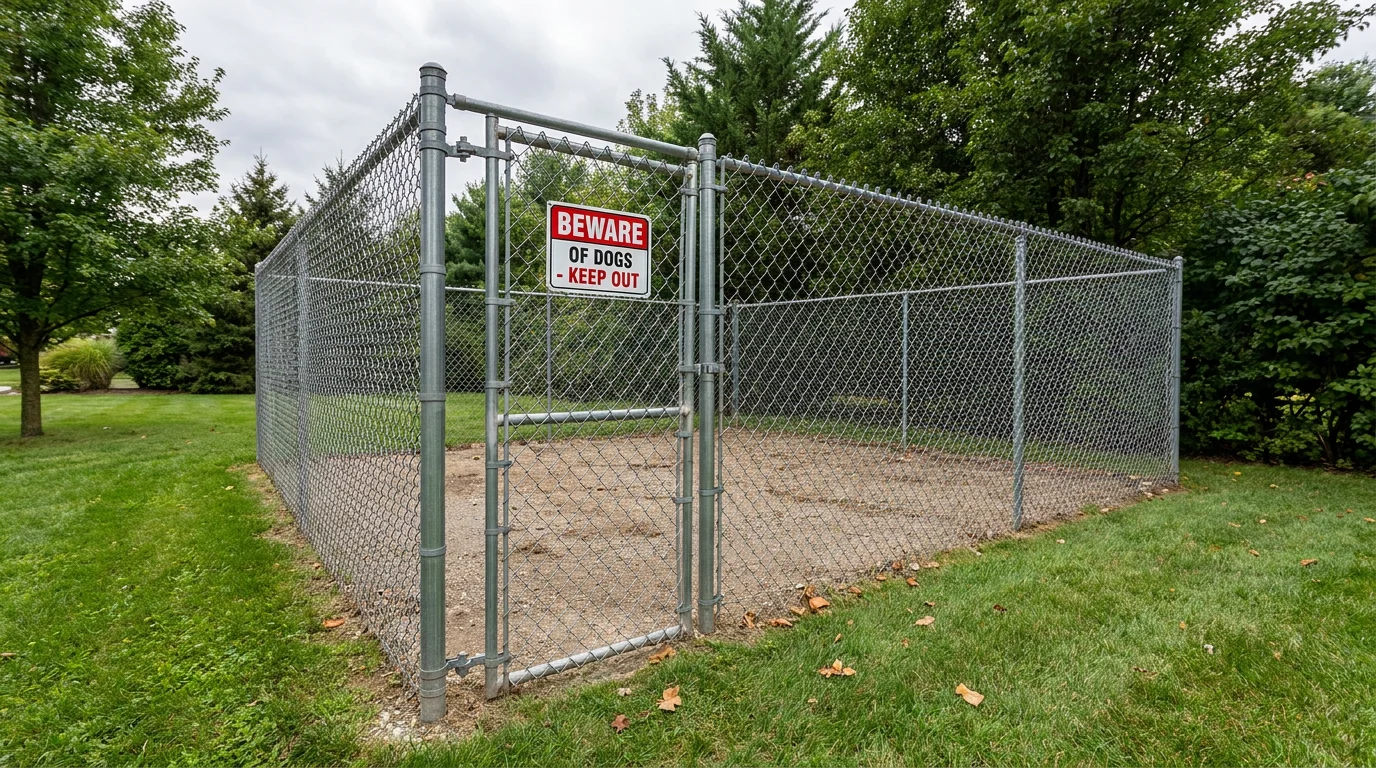
- Enclosure | Owner must use a locked pen. It needs secure sides and a secure top. If the owner does not secure a bottom to the sides, the owner must embed the sides at least 2 feet into the ground
- Warning signs | Owner must post a visible warning sign plus a separate symbol sign warning children
- Outside the enclosure | Owner must muzzle the dog and keep it on a substantial leash. A responsible person must physically restrain the dog
- Microchip and spay/neuter | A licensed veterinarian must microchip and spay or neuter the dog at the owner's expense
- Financial responsibility | Owner must carry a $50,000 surety bond or $50,000 liability insurance policy naming the Secretary of Agriculture as additional insured
- Notification | Owner must notify the Bureau and dog warden within 24 hours if the dog is loose, attacks, dies, or is transferred. The owner must also notify local police
A first instance of noncompliance constitutes a third-degree misdemeanor. A subsequent offense constitutes a second-degree misdemeanor with fines up to $5,000 and a seizure-and-destruction order. If the owner's conduct causes the dog to severely injure or kill a person, prosecutors may file a first-degree misdemeanor charge and order immediate confiscation. This applies when the owner acts intentionally. It also applies to reckless or negligent conduct. Pennsylvania also bans breed-specific legislation outright: no municipality may prohibit or limit a specific breed, and the Commonwealth Court struck down a local "vicious dog" ordinance on that basis in Lerro v. Upper Darby Township. A lease provision allowing termination if a tenant's dog receives a dangerous designation and the tenant fails to meet the statutory requirements, particularly the $50,000 insurance obligation, gives you an exit before the liability compounds.
Pennsylvania animal cruelty and neglect laws
Libre's Law (Act 10 of 2017) created three penalty tiers in 18 Pa.C.S. §§ 5532–5534, running from neglect of animal (§ 5532) through cruelty and aggravated cruelty, with severity turning on the harm caused:
- Offense | Baseline grade | If bodily injury or imminent risk of serious injury | If serious bodily injury or death
- Neglect (§ 5532): failure to provide food, water, clean shelter, or veterinary care | Summary offense, up to $750 and 90 days | Misdemeanor 3rd degree, up to $2,500 and 1 year | Felony 3rd degree under § 5534, up to $15,000 and 7 years
- Cruelty (§ 5533): intentionally, knowingly, or recklessly ill-treating, beating, abandoning, or abusing an animal | Summary offense, up to $750 and 90 days | Misdemeanor 2nd degree, up to $5,000 and 2 years | Felony 3rd degree under § 5534, up to $15,000 and 7 years
- Aggravated cruelty (§ 5534): torture, or neglect/cruelty causing serious injury or death | Felony 3rd degree in all cases, up to $15,000 and 7 years | Not applicable | Not applicable
The law requires anyone convicted of a felony-level offense to forfeit the animals to a society for the prevention of cruelty to animals.
Pennsylvania law classifies animal fighting as a serious offense under 18 Pa.C.S. Chapter 55, and a tenant who stages animal fighting on a rental property creates direct criminal exposure for themselves while also implicating the landlord through premises awareness of unlawful activity. Because animal fighting can occur without obvious outward signs, landlords drafting leases should include explicit humane-care and lawful-use clauses that prohibit any use of the premises for animal fighting or related training and conditioning. The clauses should also prohibit related paraphernalia. A well-drafted clause gives the landlord both a contractual basis for immediate termination and a documented record that the use was unauthorized.
The same law restricts cosmetic surgeries under 18 Pa.C.S. § 5542. The law prohibits ear cropping and debarking unless a licensed veterinarian performs the procedure on an anesthetized dog. Possessing a dog with an unhealed cropped ear provides prima facie evidence of a violation. The law bans tail docking on dogs over five days old, with exceptions for veterinarian-performed procedures under general anesthesia at 12 weeks or older, or between five days and 12 weeks when medically necessary. Dewclaw removal on dogs over five days old also requires a veterinarian. Courts grade violations through the cruelty statute and may additionally order a psychological evaluation at the convicted person's expense.
Exotic and wild animal ownership in Pennsylvania
If a tenant asks to keep an exotic animal, Pennsylvania law almost certainly forbids it without a permit. Under 34 Pa.C.S. § 2961, "exotic wildlife" includes all bears, coyotes, lions, tigers, leopards, jaguars, cheetahs, cougars, wolves, and any crossbreed of these animals. The statute makes the list expressly non-exhaustive and applies it regardless of whether breeders raised the animal in captivity or someone imported it. Section 2963 bars possession or acquisition of exotic wildlife without a possession permit issued by the PA Game Commission; acquisition includes purchases and other transfers. In addition, 58 Pa. Code § 137.31 bars keeping native wildlife taken from the wild.
The permit pathway is steep. An applicant needs at least two years of hands-on experience with the species from a recognized facility plus a reference letter. The applicant also needs a separate permit and $50 fee for each animal. The PA Game Commission must deem the housing adequate, and the local government must confirm in writing that the activity violates no zoning rule or ordinance. A single bear enclosure must measure 25 feet by 12 feet by 12 feet. Violations are summary offenses, each day counts separately, and the Commission can revoke the permit and order the animal's disposal. For screening purposes, a tenant claiming an exotic animal as an ESA also faces the FHA's substantial burden of proving a therapeutic need for that specific type of animal.
Who enforces Pennsylvania pet laws and how to report violations
Enforcement splits across agencies that do not share jurisdiction, so the right complaint channel depends on the problem:
- Issue | Enforcing authority | How to report
- Licensing, dogs running at large, bites, kennels, dangerous-dog registration | Bureau of Dog Law Enforcement / state dog wardens | Online complaint form or (717) 787-3062; email ra-agdoglaw@pa.gov
- Animal cruelty and neglect (18 Pa.C.S. Ch. 55) | Humane Society Police Officers and police | Local HSPO or local police; State Police where no local force exists
- Cruelty in PSPCA service counties | PSPCA Animal Law Enforcement | Hotline 866-601-7722 or the PSPCA online form
The Bureau of Dog Law Enforcement, part of the Department of Agriculture, has no jurisdiction over cruelty; wardens who suspect it refer the case to an HSPO or police officer. The Bureau issued 2,426 summary citations and 227 misdemeanor complaints statewide in 2024. A county court of common pleas appoints HSPOs with district attorney review. They complete at least 80 hours of initial training and hold authority only in the appointing county. The PSPCA has its headquarters at 350 E. Erie Avenue in Philadelphia and fields cruelty reports for Philadelphia and a set of surrounding counties including Bucks, Chester, Delaware, Montgomery, Lancaster, Lehigh, and Northampton. The Bureau accepts anonymous complaints, though it may not investigate reports without contact information.
Recent and pending Pennsylvania animal protection legislation
As of August 2026, none of the major animal bills in the 2025–2026 session has become law. Where each stands:
- Pet custody in divorce. Pennsylvania courts currently treat pets as marital property. House Bill 97, which would amend Title 23 to address pets in equitable division, passed the House 121–82 on September 29, 2025 and has sat in the Senate Judiciary Committee since October 3, 2025. HB 1432, sometimes confused with the pet custody measure, dealt with Protection from Abuse definitions, and the House tabled it in November 2025. Existing law continues to govern courts issuing protection-from-abuse orders until either measure moves.
- Cat declawing ban. HB 1716 would prohibit non-therapeutic declawing and partial digital amputation. It would also prohibit tendonectomy; the House tabled it on October 27, 2025 with no action since. SB 846, which would make non-therapeutic declawing a summary offense with fines from $50–$750 for a first offense up to $500–$1,500 for a third, has idled in Senate Judiciary since June 10, 2025.
- Beagle Bill. SB 381, restricting certain animal experimentation and sales, passed the Senate 50–0 on September 10, 2025 and remains in the House Judiciary Committee. The companion Beagle Freedom Act (HB 296) has had no votes since its January 2025 committee referral.
- Victoria's Law. HB 1816 would end pet shop-kennel licenses for selling dogs and cats after December 31, 2026. The restriction would also cover rabbits. A committee held a hearing on February 24, 2026 but took no vote. Lawmakers referred a Senate companion, SB 1190, to committee on February 27, 2026.
How pet policies affect landlord insurance
Dog liability is expensive in Pennsylvania. The Insurance Information Institute counted 1,324 dog-bite claims in the state in 2025 at an average cost of $68,786 per claim. Injured parties may bring premises-liability claims against landlords, and fair housing law forbids you from denying an ESA on breed alone.
Steadily's underwriting guidelines treat certain breeds as ineligible for liability coverage unless the policy carries an Animal Liability Exclusion endorsement: Pitbull, German Shepherd, Belgian Malinois, Rottweiler, Doberman Pinscher, Chow, Akita, Wolf, Wolf Hybrid, or any mix, along with any dog or cat with a bite history. The exclusion applies even when the dog belongs to the tenant, since premises liability can pull the landlord into a claim. A tenant's lawfully accommodated ESA can therefore belong to a breed your policy excludes, leaving a gap between what fair housing law requires you to accept and what your liability coverage will pay for. Pennsylvania's anti-breed-exclusion statute (3 P.S. § 459-507-A) applies to bonds and policies issued under the Dangerous Dog Law. Its reach into general landlord policies is unsettled, and HB 1515, which would ban breed-based underwriting for homeowners policies, remains pending.
Two coverage facts matter when you set a pet policy:
- Coverage issue | How standard forms or Steadily treat it
- Pet damage to the dwelling | Insurers treat chewing and scratching as excluded wear and tear under standard forms. They also treat urine staining as animal waste discharge. Pet rent and damage charges are your recovery tools.
- Dog-bite bodily injury | Liability coverage applies absent an animal exclusion. Steadily's liability coverage runs from $300,000 to $2 million per occurrence. It pays legal defense costs outside the limit. It also includes no-fault medical payments of $1,000–$5,000.
- Animal exclusions | The exclusion can remove liability coverage for listed breeds and mixes. It can also remove coverage for any dog or cat with a bite history, even when a tenant owns the animal.
- Rider or umbrella options | An animal liability rider can add back coverage with a typical sub-limit of $25,000–$100,000 at $100–$400 per year. An umbrella policy or specialty animal liability carrier fills the gap where no rider is available.
Steadily writes landlord insurance in Pennsylvania for rental properties, and the Landlord Hub has guides on coverage types and state-specific requirements. It also explains how to evaluate your options. When you know your pet policy and your breed exposure, get a quote in minutes. No phone call is required.
FAQ
Quick answers to the questions Pennsylvania landlords and tenants ask most about pet law.
At what age does a dog need a license in Pennsylvania?
Owners must license a dog at three months of age or upon transfer to a new owner, whichever comes first. Since Pennsylvania law allows transfers at eight weeks, the new owner may need to license a newly adopted puppy before it turns three months old.
How much does a Pennsylvania dog license cost in 2026?
An annual license runs $10.80, or $8.80 for owners 65 and older or with a disability. A lifetime license, which requires a microchip or tattoo, costs $52.80, or $36.80 with the senior or disability discount.
What happens if a tenant's dog bites someone?
The treating medical professional reports the bite within 24 hours, and health officials require a 10-day quarantine at the owner's expense. Repeated or severe unprovoked attacks can lead a Magisterial District Judge to designate the dog dangerous, triggering registration, enclosure, insurance, and muzzling requirements.
What are the penalties for animal cruelty in Pennsylvania?
Under Libre's Law, offenses range from summary violations with fines up to $750 to third-degree felonies carrying up to $15,000 in fines and seven years in prison when an animal suffers serious injury or death. The law also requires people with felony convictions to forfeit the animals.
How long can a dog legally be tethered outside?
Fewer than nine hours in any 24-hour period creates a presumption the dog was not neglected when the owner provides a proper tether. The owner must also provide the dog with adequate water and shade. In temperatures above 90°F or below 32°F, the limit drops to 30 minutes.
Which exotic animals are banned in Pennsylvania?
Owners cannot possess bears, coyotes, lions, tigers, leopards, jaguars, cheetahs, cougars, wolves, or crossbreeds of these without a Game Commission permit. The permit requires two years of species experience, adequate housing, local zoning sign-off, and a $50-per-animal fee.
Who enforces pet laws in Pennsylvania?
State dog wardens in the Bureau of Dog Law Enforcement handle licensing, strays, bites, and dangerous dogs; reach them at (717) 787-3062. County-appointed Humane Society Police Officers and police handle cruelty, and the PSPCA takes cruelty reports at 866-601-7722 in its service counties.
Who gets the pet in a Pennsylvania divorce?
Pennsylvania courts still classify pets as marital property. HB 97, which would change how courts divide them, passed the House in September 2025 but had not cleared the Senate as of August 2026.
Is any new Pennsylvania animal legislation likely to pass soon?
The Beagle Bill (SB 381) is the furthest along after a unanimous Senate vote in September 2025, but it remains in the House Judiciary Committee. The declawing bans and Victoria's Law await further votes. The pet custody bill does as well.




.jpg)




.png)