
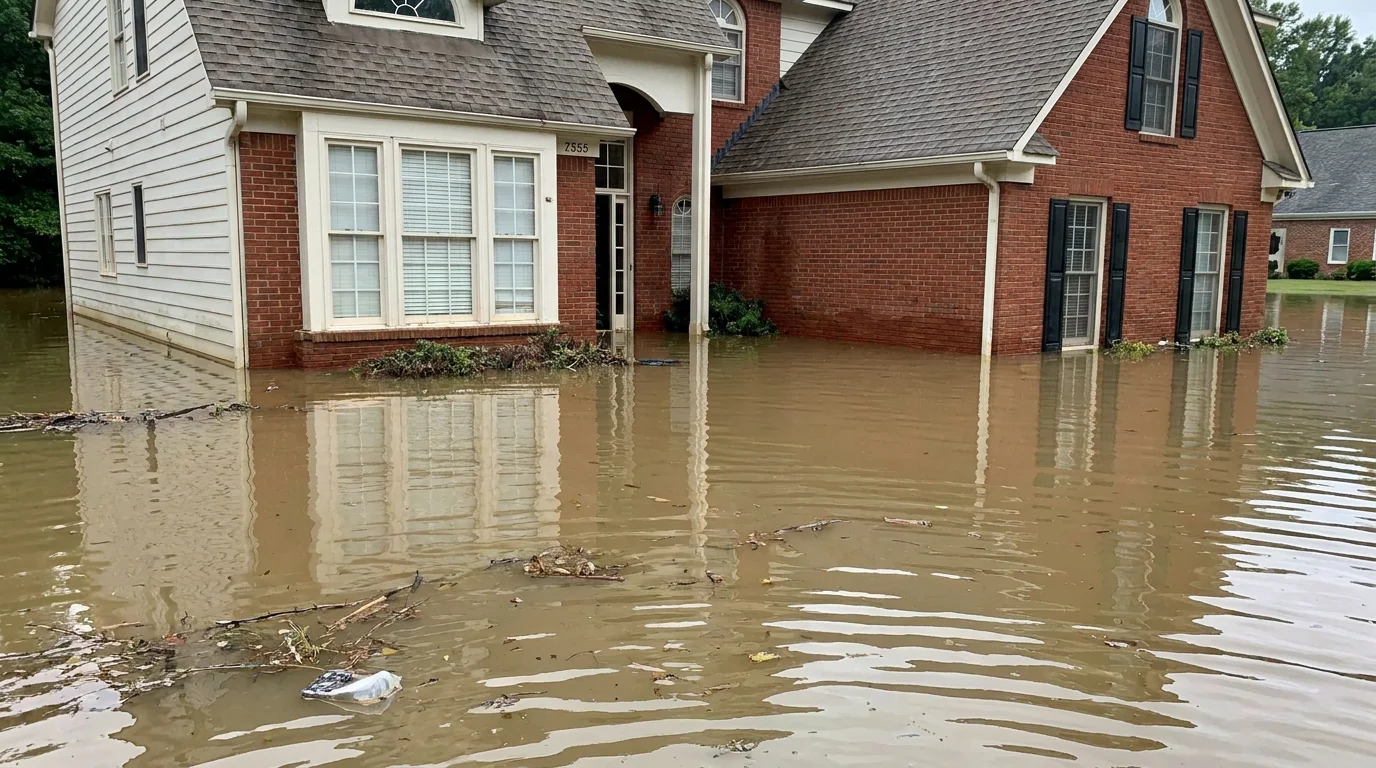
A hurricane's storm surge or a creek that jumps its banks can leave two feet of water in your rental's first floor. Standard landlord insurance will pay nothing toward the repair. Every standard dwelling policy excludes flood damage, regardless of how the water got in. Covering it requires buying flood insurance for landlords as a separate policy, either through FEMA's National Flood Insurance Program (NFIP) or a private flood carrier.
Does landlord insurance cover flood damage?
Standard landlord insurance policies, including the DP1, DP2, and DP3 forms Steadily writes, exclude flood by name. The general exclusion that appears in all three ISO dwelling forms bars payment for "flood, surface water, waves, including tidal wave and tsunami, tides, tidal water, overflow of any body of water or spray from any of these, all whether or not driven by wind, including storm surge." The exclusion applies "regardless of whether any of the above is caused by an act of nature or is otherwise caused."
The same exclusion section also knocks out water that backs up through sewers or drains and water discharged from a sump pump. It also excludes groundwater that seeps through the building's below-grade envelope. Sewer backup and sump pump discharge require a separate endorsement, commonly called water backup coverage, to be insured. Flood takes a separate policy.
What your landlord policy does cover is water that escapes from inside the property. A DP3 pays for water damage such as a burst pipe and accidental leaks from HVAC systems. It also covers rain damage following a windstorm that enters through an opening the storm created, along with perils like fire and burglary. The dividing line is where the water came from: your plumbing, covered; rising water from outside, excluded. One caveat for DP1 holders: that basic form covers fire and lightning. It also covers internal explosion, but even a burst pipe falls outside it. If a specific loss sits in the gray zone, see how insurers separate water damage from flood insurance.
How flood insurance for rental properties works
You buy flood insurance as a standalone policy that sits alongside your landlord insurance policy. You buy it from the NFIP through a licensed agent or a Write Your Own carrier, or from a private flood insurer. It comes with its own premium and deductible. It also has separate limits. Timing matters: under the October 2025 NFIP Flood Insurance Manual, a new NFIP policy carries a 30-day waiting period before coverage takes effect, so you cannot buy it the week a storm gets a name.
Building coverage vs. contents coverage
A flood policy splits into building coverage and contents coverage, and as a landlord you usually need only the building side. Building coverage insures the structure, including the foundation and structural components. It also covers built-in appliances and systems. Your flood policy does not insure the tenant's belongings; liability for those losses depends on the cause and applicable law. Tenants who want flood protection for furniture and electronics can buy a contents-only NFIP policy of their own. They should also carry renters insurance to protect their belongings from the broader range of everyday risks that flood coverage alone does not address.
Here is who insures what when a rental floods:
- What flooded | Landlord flood policy | Tenant flood policy
- Structure (foundation and structural components, plus built-in systems) | Yes, under building coverage | No
- Landlord-owned built-in appliances | Yes, under building coverage | No
- Movable landlord-owned appliances and equipment | Yes, if you add contents coverage | No
- Tenant furniture, electronics, and belongings | No | Yes, via a contents-only NFIP policy
- Lost rent while contractors repair the unit | No under NFIP; limited private options | No
NFIP flood insurance for landlords
The NFIP is FEMA's federal flood program. Independent agents and private insurers participating in the Write-Your-Own program sell NFIP policies. Under this arrangement, private carriers issue federally backed policies; FEMA does not sell them directly. Landlords in participating communities can buy them. The statute at 42 U.S.C. § 4013(b) fixes the coverage caps, so only Congress can raise them:
- Property type | Maximum building coverage | Maximum contents coverage
- Single-family and 2-4 unit rentals | $250,000 | $100,000
- Other residential buildings (5+ units) | $500,000 | $100,000
- Non-residential buildings | $500,000 | $500,000
Portfolio investors often run into the residential cap: a fourplex gets the same building limit as a single-family home, and rebuild costs in high-cost metros routinely exceed it. If you carry Florida landlord insurance on a coastal property, compare your dwelling limit to that cap before assuming the NFIP alone is enough.
If your rental sits outside the Special Flood Hazard Area (in a zone beginning with B, C, or X), ask your agent about a Preferred Risk Policy, FEMA's lower-cost NFIP option for buildings in moderate-to-low risk zones where federal law does not require flood coverage; a qualifying rental property can still obtain it even though the lender won't force your hand. Eligibility and pricing now run through Risk Rating 2.0, so the old flat-rate tables no longer apply, but the product category still exists and the premiums are meaningfully lower than standard NFIP rates for properties that qualify.
The standard waiting period has three exceptions under 44 CFR § 61.11. If you purchase coverage in connection with making, increasing, extending, or renewing a mortgage, it takes effect at loan closing with no wait. If a map revision newly places a building in a Special Flood Hazard Area (SFHA), the policy gets a 1-day wait during the first 13 months after the revision. Flooding that originates on federal land after a wildfire also gets a 1-day wait if you bought the policy on or before the fire containment date or within 60 days after it.
Private flood insurance for rental properties
Private flood insurers compete with the NFIP on coverage limits and settlement terms. Neptune raised its building coverage limit to $15 million in June 2026, per Insurance Journal, against the NFIP's residential cap. Private policies can also settle at replacement cost, per a 2023 NAIC Journal analysis, while the NFIP pays rental properties only actual cash value after deducting depreciation because a rental can never qualify as the policyholder's principal residence. Private insurers also offer shorter waiting periods: Pennsylvania Insurance Department guidance cites 10 to 14 days as typical, and a 2024 Amwins product comparison lists 7-day waits on some products.
In a December 2024 study, Federal Reserve Bank of Philadelphia researchers found that the median NFIP claim reached final payment in about 60 days, rising to a median of 99 days after major disasters. No credible independent comparison of private-carrier payment times exists. On price, the evidence is mixed: a 2024 academic study of two coastal markets found private premiums ran significantly higher than NFIP rates after controlling for other factors, and no defensible national average-to-average comparison exists.
Private flood carries structural risks the NFIP does not:
- Private insurers can decline to renew or cancel mid-term, according to the Pennsylvania Insurance Department.
- Insurers place most parametric flood products for investment properties in the surplus lines market, where policyholders get no state guaranty-fund protection.
Private flood still tends to fit best for high-value or multi-unit properties above the NFIP cap. It can also fit short-term rental operators in flood-prone metros like Houston and Miami, where one storm can take a booking calendar offline.
Parametric flood is the newest option. FloodFlash, a Lloyd's coverholder that serves all mainland US locations, installs a water-depth sensor at the property and pays a pre-agreed amount when floodwater hits a trigger height, with average claim payment a couple of weeks after the flood. Rental properties qualify if an LLC or trust owns them. A property under a personal name can also qualify when it generates rental income. Descartes Underwriting launched a sensor-based product in June 2025 with limits up to $70 million. The trade-off is basis risk: the payout tracks the sensor reading rather than your actual repair bill. Parametric coverage also does not satisfy a lender's flood insurance requirement.
When is flood insurance mandatory for landlords?
Federal law at 42 U.S.C. § 4012a requires flood insurance when the building sits in an SFHA and has a federally backed loan. An SFHA is the area with a 1% annual chance of flooding, and FEMA flood maps show it as zones beginning with A or V. The mandate covers lending institutions that the Federal Reserve, FDIC, OCC, NCUA, or Farm Credit Administration regulate. It also covers loans that lenders sell to Fannie Mae or Freddie Mac and loans guaranteed through federal housing programs. Cash buyers face no mandate.
Federal law requires coverage equal to the lesser of the outstanding loan balance or the maximum NFIP limit for the property type. Skip it and your lender must force-place coverage within 45 days of notifying you, typically on worse terms. Since July 1, 2019, federal law has required regulated lenders to accept private flood policies that meet the statutory definition, so the mandate does not lock you into the NFIP.
To check a property's zone, search the address at FEMA's Flood Map Service Center or the National Flood Hazard Layer viewer. FEMA cautions that it updates its maps continually, so a determination from closing may not match the current map.
How much does flood insurance cost for a rental property?
FEMA calculates each NFIP premium property by property under Risk Rating 2.0. FEMA fully implemented this rating methodology for all policies in April 2023. Flood zone no longer drives the price; these variables do:
- Distance to flooding sources, including the coast and rivers
- Flood frequency and type: river overflow, storm surge, coastal erosion, heavy rainfall
- First-floor height above the surrounding grade
- Foundation type, with FEMA's methodology multiplying risk by 1.30 for basements and 1.20 for crawlspaces
- Replacement cost of the building
- Deductible choice
- Paid flood claims within the past 20 years, which trigger a surcharge
Rentals pay more than owner-occupied homes by design. Leasing the property to someone else at any point during the policy term disqualifies it as a primary residence, so every rental pays the $250 annual HFIAA surcharge instead of the $25 primary-residence fee and rides the steeper 25%-per-year increase path until it reaches its full risk-based rate. The most recent national figures come from GAO's December 2022 data: a median NFIP premium of $689 and a median full-risk premium of $1,288. The Congressional Research Service put the 2022 average for the non-primary-residence category at $5,878. Authoritative sources provide no national average for 2025 to 2026. The actual-cash-value settlement noted above compounds the math, since depreciation comes off any claim check.
Two discounts can pull the number down. You no longer need an elevation certificate to buy NFIP coverage, but submitting one can lower the rate: FEMA's April 2025 discount guide shows a crawlspace foundation with a first floor 3 feet above grade earning a 22.1% discount versus one at grade, and a certificate from a licensed surveyor or engineer typically runs $300 to $900 for a standard single-family property. Community discounts stack on top through the Community Rating System, where more than 1,700 participating communities earn NFIP discounts of up to 45% inside an SFHA; your local floodplain administrator can confirm your community's class.
Does flood insurance cover lost rental income?
An NFIP policy pays nothing for lost rent. Section V of the Standard Flood Insurance Policy limits payment to direct physical loss by flood and excludes "loss of revenue or profits," loss of use of the insured property, and "any other economic loss you suffer." No NFIP endorsement adds rent coverage, so a flood that empties your unit for four months costs you every one of those rent checks.
Some private flood products fill the gap. Neptune's residential policies include up to $50,000 of loss of rental income, and its apartment program goes to $1 million over 12 months. Payments begin 14 calendar days after the flood loss. DUAL's private primary flood offers business interruption and loss of rents up to $500,000 per occurrence per building. If lost rent would sink your cash flow, price these against an NFIP quote rather than assuming the federal option is cheaper overall.
Steadily's loss of rental income coverage works differently: it pays up to 12 months of fair rental value when a covered peril, such as fire or a windstorm, makes the property uninhabitable. Flood is not a covered peril under that policy, which is why landlords in high-risk areas like Texas and Florida often pair a landlord policy with separate flood coverage that carries a rent provision.
Landlord flood disclosure laws
California and Texas both have tenant flood disclosure laws requiring landlords to inform tenants about flood risk before the lease is signed, though the two statutes work differently.
- State | Trigger | Required notice | Timing | Tenant remedy or limitation
- California | California Government Code Section 8589.45 applies when you have actual knowledge that the property sits in a special flood hazard area or an area of potential flooding. A public agency may establish actual knowledge by notifying you in writing, or your lender may require flood insurance. Carrying flood insurance yourself also establishes actual knowledge. | In type no smaller than 8-point, state the flood-zone status and point tenants to the state Office of Emergency Services MyHazards tool. Tell them your insurance does not cover their possessions. The notice must also recommend renter and flood insurance. | The statute applies to leases you enter into on or after July 1, 2018, and you must disclose the risk before both parties sign the lease. | California imposes no duty to disclose the property flood history.
- Texas | Texas Property Code Section 92.0135 applies when landlords and tenants sign or renew leases on or after January 1, 2022. The floodplain-status notice applies regardless of what you know. A separate prior-flooding notice applies only when you have actual knowledge that flooding damaged the dwelling within the five years before the lease. | For the first notice, check a box stating whether you are aware the dwelling is in a 100-year floodplain. If you check neither box, the form instructs the tenant to assume it is. The second written notice discloses qualifying flood damage during the five-year lookback. | Put both notices in the lease or a signed addendum at or before execution. | If you get it wrong and a tenant loses 50% or more of their personal property value in a flood, the tenant can terminate the lease within 30 days of the damage. You must refund all prepaid rent within 30 days of termination.
If you hold coverage in Texas, build both notices into your lease packet now. Together, they form your complete tenant flood disclosure obligation under state law.
How to get flood insurance for your rental property
Work through this sequence before storm season, not during it:
- Start with the flood zone determination that everything else depends on: search the address through FEMA's map tools, and note whether the zone begins with A or V.
- Quote both markets. Get an NFIP quote through your agent or a Write Your Own carrier, then compare private quotes on limits, replacement cost versus actual cash value, waiting period, and lost-rent coverage.
- Plan around the waiting period. Buying at loan closing skips the NFIP wait entirely; otherwise count the full waiting period forward from purchase before coverage exists.
- Reduce the risk you can control. Flood vents and barriers limit damage, and an elevation certificate documents the first-floor height that can lower your premium.
- Tell tenants in writing that your policy will not cover their belongings and point them to contents coverage. In California and Texas, fold this into the statutory disclosure forms.
Flood insurance handles rising water. Everything else your rental faces, including property and liability losses, runs through your landlord policy. Get a quote in minutes at quote.steadily.com; no phone call required.
FAQ
Quick answers to the flood questions landlords ask most.
Does landlord insurance ever cover flood damage?
All three dwelling forms, DP1, DP2, and DP3, exclude rising water, storm surge, sewer backup, and groundwater seepage. DP2 and DP3 cover water from inside the home, like a burst pipe, but any water that rose from outside requires a separate flood policy.
Should I choose NFIP or private flood insurance for my rental?
The NFIP fits properties whose rebuild cost sits under the federal caps ($250,000 for 1-4 unit rentals). Private flood offers higher limits and replacement-cost settlement. It also offers shorter waits and optional lost-rent coverage, at the cost of possible non-renewal and, for surplus lines placements, no guaranty-fund backstop.
Do I need contents coverage on a rental?
Only if you own contents worth insuring, such as appliances or the furnishings in a short-term rental. Tenant belongings are never covered by your policy; tenants can buy a contents-only NFIP policy covering up to $100,000 of their own property.
When is flood insurance mandatory?
When the property sits in a Special Flood Hazard Area and carries a federally backed mortgage. Federal law sets the required coverage at the lesser of the loan balance or the NFIP maximum for the property type. Cash buyers face no mandate, though the flood risk is unchanged.
How much does flood insurance cost for a rental property?
No reliable current national average exists. GAO's December 2022 data put the median NFIP premium at $689, and CRS reported the non-primary-residence category, which includes all rentals, averaging $5,878 that year. Your price turns on distance to water, first-floor height, foundation type, and coverage limits.
Will flood insurance replace my lost rent?
Not under the NFIP; the Standard Flood Insurance Policy excludes all economic loss. Some private carriers, including Neptune and DUAL, sell flood policies with loss-of-rent or business interruption sublimits.
What do I have to disclose to tenants about flood risk?
It depends on the state. Texas requires a floodplain-status notice in every lease plus a prior-flooding notice when you know of damage within the past five years. California requires disclosure when you have actual knowledge the property is in a flood hazard area. Check your own state's statute before your next lease renewal.
Can I buy flood insurance right before a storm?
Not through the NFIP. A new federal policy takes effect 30 days after purchase unless you are buying in connection with a loan closing, and private waiting periods commonly run 7 to 14 days. Buy during a dry month, not a wet one.



.jpg)




.png)