
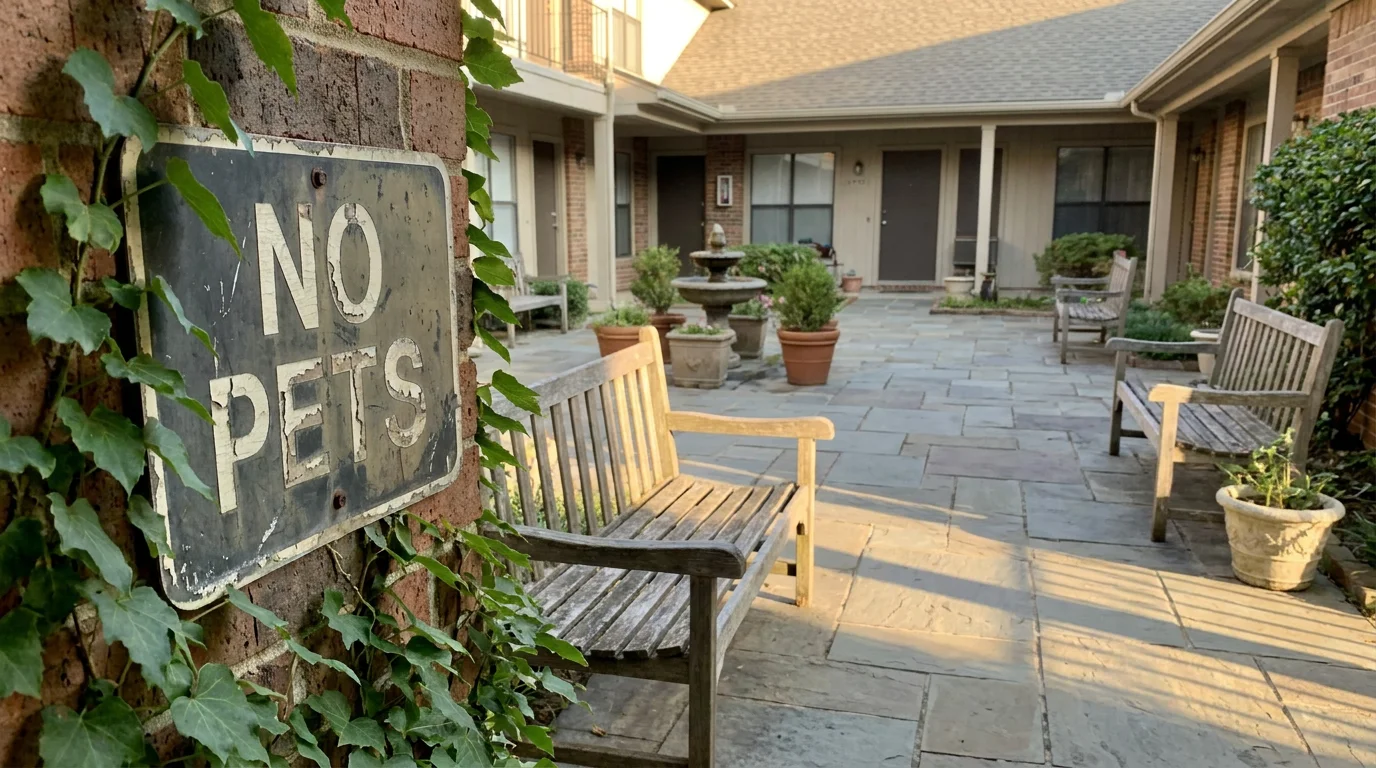
Maryland rewrote much of the legal ground under rental pet policies between October 2024 and February 2026. The statewide security deposit cap dropped to one month's rent in October 2024 and pet deposits count against it, a pet fee disclosure law took effect in October 2025, HUD withdrew its emotional support animal guidance in September 2025, and Prince George's County ended a 37-year pit bull ban in February 2026. If you still use a 2023 pet addendum, review it against the changes below.
Maryland pet laws every landlord should know
The rules affecting pets in Maryland's rentals sit in three layers. Statewide statutes control deposits and assistance animal accommodations. They also establish dangerous dog duties and rules for cruelty offenses. State statutes govern exotic species as well. County ordinances add licensing and leash rules. They also set tethering limits and, in some jurisdictions, breed permits or owner designations. Maryland appellate decisions define when a landlord can be liable for a tenant's dog bite.
Each layer touches your bottom line differently. Deposit rules limit what you can collect up front under the state's landlord-tenant laws. Assistance animal rules override your lease and connect to tenant rights enforcement by state agencies. Maryland appellate courts can turn ordinary landlord responsibilities into direct liability when a landlord knows about a dangerous tenant-owned dog and has the power to abate the risk. One example is deciding whether to renew a month-to-month tenant who keeps an aggressive dog.
What Maryland law does and does not require for pet policies
Maryland lets you ban pets outright. No statute grants tenants a right to keep an ordinary pet, and the General Assembly did not pass a 2024 bill, HB 1179, that would have barred pet bans in Low Income Housing Tax Credit properties. Service animals and assistance animals are the carve-out, and they override a no-pet clause regardless of what the lease says.
If you do allow pets, the Pet Policy Transparency Act (HB 1152 and SB 896, Chapters 490 and 489 of 2025) applies to you as of October 1, 2025. It amends Real Property § 8-210 to require landlords to disclose their pet policy on their website and rental applications. The disclosure must separately identify up-front nonrefundable pet fees and refundable pet deposits. It must also identify monthly pet fees.
Species and number limits belong in a written pet agreement. The agreement should address vaccination and county licensing compliance. It should also include removal terms for violations. One clause is off the table: requiring a cat to be declawed as a condition of tenancy would require a veterinarian to commit a statutory offense under Maryland's 2022 declawing ban, so the clause is unenforceable and could expose you to fair-housing or consumer protection claims.
Pet deposits, pet fees, and pet rent under Maryland law
House Bill 693 (Chapter 124 of 2024) cut the security deposit cap under Real Property § 8-203 to one month's rent for leases signed on or after October 1, 2024, and refundable pet deposits count against that cap. Maryland classifies advance payments according to their purpose, regardless of the label. Under § 8-203(a)(3), money collected to protect against unpaid rent or property damage is a security deposit. The same applies to money collected because of a lease breach, no matter what the lease calls it. The Department of Housing and Community Development's HB 693 FAQ states it directly: "A landlord may only require a pet deposit if the total required deposit does not exceed one month's rent."
Monthly pet rent sits outside the cap. The same DHCD FAQ confirms that "The RRSA does not prohibit monthly pet fees or pet rent," and the Maryland Association of REALTORS agrees that nothing in state law prevents a monthly pet charge. Up-front nonrefundable pet fees are the gray zone. No Maryland appellate decision holds that a labeled "non-refundable pet fee" escapes § 8-203, and under the functional test, a fee that protects against pet damage looks like a capped deposit in disguise.
Overcharging can trigger treble damages. A tenant can recover up to three times the excess amount plus attorney's fees without proving actual loss, a remedy the courts applied in Camer v. Lupinacci (1993). Charging above the cap and then also deducting for damage beyond normal wear and tear invites the kind of legal consequences that turn a $500 pet fee into a four-figure judgment.
Montgomery County adds its own limit for regulated rental units: local regulations cap pet charges at a $25 monthly fee per pet plus a pet deposit of no more than $300, which the landlord must return within 45 days after tenancy unless the pet caused damage.
Assistance animals and emotional support animals
HUD withdrew Notice FHEO-2020-01, the framework most landlords used to evaluate ESA documentation, effective September 17, 2025. A May 22, 2026 memorandum narrowed federal enforcement to animals "trained to provide disability-related assistance." Under the memo, requests for trained animals are "presumptively reasonable," while requests to waive pet policies for untrained emotional support animals "are not presumptively reasonable."
Maryland did not follow. The state's Tenant Bill of Rights (October 1, 2025) defines an assistance animal broadly to include one that "provides emotional support that reduces one or more identified effects of a person's disability," and the Maryland Commission on Civil Rights treats charging extra fees for an assistance animal as illegal. A landlord who tightens ESA screening based on the federal memo alone still faces state-level enforcement exposure.
When the disability or the need for the animal is not obvious, you may request:
- Confirmation that the tenant or a household member is a person with a disability
- An explanation of the animal's role in assisting with that specific disability and confirmation that the animal provides that assistance
You may not request training certification for an assistance animal or access to medical records or providers. For a service animal, you also may not request information about the nature or extent of the disability. HUD's service animal guidance limits you to two questions: is this a service animal required because of a disability, and what work or tasks has the animal been trained to perform?
Maryland bars additional rent or fees for statutory service dogs. State Government § 20-706 exempts statutory service dogs from no-dog lease provisions and bars landlords from charging additional rent or fees. The tenant remains liable for damage. For assistance animals generally, DHCD says you cannot charge an additional application fee or security deposit, but you can charge repair fees for actual damage to the unit or common areas. You can deny a request when the disability and need are not obvious and the tenant cannot provide the information above.
When are Maryland landlords liable for a tenant's dog?
You are liable when you knew about a dangerous dog and had the power to do something about it. In Shields v. Wagman, 350 Md. 666 (1998), a tenant's pit bull burst out of an auto-repair shop in a strip mall and mauled a visitor; the victim needed emergency surgery, skin grafting, and four months off work. Maryland's highest court held the landlords could be liable because they retained control over the common area and could have refused to re-let the space unless the tenant removed the dog. One landlord had testified he "didn't think that a pit bull should be on the premises," which was enough to put his knowledge before a jury. The court expressly limited the holding to injuries in common areas.
A month later, Matthews v. Amberwood Associates extended the rule inside the leased unit itself. Because the lease contained a no-pets clause, the landlord retained contractual control over the dog's presence, and knowledge of the dog's past viciousness made an attack inside the apartment foreseeable. Ward v. Hartley (2006) marks the boundary in the other direction: the court granted summary judgment to a landlord who had no control over the portion of the premises where the danger existed.
The General Assembly preserved that standard in Courts and Judicial Proceedings § 3-1901(b), which retains the pre-2012 common law for non-owners, including landlords, "without regard to the breed or heritage of the dog." Liability turns first on control over the area or the dog's presence. It also requires knowledge or reason to know of the danger. The landlord must have the ability to abate it. Latz v. Parr (2021) confirmed that framework and held that a person can face liability as a harborer or keeper even without formal ownership.
Landlord liability also runs the other direction. Buddy's Law (HB 438/SB 581, effective October 1, 2025) raised the damages cap for tortiously injuring or killing a pet from $10,000 to $25,000. The law gives tenants a civil lawsuit remedy and may give landlords one as well when a pet suffers tortious harm. If your negligence, a defective fence for instance, contributes to a tenant's pet being harmed by another animal, your exposure to a civil claim has more than doubled.
Maryland's dangerous dog law: definitions, owner duties, and penalties
Criminal Law § 10-619 defines a dangerous dog as one that, without provocation, has killed or inflicted severe injury on a person. The definition also covers a dog that county animal control first designated "potentially dangerous" and that then bit a person or attacked without provocation. It also covers that dog if it killed or severely injured a domestic animal off its owner's property. "Severe injury" means broken bones or disfiguring lacerations requiring multiple sutures or cosmetic surgery.
One definition matters specifically to landlords. "Owner's real property" excludes common areas of a condominium, apartment complex, or townhouse development, so a tenant's dangerous dog in a shared hallway or courtyard is legally off its owner's property and subject to the off-property rules.
Dangerous-dog owners must confine unattended dogs and muzzle them off the property. An owner may not leave a dangerous dog unattended on the property unless the owner confines it indoors or in a securely enclosed, locked pen or comparable structure. Off the property, the owner must keep it leashed and muzzled or otherwise securely restrained and muzzled. An owner who transfers the dog must notify the determining authority of the new owner's name and address. The owner must also warn the new owner of the dog's history. Violation is a misdemeanor with a fine of up to $2,500.
On the civil side, § 3-1901(a) creates a rebuttable presumption that a dog's owner knew of its vicious propensities once the dog causes injury, and § 3-1901(c) makes an owner liable for injuries caused by a dog running at large. The defenses cover trespass or commission of a crime, plus teasing and tormenting the dog. Local animal-control hearings can add muzzling and spay/neuter orders. They can also require liability insurance or fencing. Obedience training is another available requirement.
Breed-specific rules and county restrictions
Maryland has no statewide breed-specific law. The Court of Appeals' 2012 Tracey v. Solesky decision briefly imposed strict liability on landlords who knew a tenant kept a pit bull, but the General Assembly abrogated it in 2014 with an emergency measure (HB 73/SB 247) and replaced it with the breed-neutral § 3-1901.
Prince George's County ended its 37-year pit bull ban on February 2, 2026, when CB-097-2025 took effect after the County Council passed it 7-0 in November 2025. Pit bull terriers, meaning American Pit Bull Terriers, American Staffordshire Terriers, and Staffordshire Bull Terriers, are now legal with an annual $25 permit plus the standard license, proof of rabies vaccination and microchipping, spay/neuter, a county Pet Parenting Class certificate with a score of 70% or higher, and a signed Responsibility Agreement. Owners must report an escape or disappearance within 8 hours. The same deadline applies to a bite. They must report a death or ownership change within 24 hours. Address changes share that deadline. Failure to obtain a permit or violating its conditions each carries a $300 fine under the county's pit bull ordinance. If your Prince George's lease addendum still recites the old ban, it needs updating.
Baltimore County went a different direction in 2026. The Baltimore County Council passed Bill No. 29-26 on May 4, 2026, creating a Reckless Animal Owner designation under County Code § 12-3-305. The Health Officer can designate an owner who violated the county's animal article two or more times in separate incidents within 24 months and meets at least one qualifying basis, such as a dangerous-animal designation or a court finding. The designation bars the owner from owning or keeping any animal and from residing with one for four years. The county revokes all licenses and impounds the animals. The owner has 5 days to appeal in writing. A tenant carrying that designation cannot lawfully keep any pet, which gives you clear grounds to require removal or enforce a no-pet clause.
If the tenant refuses to remove the animal, that refusal to comply with a lawful lease term or county order can support eviction proceedings. Where an animal is aggressive and poses a threat to other residents or neighbors, a landlord may also explore whether the animal qualifies as a public nuisance animal. That designation can strengthen the case for removal and, in extreme situations, provide a basis for seeking a protective order to safeguard other occupants. Document every incident, complaint, and notice carefully so you and your attorney can support an eviction or removal action.
Rabies vaccination and pet licensing across Maryland counties
Statewide, owners must vaccinate dogs and cats against rabies by 4 months of age under COMAR 10.06.02.10. They must also vaccinate ferrets by that age. A first vaccination is valid for one year. Animals with documented prior vaccinations receive three-year validity, while owners must vaccinate ferrets annually. Each local jurisdiction sets its license fees, and the spread is wide.
The major counties use the following fees and requirements as of 2026 (altered means spayed or neutered):
- County | License fee (altered / unaltered) | Requirement
- Montgomery | $12 / $25 per year; $32 / $75 for 3 years | License at 4 months; vaccination must be valid for at least 60 days
- Prince George's | $10 / $25 per year | License at 4 months and within 30 days of residency
- Howard | $6 / $24 per year | License at 4 months; residents 62+ pay half
- Baltimore County | $7 / $17 per year | License at 4 months; license year runs July 1–June 30
- Anne Arundel | $2 / $15 per year (dogs) | Dogs licensed at 6 months; cat licensing eliminated July 5, 2025
- Baltimore City | $10 / $30 per year | License at 4 months; fees come from a 2012 schedule, and official pages do not confirm current amounts
An unlicensed or unvaccinated pet also complicates matters if animal control impounds it. Baltimore County conditions redemption on proof of current rabies vaccination and a county pet license; check the applicable county's rules elsewhere. Check proof of current licensing and vaccination at move-in and renewal through a lease clause that keeps compliance on the tenant.
Leash laws, animals at large, and impoundment
Maryland state law never defines "at large." A 2026 legislative fiscal note says so explicitly, and the General Assembly did not enact HB 1568, which would have required every county and municipality to adopt a dog-at-large law. The Appellate Court of Maryland has construed the phrase to mean "free, unrestrained, or not under control," and each county writes its own definition. Montgomery County's version matters for multifamily owners: HOA and condo common areas do not count as the owner's premises, so a dog loose in a shared courtyard is at large.
At the state level, Criminal Law § 10-617 bars a shelter from selling, placing, or destroying an impounded animal until 72 hours after the shelter or animal-control agency notifies the owner. If the agency cannot identify the owner, the 72-hour period begins at impoundment. Counties layer longer holds and their own fee schedules on top:
- Jurisdiction | Hold period | Redemption cost
- Montgomery | Statute says at least 3 days; the shelter's operational page lists 5 | $25/$50/$75 for first/second/third impoundment, plus $10 per day boarding for dogs
- Baltimore County | 72 hours | $39 redemption plus $16 per night
- Anne Arundel | At least 5 days | $25–$200, tiered by neuter status and frequency, plus $5 per day
- Prince George's | 5 business days if identified; 3 if not | $15 (altered, first offense) up to $100 (repeat within 12 months)
- Baltimore City | At least 72 hours | Not specified in the retrieved code
After the hold expires, unclaimed animals become county property. The county may adopt them out or transfer them. It may also euthanize them. Baltimore County requires photo ID and proof of ownership before releasing an animal. It also requires a current rabies vaccination and a current county pet license.
Animal cruelty laws and reporting obligations
Maryland's animal cruelty laws operate on a tiered scale. At the entry level, Criminal Law § 10-604 treats basic neglect as a misdemeanor, requiring anyone with custody of an animal to provide nutritious food and veterinary care. The person must also provide drink, air, space, shelter, and weather protection, on pain of up to 90 days in jail or a $1,000 fine. When neglect kills the animal or forces euthanasia, the offense rises to a year and $5,000 under § 10-604.1. Aggravated cruelty under § 10-606, meaning mutilation, torture, or cruel beating or killing, is a felony carrying up to 3 years and $5,000.
Tethering carries both criminal and civil rules. Statewide, restraints that unreasonably limit movement, use a primarily metal collar, cut off access to water or shelter, or injure the dog are a misdemeanor. Leaving a dog outside unattended more than 30 minutes without continuous suitable shelter during extreme weather (below 32°F or an active winter weather warning, or above 90°F) is a civil offense: a warning first, then fines up to $500 and $1,000. Montgomery County limits tethering to one cumulative hour per 24 and bans it from 8 p.m. to 8 a.m. Anne Arundel allows a single 15-minute unsupervised period per day. Howard prohibits it almost entirely.
Hot cars fall under Transportation § 21-1004.1. The statute prohibits leaving a cat or dog unattended in a motor vehicle in a manner that endangers its health or safety, and a violation carries a $70 fine. The statute authorizes only five categories of officials to use reasonable force to remove an animal they find unattended in a motor vehicle: law enforcement, public safety employees, animal control officers, authorized humane society officers, and fire-and-rescue personnel. They receive civil immunity for doing so. A private citizen who breaks a window to reach the animal remains liable for the damage. A property manager on site should call animal control and should not damage the vehicle.
Animal fighting draws the heaviest penalties in the article:
- Offense | Classification | Maximum penalty
- Dogfighting (§ 10-607) | Felony | 3 years, $5,000 fine
- Cockfighting (§ 10-608) | Felony | 3 years, $5,000 fine
- Attending a fight as a spectator (§ 10-605) | Misdemeanor | 1 year, $2,500 fine
- Possessing dogfighting implements (§ 10-607.1) | Misdemeanor | 90 days, $5,000 fine per implement
Abandoning a domestic animal is a misdemeanor with a fine up to $100 under § 10-612. Maryland also banned cat declawing statewide effective October 1, 2022 (SB 67, Chapter 179); the only exception is a therapeutic purpose, and veterinarians face fines up to $5,000 for a first offense and $10,000 after that. Veterinarians are the only mandated cruelty reporters under Agriculture § 2-313.1, with immunity for good-faith reports. Landlords have no statutory reporting duty.
Exotic and captive wildlife tenants cannot keep
Some animals are illegal for your tenant to possess no matter what the lease allows. Criminal Law § 10-621 prohibits importing, possessing, breeding, or selling:
- Members of the dog family other than domestic dogs and dog-domestic hybrids
- Members of the cat family other than domestic cats, including cat-domestic hybrids over 30 pounds
- Foxes, skunks, raccoons, and bears
- Caimans, alligators, and crocodiles
- Nonhuman primates, from lemurs and marmosets to chimpanzees and gorillas
- Venomous snakes in the Hydrophidae, Elapidae, Viperidae, and Crotalidae families
Native wildlife requires a state permit. Natural Resources § 10-902 requires a Department of Natural Resources permit to possess, import, breed, or sell any native Maryland wildlife; non-native species need no DNR permit. For reptiles and amphibians, COMAR 08.03.11 sets the tiers. Up to four List A individuals require no permit. More than four List A animals or more than one List B animal requires the Captive Reptile & Amphibian Permit. Breeding or selling any reptile or amphibian also triggers the permit requirement. Trading one triggers it as well. A single $10 permit covers all three activities and runs from issuance through the following December 31. DNR allows people to hold List C species, including the Bog Turtle and Timber Rattlesnake, only under scientific-collection or endangered-species permits. The Hellbender also falls on List C, and no permit allows possession of venomous snakes. Turtles under four inches require a permit to possess, and sellers may not sell or publicly distribute them.
Counties add their own lists. Prince George's County prohibits venomous reptiles, native wildlife such as raccoons and foxes, non-domestic cats, and wolf-dog hybrids without a permit. Civil penalties are $100 for a first offense, $1,000 for a second, and $2,500 after that.
Beyond species-possession rules, Maryland also regulates the retail sale of certain animals, a dimension that matters when evaluating exotic pets and the broader pet trade. COMAR 10.06.01.22 bars sellers from selling or publicly distributing turtles with a carapace length under four inches, a rule rooted in public-health concerns about salmonella exposure. Maryland does not have a statewide retail pet sale ban covering dogs and cats, so pet stores may still sell commercially bred animals. This gap connects to ongoing concerns about puppy mills. Some local jurisdictions around the country have enacted retail pet sale bans specifically to cut off the market for puppy-mill animals, and advocates have pushed for similar measures in Maryland. Landlords who want to address these issues in a lease should be aware that a tenant's "pet" may have entered the market through channels that carry their own regulatory history.
Two lease clauses do most of the work here: a requirement that any animal on the premises comply with Criminal Law § 10-621 and applicable DNR permitting, and a right to demand proof of a current DNR permit for any reptile or amphibian collection above the no-permit thresholds. A tenant keeping a prohibited species is committing an offense on your property. Write the lease to require the tenant to remove any prohibited species after notice.
How Maryland pet laws fit statewide vs county rules
State law applies statewide, and counties may add stricter local requirements. The one-month deposit cap and assistance animal protections apply throughout Maryland. Dangerous dog duties and cruelty statutes also apply statewide. Counties then add licensing fees and leash or tethering rules. Prince George's adds breed permits, while Baltimore County uses the reckless owner designation. Montgomery County imposes stricter pet fee caps in regulated units. Lease terms and local ordinances cannot conflict with controlling state law.
The practical sequence for Maryland landlords is to write the pet addendum to the strictest applicable layer, then screen to it. Build comprehensive screening around the county where the property sits. Require proof of licensing and vaccination at that county's ages and fees. Require the pit bull permit where Prince George's rules apply, and use a pet interview to check the animal against both your policy and county law. Pair that with clear lease agreements that state the fee categories the Pet Policy Transparency Act requires. Revisit the addendum every legislative session; several of the laws in this article changed between 2024 and 2026.
Insurance is the layer the statutes leave to you. A dog-bite claim may trigger landlord liability coverage, subject to the policy's terms and limits. Animal exclusions may also apply. Many policies, including Steadily's, exclude certain dog breeds, so check your policy's animal exclusions before you approve a tenant's dog. Steadily writes landlord insurance in Maryland for rental properties, with liability limits from $100K to $1M+. Get a quote in minutes at quote.steadily.com. You do not need to call.
FAQ
These answers summarize Maryland's statewide pet rules and the county exceptions landlords encounter most often.
Can Maryland landlords charge a pet deposit, pet fee, and pet rent?
A refundable pet deposit is legal but counts toward the one-month security deposit cap under Real Property § 8-203. Monthly pet rent is lawful and uncapped statewide (Montgomery County limits it to $25 per pet in regulated units). Up-front nonrefundable fees are risky: a fee that functions as protection against damage can fall within the capped deposit category, and overcharges expose you to treble damages plus attorney's fees.
Can a landlord ban pets entirely in Maryland?
Yes, for ordinary pets. Service animals and assistance animals, including ESAs under Maryland's DHCD and MCCR guidance, override a no-pet clause, and you cannot charge extra fees or deposits for them.
Is a landlord liable if a tenant's dog bites someone?
Potentially, when you controlled the area or the dog's presence and knew or had reason to know of the danger. You must also have been able to abate it. Shields v. Wagman established liability for common-area attacks, and Matthews v. Amberwood extended it inside a unit where the lease had a no-pets clause. Breed plays no role under CJP § 3-1901(b).
What makes a dog legally dangerous in Maryland?
Under Criminal Law § 10-619, a dog that kills or severely injures a person without provocation qualifies as dangerous. The definition also covers a designated "potentially dangerous" dog that goes on to bite someone or attack again. It also covers one that kills a domestic animal off its owner's property. Owners face confinement and muzzling duties and a misdemeanor fine of up to $2,500 for violations.
What are the rabies vaccination and licensing rules for rental pets?
Owners must vaccinate dogs and cats by 4 months of age statewide. They must also vaccinate ferrets by that age. Counties run licensing: annual fees range from $2 for an altered dog in Anne Arundel County to $30 for an unaltered animal in Baltimore City, and Anne Arundel stopped licensing cats in July 2025.
Which exotic animals are tenants barred from keeping?
Criminal Law § 10-621 bans non-domestic canids and felids (cat hybrids over 30 pounds), foxes, skunks, raccoons, bears, crocodilians, primates, and venomous snakes. Native wildlife needs a DNR permit, and tenants cannot keep List C species such as the Timber Rattlesnake under any pet permit.
What are the penalties for animal cruelty in Maryland?
Neglect carries up to 90 days and $1,000, while neglect causing death carries up to a year and $5,000. Aggravated cruelty, dogfighting, and cockfighting are felonies carrying up to 3 years and $5,000. Extreme-weather tethering beyond 30 minutes is a civil offense with fines that reach $1,000.
Do county rules override Maryland pet laws at the state level?
State statutes apply throughout Maryland. Counties may add stricter rules, such as Prince George's pit bull permits and Baltimore County's four-year reckless owner ban. Montgomery County also imposes pet charge caps in regulated units. Your lease has to satisfy both controlling state law and the applicable local requirements.




.jpg)




.png)