
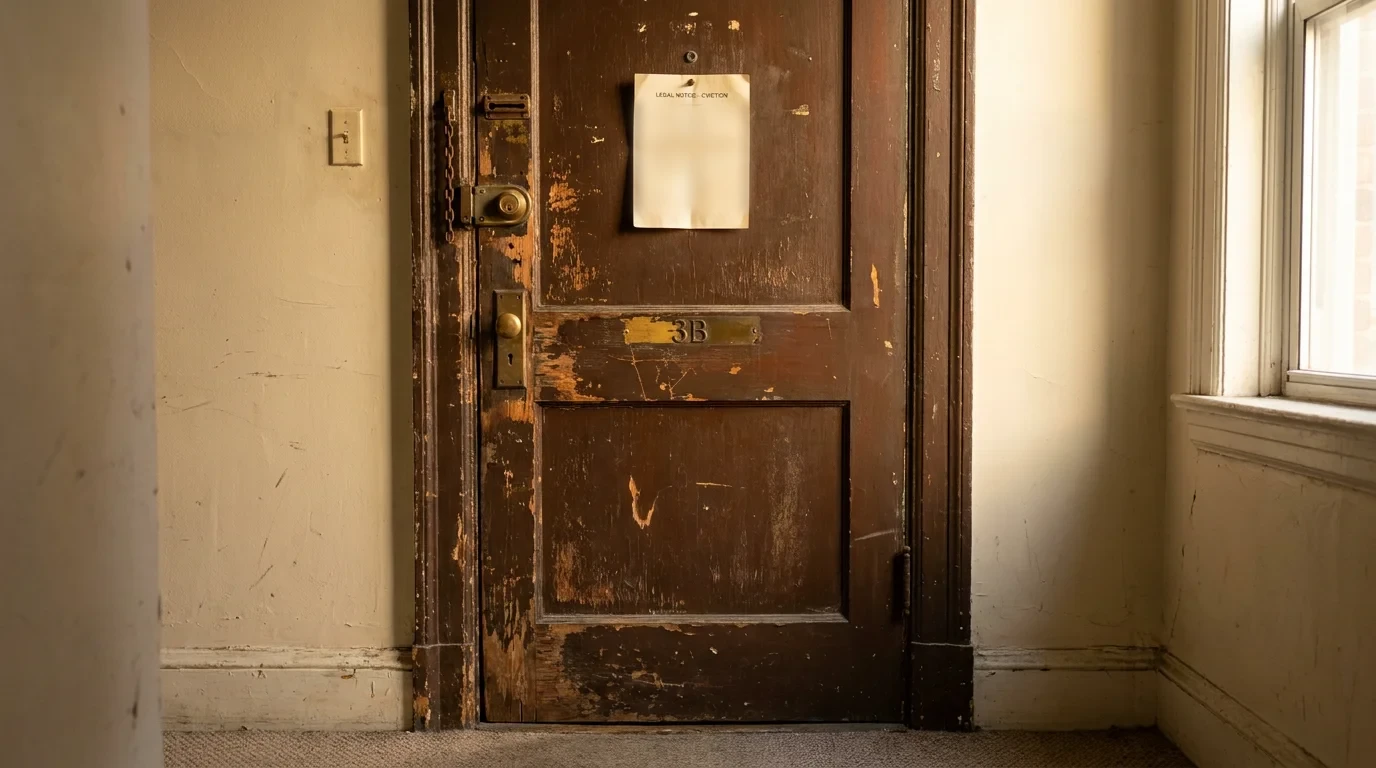
Many Maine landlord violations carry statutory damages or fee awards. A landlord who changes the locks on a nonpaying tenant owes that tenant money; a tenant who knows the deposit clock can collect double when it runs out. Whether you own two units in Bangor or rent a walk-up in Portland, the list of what a landlord cannot do Maine-wide is the same, and cities only add to it.
What a landlord cannot do in Maine: the short list
Title 14 of the Maine Revised Statutes sets nearly every limit below; the Maine Human Rights Act in Title 5 covers discrimination. A landlord in Maine cannot:
- Enter a unit without reasonable notice unless an emergency or impracticability excuses notice. Maine presumes 24 hours is reasonable, and an animal-welfare emergency also permits entry without 24 hours' notice (14 M.R.S. §6025).
- Collect a security deposit above two months' rent, or hold it past 30 days after a written lease ends or 21 days after a tenancy at will ends (§6032, §6033).
- Charge a late fee before rent is 15 days overdue, or charge more than 4% of one month's rent (§6028).
- Raise rent without 45 days' written notice, or 75 days when the increase is 10% or more (§6015).
- Change the locks without a court order. The landlord also cannot shut off utilities or seize belongings without one (§6014).
- Remove a tenant without a written notice to quit and a Forcible Entry and Detainer judgment (§6002, §6005).
- File an eviction within six months of a tenant's code complaint or written repair request without first rebutting a presumption of retaliation (§6001(3)).
- Rent a unit that is unfit to live in or, when the lease makes the landlord responsible for heat, provide a heating system that cannot hold 68°F (§6021).
- Reject an applicant because of race, sex, disability, familial status, or receipt of public assistance, or refuse an assistance animal (5 M.R.S. §4581, §4581-A, §4582-A).
- Skip required disclosures: the late-fee warning at lease signing, radon results within 30 days of testing, current bedbug status in adjacent units, and a 30-day notice before disturbing lead paint in a pre-1978 building.
Each item below expands one of these limits and names the money at stake. For the tenant-side view of the same statutes, the guide to the rights of tenants in Maine covers notice and repair rules from the renter's chair, along with deposits.
Entering your apartment without 24 hours' notice
Section 6025 requires "reasonable notice" before a landlord enters, and it treats 24 hours as reasonable "in the absence of evidence to the contrary." Entry also has to happen "at reasonable times." The only exceptions are an emergency, a situation where notice is impracticable, or an animal-welfare emergency under §6025-A, which a 2023 amendment added.
A lease cannot write this away. Subsection 4 says any tenant agreement to waive the section's protections "is against public policy and is void," so a clause granting the landlord entry "at any time" has no legal effect even if the tenant signed it.
Violations carry a price. Under the current codified text, a tenant can recover actual damages or $100, whichever is greater, for an entry without notice, a lawful entry done in an unreasonable manner, or repeated demands for entry that amount to harassment. The court can also order the landlord to stop, and if the tenant wins after a contested hearing, the landlord pays reasonable attorney's fees.
That $100 floor may rise to $250. PL 2026, c. 767 became law on April 22, 2026, without the Governor's signature and is scheduled to take effect 90 days after the Legislature adjourns. As of September 11, 2026, the statute page current through October 1, 2025, still shows $100. Landlords and tenants should verify whether the effective date has passed and whether the current floor is $100 or $250.
Can a tenant refuse entry?
A tenant can refuse an entry that arrives without notice or at an unreasonable hour, and can refuse a landlord who shows up without one of the listed purposes. A tenant cannot "unreasonably withhold consent" once proper notice is given for inspection, necessary or agreed repairs, supplying services, or showing the unit to buyers, lenders, prospective tenants, or contractors. Subsection 1 also bars the tenant from changing the lock without telling the landlord and handing over a duplicate key within 48 hours; a domestic-violence victim may change the locks at their own expense and has 72 hours to supply the key.
Locking you out, shutting off utilities or removing your belongings
Every form of self-help eviction is illegal in Maine, and the statute reaches indirect tactics too. Section 6014 bars a landlord from willfully causing "the interruption or termination of any utility service being supplied to the tenant including, but not limited to, water, heat, light, electricity, gas, telephone, sewerage, elevator or refrigeration," whether or not the landlord controls that service. The only carve-out is a temporary interruption during actual repairs or an emergency.
The same section bars a landlord from denying a tenant "access to and possession of the tenant's rented or leased premises, other than through proper judicial process," and from holding the tenant's property except through the courts. Changing a lock or chaining a door violates the access rule. Letting the oil tank run dry on purpose or hauling furniture to the curb violates the utility or property rules.
Once a court finds an illegal eviction, the remedies are not optional. The tenant "is entitled to recover actual damages or $250, whichever is greater," plus costs and a reasonable attorney's fee. Attorney's fees here are mandatory when the tenant prevails, unlike the entry statute, where they require a contested hearing. The one protection for landlords sits in §6014(3): if the tenant's suit was frivolous or brought only to harass, the court may award fees to the landlord instead.
A related statute covers a quieter failure. If the utility account is in the landlord's name and the landlord stops paying, §6024-A lets the tenant recover what the tenant paid to keep service on, or $100, whichever is greater, with attorney's fees at the court's discretion.
Overcharging or improperly keeping your security deposit
Maine caps deposits at two months' rent and bans deductions for ordinary aging of the unit. Section 6032 says a lease or tenancy-at-will agreement "may not require a security deposit equivalent to more than the rent for 2 months." Section 6031 defines normal wear and tear as "the deterioration that occurs, based upon the use for which the rental unit is intended, without negligence, carelessness, accident or abuse," and §6033 says no portion of the deposit "shall be retained for the purpose of paying for normal wear and tear." Scuffed paint and worn carpet in a five-year tenancy stay on the landlord's side of the ledger.
The return deadline depends on the tenancy type:
- Tenancy type | Return deadline under §6033
- Written rental agreement | The period stated in the lease, not to exceed 30 days
- Tenancy at will (month-to-month) | 21 days after the tenancy ends or the premises are surrendered and accepted, whichever is later
Any withholding requires a written statement itemizing each reason with a specific cost per item. Miss the deadline or skip the itemization and the landlord "shall forfeit his right to withhold any portion of the security deposit," even for damage that was real.
Wrongful withholding gets expensive under §6034. The tenant sends a written notice of intent to sue; if the landlord does not return the deposit and statement within seven days of that notice, the landlord owes double the amount wrongfully withheld, plus reasonable attorney's fees and court costs. Section 6034 also places the burden on the landlord: "the landlord has the burden of proving that the withholding of the security deposit was not wrongful," which is why move-in photos and a dated condition report matter more than the lease language.
Two more rules trip up small owners. Section 6038 requires every deposit to sit in a bank or financial institution account "beyond the claim of creditors of the landlord," including a foreclosing lender or bankruptcy trustee, and never commingled with the landlord's own funds; a violation costs actual damages or $500 or one month's rent, whichever is greatest, plus costs. And §6037 exempts owner-occupied buildings of five or fewer units from the whole deposit chapter. Tenants in those buildings can still sue to get the deposit back, but Pine Tree Legal Assistance notes they cannot collect the double-damages penalty.
Raising rent, adding late fees or charging fees the wrong way
Maine sets no ceiling on rent at the state level, but it controls timing tightly. Under §6015, rewritten in 2023, every residential rent increase requires at least 45 days' written notice. If the landlord raises rent by 10% or more, the notice period stretches to 75 days. Several smaller increases that add up to 10% within 12 months trigger the 75-day rule before the increase that crosses the line. Since January 1, 2025, the same notice rules apply to any mandatory recurring fee, such as a monthly parking or trash charge. Waivers, written or oral, are void.
The Attorney General advisory sets a separate 90-day clock for mobile home park rents.
Fixed-term leases block increases entirely. The Attorney General's tenant rights guide states that during an unexpired lease the landlord may not evict, raise rent or non-rent fees, or change the agreement one-sidedly. When the term ends and the tenant stays, the tenancy converts to month-to-month, and the landlord must follow the 45/75-day notice rules.
Late fees have not changed since 1987. Section 6028 says rent is late only after 15 days from the due date, and the penalty "may not exceed 4% of the amount due for one month." A landlord who never disclosed the possible late fee in writing when the tenant signed cannot charge it at all.
One more fee limit hides in §6030. A lease clause that waives tenant rights under the landlord-tenant or security deposit chapters is an unfair and deceptive trade practice, and a clause requiring the tenant to pay the landlord's legal fees for enforcing the lease is generally unenforceable.
Renting or keeping a unit that is unsafe: heat, pests, mold, alarms and lead
Every Maine residential lease carries an implied promise that the unit is fit for human habitation, and §6021 lets a tenant sue when a landlord breaks it. The tenant has to show that a condition endangers or materially impairs health or safety and that the tenant did not cause it. The tenant must report the condition in writing without unreasonable delay, and the landlord must then fail to repair it despite that notice. The tenant also must have been current on rent when the notice went out.
A court can order repairs, cut rent to fair value from the notice date until the fix, and excuse the tenant from paying while the unit is empty for repairs. It cannot award consequential damages, and Maine law does not let tenants withhold rent on their own.
Heat is the failure Maine defines most precisely. When the lease makes the landlord responsible for heat, the system must be able to hold 68°F when it is minus 20°F outside. Measure the temperature 3 feet from an exterior wall and 5 feet above the floor. The statute sets no calendar dates for the heating season; the standard applies whenever the outside temperature demands it, and municipalities may impose stricter seasonal rules but not looser ones.
A landlord and tenant can agree to less heat only in a separate, plain-English document in at least 12-point type. Both must sign it, and either party may revoke it on reasonable notice. The agreement must set a floor of 62°F and provide a rent reduction. That agreement is off the table if anyone over 65 or under 5 lives in the unit.
Repair-and-deduct is narrow. Under §6026, a tenant may hire a licensed professional and deduct the cost only when the repair runs less than $500 or half a month's rent, whichever is greater, and only after a certified-mail notice and 14 days of landlord inaction (faster in an emergency). Buying heating fuel when the landlord fails the §6021 heat standard counts as a cost of compliance the tenant can deduct.
The other common failures each have their own rule:
- Condition | What the landlord must do | Where it comes from
- Insects, rodents, mold, unsafe wiring, no winter heat | Treat as unfit conditions under the general warranty; PTLA lists these in its unsafe housing guide | 14 M.R.S. §6021
- Bedbugs | Inspect within 5 days of tenant notice, contact a pest control agent within 10 days of confirming infestation, disclose adjacent infested units before renting, never rent a unit known or suspected to be infested; penalty $250 or actual damages plus attorney's fees | 14 M.R.S. §6021-A
- Smoke detectors | Provide working detectors at occupancy; repair or replace after written notice | 25 M.R.S. §2464
- Carbon monoxide detectors | Install at least one in each area giving access to bedrooms in multifamily buildings; repair after written notice | 25 M.R.S. §2468
- Radon | Test by a registered tester every 10 years on tenant request (within 12 months of occupancy for post-March 2014 buildings); disclose results in writing within 30 days; at 4.0 pCi/L or above either party may end the tenancy on 30 days' notice; fine up to $250 per violation | 14 M.R.S. §6030-D
- Lead paint (pre-1978 buildings) | Post entry-door signs and send certified mail to every unit at least 30 days before non-emergency renovation; fine up to $500 per violation; relocate a family at owner expense if a child's blood lead level is elevated and hazards are found | 14 M.R.S. §6030-B
A tenant can report any item in that table to the local code enforcement office. Section 6001(3)(B) protects a good-faith complaint about a code, ordinance, or statute violation made to "a body charged with enforcement," and filing that report triggers the six-month retaliation presumption described next.
For landlords, the pest and mold rows can carry a second cost. Steadily policies list pest infestations as an exclusion and cover mold only under limited triggers, so confirm your policy's terms before assuming insurance will pay for treatment or remediation after a code complaint.
Retaliating against you for complaining or reporting code violations
Maine presumes an eviction filed within six months of a protected tenant act is retaliatory, and the landlord has to prove otherwise before a court will issue a writ of possession. Section 6001(3) states the presumption applies when, in the six months before the Forcible Entry and Detainer action, the tenant did any of the following:
- Asserted rights under the rent-increase, habitability, radon, or related statutes.
- Complained in good faith to a code enforcement body about a violation.
- Complained in writing or made a written repair request to the landlord or the landlord's agent.
- Filed a fair housing complaint with the Maine Human Rights Commission or HUD with a reasonable basis, before receiving an eviction notice.
- Told the landlord that the tenant or the tenant's minor child is a victim of domestic violence or a similar offense, before receiving an eviction notice.
- Reported sexual harassment to the landlord, law enforcement, the Commission, or a court, before receiving an eviction notice.
"A writ of possession may not issue in the absence of rebuttal of the presumption of retaliation." A landlord who sends a 30-day no-cause notice five months after a tenant's written repair request will have to show the court a non-retaliatory reason.
Two limits apply. The presumption does not attach when the eviction is for nonpayment or another §6002(1) ground or for a lease violation, unless the tenant has exercised the repair-and-deduct right under §6026. And membership in a tenants' organization gets a separate treatment under §6001(4): the tenant must prove the eviction was retaliation for that membership, with no presumption to lean on.
Discriminating against you or refusing your assistance animal
The Maine Human Rights Act bars housing discrimination based on race, color, sex, sexual orientation or gender identity, physical or mental disability, religion, ancestry, national origin, familial status, and protection-order status under 5 M.R.S. §4581. Gender identity became an explicit class in 2021 and protection-order status in 2025.
Source of income is protected too. Section 4581-A(4) makes it unlawful to refuse to rent or to impose different terms on anyone receiving federal, state, or local public assistance, "including medical assistance and housing subsidies," because of that status. Landlords may still decline to join the Housing Choice Voucher program, but once they accept a voucher, PTLA's fair housing guide explains they cannot charge a different rent or fees or set different rules for the voucher holder.
Assistance animals get their own section. 5 M.R.S. §4582-A prohibits refusing "to permit the use of an assistance animal" by a person with a disability, and it forbids conditioning that use "on the payment of a fee or security deposit." The tenant remains liable for damage the animal causes. A no-pets policy, a breed ban, and a weight limit all yield to this rule. The landlord's only defenses are that the specific animal poses a direct threat to others' health or safety, would cause substantial physical damage to others' property, or would substantially interfere with others' enjoyment of the housing.
The housing definition is broader than the public-accommodations one. Under §4553(1-H), an assistance animal is either trained to perform tasks or determined necessary by a licensed health professional, so an emotional support animal qualifies with a professional's letter and no training. PTLA spells out what a landlord may and may not ask: when the disability is not obvious, the landlord may request information about the disability-related need for the animal, but may not demand a diagnosis, medical coding, or proof of training. A certificate bought online is not a training credential. The Maine Human Rights Commission adds that Maine fines people who misrepresent an animal as an assistance or service animal or forge documents to do so.
Evicting you without going to court: the notice and FED process a landlord must follow
A Maine landlord ends a tenancy in two steps: a written notice to quit, followed by a Forcible Entry and Detainer (FED) action in District Court. A landlord cannot remove the tenant without a writ of possession, which a sheriff or constable may serve. The notice periods under §6002 depend on the reason:
- Ground | Minimum written notice
- No cause (tenancy at will) | 30 days, and the notice may not expire before the date rent is paid through
- Nonpayment of rent, 7 or more days in arrears | 7 days
- Substantial damage left unrepaired | 7 days
A 7-day nonpayment notice must state the arrears as of the notice date and include the statute's cure language word for word. That language tells the tenant that paying before the notice expires voids it.
It also explains the second cure period. Paying all arrears, current rent, and the landlord's actual filing and service fees before the writ issues reinstates the tenancy. Every notice, for any ground, must tell the tenant of the right to contest in court, and since January 1, 2024, every notice must have the Judicial Branch's CV-256 information sheet attached.
After the notice expires, the FED process proceeds in order:
- The landlord files the FED complaint (form CV-007) in the District Court for the property's location and pays a $100 filing fee plus $5 per summons.
- A sheriff serves each tenant individually. The hearing date must be at least 14 days after the tenant receives the papers, and the landlord must file with the court at least 3 business days before the hearing.
- The court offers free mediation at the courthouse on the hearing date.
If the landlord wins, the court issues the writ of possession 7 calendar days after judgment under §6005. A sheriff or constable serves it, and the tenant then has 48 hours to leave before becoming a trespasser. A tenant who wants to appeal must file before the writ issues, which in practice means within about 6 days of the judge's order.
A worked example: one month of unpaid rent
Rent of $1,400 was due on the 1st and has not arrived. The landlord's permitted path starts on the 8th, when the tenant is 7 days in arrears: serve a 7-day notice stating $1,400 owed, with the cure language, the right-to-contest sentence, and CV-256 attached. A late fee cannot be added until the 16th, and it tops out at $56 on this rent. If the tenant pays $1,400 before the notice expires, the notice is void. If not, the landlord files CV-007 around the 16th, a sheriff serves it, and the hearing lands roughly two and a half weeks later. The earliest the tenant is out is 48 hours after the writ is served, about a week past judgment, and the tenant can still stop everything by paying the arrears, any rent that has since come due, and the landlord's $100 filing fee and sheriff's service costs before the writ issues.
The prohibited path costs more than the rent. Changing the lock on the 8th, turning off the heat, texting "be gone by Friday," or boxing up the tenant's belongings each violates §6014 and carries a $250 floor plus mandatory attorney's fees. The lockout does not erase rent already owed, but the landlord still needs a court judgment and writ to recover possession. For the full statewide picture of notice, cure rights, and court forms, see the guide to Maine landlord-tenant laws.
What Portland and other cities add
State law is the floor, and several Maine cities build well above it, with Portland the most demanding. Portland's rent control sits in City Code Chapter 6, Article XII, in force since December 2020. It applies to most rental units. The PTLA Portland guide lists the exceptions: owner-occupied buildings of 2 to 4 units, subsidized units, accessory dwelling units, municipal housing, dormitories, and religious or extended-care facilities.
Each September 1 the city's Housing Safety Office publishes the Allowable Increase Percentage, set at 70% of the change in the Greater Boston CPI-U over the prior year. The Press Herald report put the 2026 figure at 2.2%, down from 2.5% in 2025 and 7.0% in 2023.
A landlord may use these additional permitted increases:
- Add 5% of base rent when a new tenant moves in after a voluntary move-out.
- Use banked increases from prior years; banked rent never expires.
- Pass through a property tax rate change.
- Petition the Rent Board for a fair-return increase.
No matter how those stack, rent cannot rise more than 10% in a year, only once a year, and never mid-lease.
Portland's notice rules run twice the state's. Any rent increase requires 90 days' signed written notice. The notice must state when the tenancy began, when and by how much rent will rise, the justification, and any remaining banked rent.
Ending a tenancy without cause requires 90 days' notice. A landlord can instead give 60 days' notice by paying the tenant one month's rent, or 30 days' notice by paying two months' rent. For-cause terminations stay at 7 days.
Landlords register every unit with the city annually, and false registration information carries a $1,000 penalty. Enforcement has teeth. In March 2026, a Superior Court judge upheld a Rent Board order requiring landlord Geoffrey Rice to refund tenants, pay $170,500 in fines, and roll rents at 59 State St. and 655 Congress St. back to December 2022 levels. A Press Herald report described the ruling.
On September 9, 2026, the City Council voted 7-2 for a resolution urging staff to verify 2020 base rents and build an online registration system. Another Press Herald report covered the vote.
Other cities add narrower layers:
- City | Local rule beyond state law | Source
- South Portland | 10% annual rent cap for owners of 16 or more units under common ownership; 90 days' written notice for increases; the ordinance took effect May 27, 2023, and is set to repeal May 27, 2030; new construction and small proprietors exempt | City Q&A
- Bangor | 60 days' written notice for any rent increase; no rental application fees; screening fees limited to hard costs such as background and credit checks (adopted February 27, 2023) | Ordinance No. 23-086
- Lewiston | Annual registration of buildings with three or more residences, due before March 1, no fee; duplexes and single-family rentals excluded | Rental Registration Program
Portland's registration and Rent Board rules govern long-term tenancies; if you run a furnished unit on Airbnb or VRBO, the rental laws in Maine for short-term rentals set a different set of permits and caps on top of these.
What to do next: complaints, damages you can recover, and who to call
Most Maine landlord-tenant disputes go to the local code enforcement office or small claims court. Discrimination claims start with the Maine Human Rights Commission, while tenants seeking legal help can call a Pine Tree Legal Assistance intake line.
Pine Tree Legal Assistance takes housing calls at 207-942-8322 on Mondays from noon to 2:30 p.m. and on Tuesdays and Thursdays from 9 to 11:30 a.m., with walk-in intake in Portland, Augusta, and Bangor on Wednesday mornings, Lewiston on Fridays, Machias on Mondays, and Presque Isle on Monday, Wednesday, and Friday mornings. A PTLA attorney runs a live virtual eviction session every Tuesday at 9 a.m.. Free representation is income-limited to households under 200% of the federal poverty level before deductions and 125% after, though the self-help guides are open to anyone.
Money claims up to $10,000 go to small claims court. 14 M.R.S. §7482 raised the limit from $6,000 effective January 1, 2026. What a tenant can recover for each prohibited act:
- Prohibited act | Statute | What the tenant can recover
- Entry without notice, or harassing entry demands | 14 M.R.S. §6025 | Actual damages or $100 (with a pending increase to $250; verify the current amount), an injunction, and attorney's fees after a contested hearing
- Lockout, utility shutoff, seizing belongings | 14 M.R.S. §6014 | Actual damages or $250, plus mandatory attorney's fees and costs
- Landlord stops paying a utility bill in the landlord's name | 14 M.R.S. §6024-A | The tenant's own utility payments or $100
- Deposit wrongfully withheld after 7-day notice | 14 M.R.S. §6034 | Double the amount withheld, plus attorney's fees and costs
- Deposit commingled or not held in a bank account | 14 M.R.S. §6038 | Actual damages or $500 or one month's rent, whichever is greatest, plus costs
- Bedbug duties ignored | 14 M.R.S. §6021-A | $250 or actual damages, plus attorney's fees
- Unfit conditions left unrepaired | 14 M.R.S. §6021 | A repair order and rent reduced to fair value from the notice date; no consequential damages
- Housing discrimination | 5 M.R.S. §4613 | Actual and punitive damages; civil penal damages up to $20,000 for a first order, $50,000 for a second, $100,000 for a third
Discrimination claims start at the Maine Human Rights Commission, 51 State House Station, Augusta, Maine 04333-0051, phone 207-624-6290. The complainant must swear to the complaint before a notary and file it within 300 days of the discriminatory act. The Commission's mediation program costs $550 split between the parties and settles about 66% of referred cases. After 180 days on file, a complainant can request a right-to-sue letter and take the case to court; under 5 M.R.S. §4622, skipping the Commission forfeits attorney's fees and civil and punitive damages.
Landlords face the same math from the other side. Landlord insurance can cover the property itself and liability claims, subject to the policy's terms and exclusions. That is why owners with units in Portland or Lewiston pair their compliance calendar with Maine landlord insurance written for rental occupancy rather than a homeowners form. Get a quote in minutes at quote.steadily.com, with no phone call required.
FAQ
These answers cover Maine's overall landlord-tenant balance, the so-called no-touch law, basic rights, and abandoned belongings.
Is Maine landlord-friendly?
On procedure, no. Maine's six-month retaliation presumption, mandatory attorney's fees for lockouts, doubled deposit damages with the burden on the landlord, and 75-day notice for large rent increases all favor tenants, and Portland layers rent control and 90-day notices on top. On substance, landlords keep more room than in many northeastern states: there is no statewide rent cap, a tenancy at will can end on 30 days' notice without cause outside Portland, tenants cannot withhold rent for repair problems, and repair-and-deduct stops at $500 or half a month's rent.
What is the no-touch law in Maine?
No Maine statute carries that name. The rules readers usually mean are the self-help eviction ban in 14 M.R.S. §6014, which bars a landlord from seizing or holding a tenant's belongings or blocking access to the unit outside "proper judicial process," and the entry rules in §6025, which keep a landlord out of an occupied unit without notice. Together they mean a landlord does not touch the tenant's door, utilities, or possessions until a sheriff or constable serves a writ.
What are the basic rights of landlords and tenants in Maine?
Tenants have the right to notice before entry, a habitable unit with working heat and detectors, return of the deposit within 21 or 30 days, written notice before any rent increase, freedom from retaliation for complaints, and a court hearing before losing possession. Landlords have the right to timely rent, to enter with notice for repairs and showings, to a duplicate key within 48 hours of a lock change, to a 7-day notice path when rent is a week late, to end a tenancy at will on 30 days' notice, and to attorney's fees when a tenant's suit is frivolous.
What happens to a tenant's belongings after an eviction, and can a landlord place a lien on them?
A landlord cannot take a lien on a tenant's personal property; the Attorney General's tenant rights guide says any agreement pledging belongings as security for rent is prohibited.
If a sheriff or constable serves the writ and the tenant leaves belongings for 48 hours, Maine law considers them abandoned under §6005. §6013 then requires this sequence:
- The landlord must store the belongings in a safe, dry, secured place and mail a written notice with an itemized list by first-class mail with proof of mailing.
- If the tenant claims the property within 7 days, the landlord must release it and may not demand payment of any kind first.
- If the tenant responds, the landlord must continue storing the property for at least 14 days from the notice.
- Only after those windows close may the landlord condition release on payment of arrears and storage costs, sell the items at fair market value and send any surplus to the Treasurer of State, or discard items with no market value.



.jpg)




.png)