
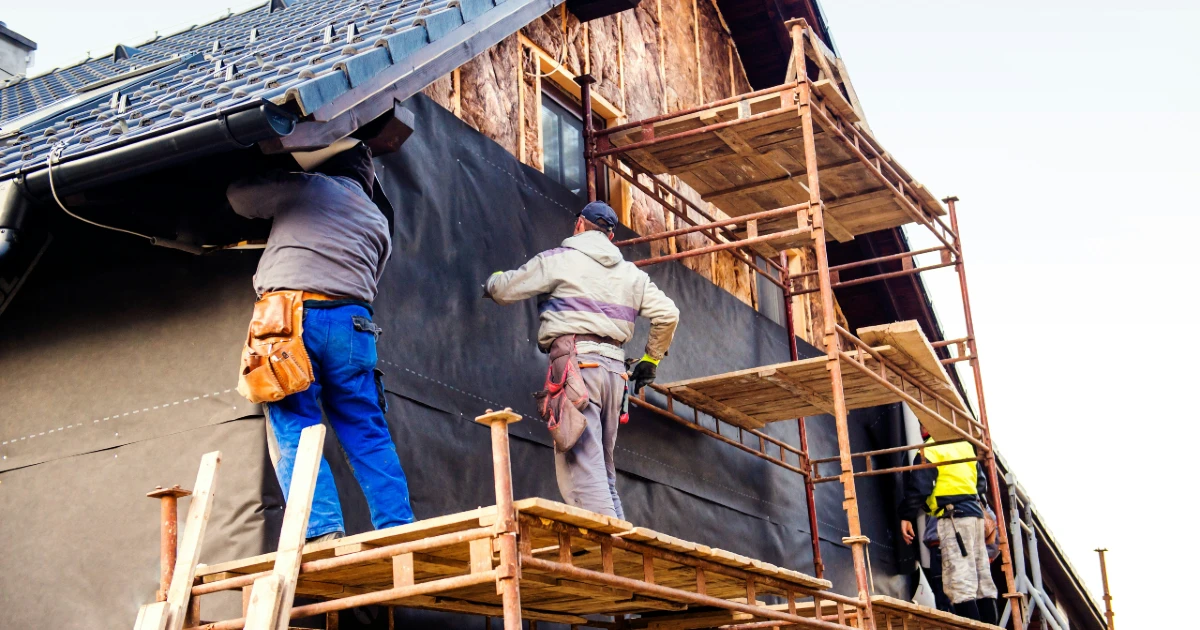
Two landlords get hit by the same April hailstorm in the same Texas suburb. Both file a roof claim the next morning. The adjuster scopes both jobs identically: $22,500 to strip and replace the asphalt shingle roof, including underlayment, drip edge, and gutters. They're in the same housing development, so they have the same roof age, same square footage, same condition.
One landlord gets a check for around $11,500 and starts asking other landlords on Facebook how to cover the rest. The other gets the full $22,500 across two checks. He pays the roofer in full, the only out-of-pocket cost coming from the deductible.
The difference is four letters on the declarations page: ACV or RCV, which means "actual cash value" or "replacement cost value." Which one your policy uses decides whether you get the cost to actually rebuild after a covered loss, or just the depreciated value of what was there before.
On a wind and hail roof claim like this one, that's $11,000 in real money. On a kitchen fire, the same difference runs $15,000 to $20,000. On a major fire that takes the property uninhabitable, the gap can exceed $100,000.
This article walks through how the two payout methods actually work, the math that produces those very different numbers, and how Steadily's DP1 and DP3 landlord insurance packages handle ACV and RCV differently. By the end, you'll know which package you have, how to check your declarations page, and whether the difference is worth the premium delta on the kind of property you own.
Actual cash value vs replacement cost: how each defines your payout
The two payout methods sit on opposite ends of how insurance settles a loss. One pays the depreciated value of what was damaged. The other pays the cost to actually replace it. Same coverage limit on the policy, very different checks at the end of the claim.
What actual cash value (ACV) means
Actual cash value is replacement cost minus depreciation. The insurer prices out the same repair the contractor would, then subtracts a number representing how much the damaged property had already aged before the loss happened. If your roof had used up half its useful life, you get something close to half the replacement cost. The rest comes out of your pocket.
From the insurer's side, ACV is the older, more traditional approach. It treats insurance as a guarantee against your current asset value, not against the cost of rebuilding to the same standard. The thinking is that you wouldn't expect to get a brand-new roof to replace one with five years of life left on it, so you shouldn't be paid as if you would.
What replacement cost value (RCV) means
Replacement cost is what it would cost today to repair or rebuild the damaged property with materials and labor of similar kind and quality. Brand-new shingles, brand-new drywall, brand-new cabinets. The insurer pays the bill the contractor sends you, up to the policy limit. Depreciation doesn't come off the structural payout.
RCV treats insurance as a guarantee that you can actually rebuild the rental to the same standard after a covered loss, regardless of how aged the original was. For most landlords, that's what they thought they were buying when they signed up.
How depreciation actually gets calculated
Depreciation isn't subjective; it's based on actual math. Adjusters calculate it from a depreciation table the carrier uses, broken down by category and material. Asphalt shingle roofs have a 20 to 25-year useful life on most tables. Wood-frame siding might be 50 years. Kitchen cabinets might be 20. HVAC systems are typically 15 to 20. The category and the age of the item drive the depreciation rate.
The formula in its simplest form: divide the age of the item by its useful life, then apply that fraction to the replacement cost. A 10-year-old roof with a 25-year useful life is 40% depreciated. Replacement cost of $20,000 means depreciation of $8,000 and an ACV payout of $12,000.
Reality is a little more nuanced than that. Adjusters can apply condition adjustments, factor in whether the item was well-maintained or neglected, and use different curves for different categories. But the basic math is age divided by useful life, multiplied by replacement cost.
The key consequence: the older the damaged property, the bigger the gap between ACV and RCV. On a brand-new roof, the two numbers are almost identical. On a 20-year-old roof, ACV might be less than half of RCV.
Scenario 1: The 12-year-old roof in a hailstorm
Single-family rental, 1,800 square feet, asphalt shingle roof installed 12 years ago. A spring storm produces hail large enough to damage every slope. The adjuster scopes the roof replacement at $18,000.
Under RCV, the insurer pays the $18,000, less your deductible. If your deductible is $2,500, you net $15,500 toward a brand-new roof. The contractor installs new shingles, you submit the invoice, the holdback is released, and the roof gets replaced with no out-of-pocket cost beyond the deductible.
Under ACV, the adjuster calculates depreciation. A 12-year-old roof with a 25-year useful life is 48% depreciated. The depreciation comes off the $18,000, leaving $9,360 in actual cash value. After the same $2,500 deductible, you net $6,860. The contractor still wants $18,000. You're $11,140 short, and that's coming out of your reserves. Plug your property details into a landlord insurance calculator for a property-specific number.
This is the cleanest example of why storm and hail coverage looks very different depending on which payout method you have. The damage itself is the same. The difference is whether your insurance was sold to you as a true rebuild guarantee or as a depreciated-value guarantee.
Scenario 2: A kitchen fire on a 15-year-old kitchen
Tenant leaves a pan unattended. Grease fire, flames damage the cabinets, range hood, and ceiling, plus heavy smoke through two rooms. The adjuster scopes the loss at $42,000 covering cabinet replacement, appliance replacement, drywall, flooring, paint, and smoke remediation.
Under RCV, you get $42,000 less deductible. Cabinets get replaced with new boxes and doors of similar quality. The kitchen comes back the way it was before the fire.
Under ACV, depreciation applies category by category. The 15-year-old cabinets depreciate at about 60% under most tables. The 8-year-old range and dishwasher depreciate maybe 40%. The 5-year-old flooring depreciates maybe 20%. Mixed together, the depreciation on the total scope comes to roughly 35 to 45%, putting ACV at about $24,000 to $27,000. After deductible, you net somewhere around $21,500 to $24,500 on a $42,000 repair bill.
The shortfall is real money. On a fire claim like this, the typical gap between ACV and RCV runs $15,000 to $18,000, all of which comes out of your operating reserves or your refinance plans for the property. Landlord fire coverage typically includes the smoke and soot remediation portion of the loss, which is what pushes a kitchen fire scope from $20,000 toward the $40,000 range. The depreciation math under ACV hits all of that uniformly.
Scenario 3: A total loss on an older home
1925-built duplex, 2,400 square feet, hit by an electrical fire that started in the wiring and burned the structure to the ground before the fire department could control it. Steadily underwrote it for $400,000 replacement cost. The local builder confirms $400,000 is roughly what it would cost to rebuild today.
Under RCV, you receive the $400,000 (less deductible), use it to rebuild, and the rental is back in your portfolio in 9 to 12 months.
Under ACV, the depreciation table is now applied to a structure that's 100 years old. The land value isn't depreciated, but the structure itself is. Depending on the carrier's depreciation curve and any condition adjustments, ACV on a structure that age can land anywhere from 35% to 60% of replacement cost. Best case, you get around $240,000. Worst case, you get $140,000 on a $400,000 rebuild. The rest is your problem.
This is the scenario that ends landlord investing careers when it happens on the wrong kind of policy. The land value gives you something to recover, but the lost income, the rebuild gap, and the year of carrying costs without rental income compound in a way that's very hard to dig out of.
Steadily's DP1 and DP3 packages, and how each handles ACV and RCV
Steadily writes landlord insurance on two policy forms: DP1 and DP3. The two packages differ on two dimensions that decide what protection you actually own: which perils each one covers by default, and how the carrier settles a loss when a claim is paid.
The Steadily DP1 package
DP1 is the narrower, more affordable option. It covers nine specifically listed perils on the structure: fire and lightning, explosion, windstorm and hail, riot and civil commotion, smoke, aircraft, vehicles, vandalism, and volcanic eruption. Anything not on that list isn't covered by default. The biggest gaps for landlords are water damage from a burst pipe, theft, and most accidental damage that doesn't fit one of the nine perils.
If a frozen pipe ruptures and floods two rooms on a Steadily DP1 policy without a water endorsement, the claim doesn't pay. Same for a tenant breaking into the rental and stealing the appliances you provided. These losses can be brought into coverage through specific endorsements on a DP1 policy, but they aren't there by default.
On top of the narrower peril list, DP1 settles losses on an actual cash value basis. Older roof, older HVAC, older finishes: depreciation comes off the top of every payout. The combination of named-peril coverage and ACV settlement makes DP1 the cheaper monthly premium but the policy that pays out the least when a claim does come in.
The Steadily DP3 package
DP3 is the broader option and is the form Steadily writes by default for most non-owner-occupied rentals. DP3 covers anything that isn't specifically excluded, which means burst pipes, theft, vandalism, falling objects, and most accidental damage are all in by default. The list of named perils that DP1 limits coverage to is replaced with a much shorter list of named exclusions.
What the Steadily DP3 package still excludes: tenant-owned belongings (those go on the tenant's renters insurance, not yours), earth movement (earthquake, landslide, sinkhole), flooding from outside the structure (requires separate flood insurance), mold beyond a small sublimit unless tied to a covered water loss, ordinance and law without the endorsement, gradual damage and neglect and wear and tear, and intentional acts by the insured. Everything outside that list of exclusions is covered.
The settlement side is where DP3 changes the math. DP3 pays replacement cost value on the dwelling structure itself, with the depreciation portion released as recoverable depreciation after the repair is complete. For most landlords filing most claims, the structural payout under DP3 is what gives the coverage the financial weight that landlords expect insurance to have.
The DP1 versus DP3 distinction goes beyond just ACV versus RCV. The two forms also differ on which perils they cover by default, which means a claim under DP1 sometimes gets denied entirely on coverage grounds before depreciation math even enters the picture. The complete landlord insurance claims process is the broader framework that ACV and RCV mechanics fit into, with the filing step, the adjuster, and the scoping all happening before the depreciation calculation arrives at the final payout.
Steadily offers DP1 and DP3 in all 50 states. Get a free quote in minutes:
The few items still settled on ACV under DP3
RCV on the dwelling structure isn't the same as RCV on everything. Most DP3 policies, including Steadily's, still settle a few specific categories on actual cash value:
- Older roofs. Many carriers move roofs over a certain age (often 15 or 20 years) to ACV settlement, even on DP3 policies. The dwelling itself is still RCV, but the roof line item is depreciated.
- Outdoor property. Fencing, landscaping, awnings, and similar items often settle on ACV because the depreciation curves are short and easy to apply.
- Some interior finishes on a per-carrier basis, particularly when condition or age is unusual.
- Personal property you own at the rental (appliances you provide, furniture you provide). This depends on whether you added Personal Property Replacement Cost as an endorsement. Without it, your appliances and furniture are settled on ACV.
For most claims on most rental properties, the structural payout is RCV and the line-item exceptions account for a small portion of the total. But on a roof-only claim where the roof is the loss, the ACV exception is the entire payout.
Recoverable depreciation and how the holdback actually works
One thing that confuses landlords filing their first RCV claim: the first check doesn't cover the full replacement cost. Most RCV policies pay the actual cash value upfront, then release the depreciation portion (called "recoverable depreciation") after you actually complete the repair and submit invoices.
So on a $20,000 RCV roof claim with 40% depreciation: the first check is $12,000 (ACV portion, minus deductible). You hire the roofer, they install the new roof, you send the final invoice and certificate of completion to your insurer, and the carrier releases the remaining $8,000 in recoverable depreciation. Total payout: the full $20,000 (minus the deductible), but in two checks separated by however long the repair took.
The mechanic exists to keep landlords honest. If the insurer paid full RCV upfront and the landlord then took the cash and didn't actually repair the property, the structure would be left in degraded condition and the carrier would have effectively paid for a brand-new roof on an asset that's still aging. The two-check model means the higher payout is contingent on the actual rebuild happening.
Recoverable depreciation has a time limit. Most policies give you 180 days to a year to complete the repair and submit the invoice. Miss the window and the depreciation portion stays with the carrier. If the repair is going to take longer than the holdback window, ask the carrier in writing for an extension before the window expires.
Why this matters more for some landlords than others
The size of the ACV vs RCV gap is driven by the age of the property and its systems. A landlord with a 2-year-old build-to-rent property and a recent renovation has very little to lose from ACV settlement; depreciation off recent finishes is small. A landlord with a 30-year-old portfolio of single-family rentals or a multifamily building with original systems is exposed to potentially six-figure gaps on a major claim.
The premium difference between DP1 (ACV) and DP3 (RCV) varies by carrier and state, but typically runs 10% to 25% higher for the DP3 form. On a $1,500 annual landlord policy, that might be $150 to $375 more per year. On a single bad claim on an older property, the payout difference is in the tens of thousands. The math favors DP3 for any rental that isn't brand-new construction with new systems throughout.
This same logic applies across property types. Single-family rentals, condos, and ADUs all benefit from RCV settlement on the structure, especially when there's any age on the property. Vacant restoration properties are a special case because the condition during restoration affects underwriting and settlement, but the same ACV vs RCV principles apply.
How to know if you have ACV or RCV
Two places to check.
First, your declarations page. It's the cover sheet of the policy that summarizes coverages, limits, deductibles, and form name. Look for "Dwelling Property 3," "DP-3," or "Special Form" (those are DP3 and you have RCV on the structure by default). "Dwelling Property 1," "DP-1," or "Basic Form" mean DP1 and ACV on the structure.
Second, the dwelling coverage line on the dec page often lists the settlement basis. "Replacement Cost" or "RC" is RCV. "Actual Cash Value" or "ACV" is ACV. If you see "Actual Cash Value" specifically called out as the dwelling settlement basis, you're paying for less coverage than most landlords think they're buying.
If anything is ambiguous, call your carrier and ask. The question is exactly one sentence: "Is my dwelling coverage settled on replacement cost or actual cash value?" The answer should be a one-word reply. If they hedge or won't answer plainly, that's information too.
The honest take
For most rental properties, replacement cost coverage on a DP3 form is the right answer. The premium uplift over DP1/ACV is real but small relative to the payout difference on a meaningful claim. The cost of getting this wrong shows up at the worst possible moment: after a fire, after a major hail event, after the kind of loss insurance is supposed to handle.
If your rentals are brand-new builds with new systems and no real depreciation exposure, ACV settlement is defensible because the payout math is similar. If your rentals are anything else, including the typical 20-year-old single-family rental that makes up the bulk of investor portfolios, DP3 with RCV settlement is the version that actually does what landlords expect insurance to do.
Landlord insurance claim timelines vary dramatically by peril type, with wind and hail wrapping in weeks while fires can run six months or more, and the depreciation holdback adds its own waiting period to RCV claims even after the structural rebuild is done. Appealing a denied landlord insurance claim follows its own process with carrier-set deadlines and state insurance commissioner escalation paths if the internal answer doesn't change. Burst pipe water damage coverage is where the ACV vs RCV difference shows up most often in practice, since burst pipe claims combine structural damage with interior finish replacement in a way that makes the depreciation math very visible across multiple line items.



.jpg)




.png)