
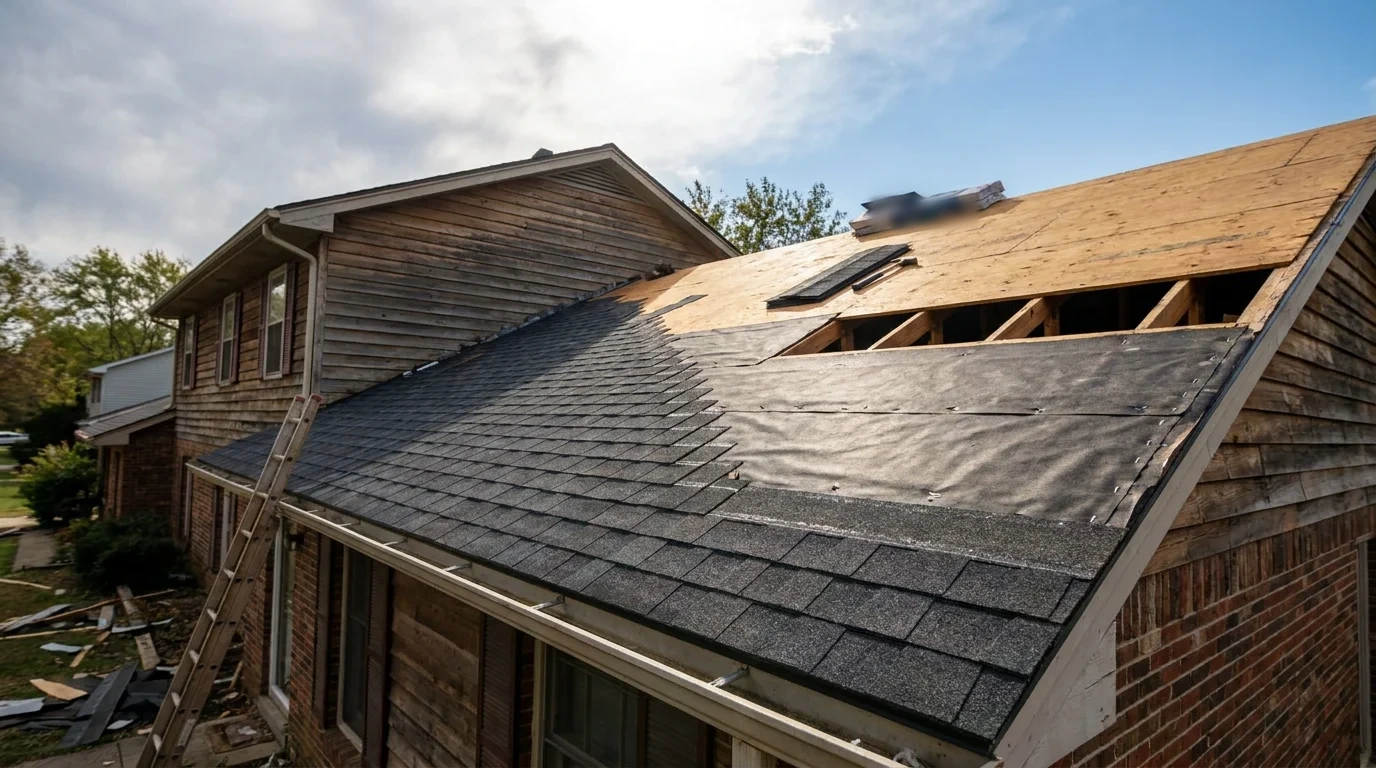
Six hours of wind-driven rain came through the roof of your Bradenton duplex after the shingles let go, and your tenant is calling from a motel in Orlando asking who pays for what. Your landlord policy answers most of that. A DP3 pays for wind damage to the structure and replaces the rent you lose while the units sit empty, but the check arrives minus a hurricane deductible calculated as a percentage of your dwelling limit rather than the flat all-other-perils deductible you pay on a burst pipe.
Flood and storm surge fall outside every dwelling form and need a separate NFIP or private flood policy. Your tenant's ruined couch and motel bill fall to the tenant's renters policy.
How hurricane coverage on a rental property works
Landlord hurricane insurance is three policies working together, and no single one of them covers the whole event. Your dwelling policy carries the structure under Coverage A and the lost rent under Coverage D. The tenant's HO4 renters policy carries the tenant's belongings and temporary housing. A separate flood policy carries water that rises from the ground.
Wind is the peril your landlord policy handles. Florida's Department of Financial Services defines hurricane coverage as "coverage for loss or damage caused by windstorm during a hurricane" and notes it "does not include coverage for flooding." Wind and flood generally remain separate, subject to state law and individual policy terms. Depending on the state and carrier, a hurricane or named-storm percentage deductible may replace your all-other-perils deductible when the policy's trigger applies. The National Association of Insurance Commissioners (NAIC) reports that nineteen states and the District of Columbia allow that structure.
The tenant's side is separate by design. Nothing in your dwelling policy responds to a tenant's furniture, and nothing in the tenant's renters policy responds to your roof.
Landlord insurance vs. renters insurance vs. homeowners insurance: who pays for what
The owner insures the building and the income it produces; the tenant insures what they brought into it. A homeowners policy left in place on a rental covers neither reliably once someone other than you lives there.
The split after a hurricane looks like this:
- Loss | Landlord policy (DP3) | Tenant's renters policy (HO4) | Homeowners policy still on the rental
- Roof, siding, windows, drywall | Pays, minus hurricane deductible | Does not respond | Exclusion for non-owner occupancy typically applies
- Tenant's furniture and electronics | Excluded | Pays, minus tenant's deductible | Excluded
- Tenant's motel bill | Excluded | Pays as additional living expense | Excluded
- Rent you lose during repairs | Pays as fair rental value under Coverage D | Does not respond | Not designed for rental occupancy
- Flood or storm surge to the building | Excluded on all DP forms | Excluded | Excluded
- Flood damage to tenant belongings | Excluded | Excluded; tenant needs a contents-only NFIP policy | Excluded
The homeowners problem is occupancy. The NAIC's consumer guidance on home sharing states that "most homeowners or dwelling insurance policies are not designed to cover" rental activity and warns that if a home is listed with any frequency, "there is a good chance the activity will be defined in the policy as a home-based business." The insurer priced the risk for an owner living in the house, and you might not find out until claim time that the insurer may deny roof coverage.
Wind and named storm damage: what the dwelling policy covers
A DP3 covers hurricane wind by default because it insures the dwelling on an open-peril basis; anything not excluded is covered. DP1 and DP2 work the other way. Both are named-peril forms, and windstorm and hail appear on neither form's default list. The ISO forms review explains that you have to buy the Extended Coverage endorsement and see it printed on your declarations page. A DP1 without that endorsement pays nothing when the roof comes off.
Settlement basis matters as much as the peril list. DP1 pays actual cash value on the dwelling unless you add replacement cost. DP2 and DP3 pay replacement cost as long as you insure the building to at least 80% of its rebuild value. On a 15-year-old roof, the gap between depreciated value and replacement cost can run into five figures.
Coastal policies come with a second layer of exceptions. In Texas, a private carrier's policy on a first-tier coastal property may exclude wind and hail entirely, and the Texas Windstorm Insurance Association sells that coverage as a separate policy. North Carolina's Beach and Coastal areas work the same way through the NCIUA, with its own windstorm deductible. Some carriers sell extended replacement cost endorsements that push the dwelling limit to 120% to 150% after a loss, which matters when every roofer in the county raises prices in the month after landfall.
The hurricane disputes analysis explains that rain entering through an opening the wind created is wind damage and is covered. Water that rises from the street is not, and the next section explains why.
Steadily offers DP1, DP2, and DP3 forms across all 50 states. Covered perils depend on the selected form, endorsements, carrier, and declarations page. Steadily prices hurricane exposure at the parcel level using Moody's RMS hurricane analytics rather than a county-wide rate.
Flood and storm surge: why you need a separate NFIP or private flood policy
All three DP forms exclude flood through the general water-damage exclusion, and storm surge is flood. The exclusion covers surface water and waves. It also covers tidal water and overflow of any body of water, and it applies whether the water arrived by hurricane or by a failed levee. The PropertyCasualty360 exclusions review lists flood and sewer backup among the losses a DP3 will not touch. It also identifies earth movement and off-premises power failure.
The NFIP policy a landlord buys is the Dwelling Form, and it treats a rental differently from a primary residence. Building coverage tops out at $250,000 for a one- to four-family building. The NFIP settles losses at actual cash value because replacement cost settlement applies only when the dwelling is your principal residence. You pay a $250 annual HFIAA surcharge instead of the $25 an owner-occupant pays, and your premium can rise up to 25% a year toward full-risk pricing instead of 18%. The Congressional Research Service documents those rate caps. The NFIP also excludes loss of use and loss of revenue outright, so an NFIP policy pays nothing toward the rent you lose during flood repairs.
Your tenant cannot ride on your policy. The NFIP Flood Insurance Manual states that "coverage for contents owned by the tenant must be written on a separate policy in the name of the tenant only," with a $100,000 contents ceiling. FEMA's FloodSmart program says renter contents coverage can start at $100 a year.
Private flood fills several of those holes at a price that varies by carrier and zone:
- Feature | NFIP Dwelling Form | Private flood (varies by carrier)
- Building limit | $250,000 | Higher; one product goes to $7 million
- Contents settlement | Actual cash value | Replacement cost available
- Loss of rental income | Excluded | May be included
- Waiting period | 30 days | 5 to 14 days
- Basement contents | A/C, washers, dryers, freezers only | Broader coverage may be available
- Mid-term cancellation | Specified reasons only | Freely cancellable under the ISO personal flood form
The 30-day NFIP waiting period comes from 44 CFR 61.11, and it has two exceptions that matter to investors. When you buy flood coverage in connection with a loan closing, the coverage takes effect at closing with no wait. And when a revised flood map newly places your property in a Special Flood Hazard Area, you get a one-day waiting period for 13 months after the map takes effect.
The high-risk trigger is that FEMA zone designation. A federally regulated lender on a property in a Special Flood Hazard Area requires flood coverage, and since the 2019 interagency rule that lender must accept a private policy that meets the statutory definition of private flood insurance. Florida Citizens goes further: since April 2023, Citizens has required landlords with wind policies on properties in a Special Flood Hazard Area to maintain flood policies whose Coverage A meets or exceeds the Citizens dwelling limit. The Citizens flood notice explains the requirement.
Your hurricane deductible, calculated on a real property
A percentage hurricane deductible is a share of your dwelling limit, so the out-of-pocket number scales with the house rather than the claim. Triple-I puts the typical range at 1% to 5% of insured value, with some filings reaching 15%. Florida law under Fla. Stat. § 627.701 requires insurers to offer $500, 2%, 5% and 10% options, though insurers do not have to offer the $500 option when the dwelling limit is at least $250,000. Section 627.4025 confirms the requirement covers dwelling fire policies, so a DP3 on a rental gets the same percentage options as an owner's HO3.
Run it on a $350,000 dwelling limit with a $60,000 wind claim. That claim size is realistic: a 2023 study of Hurricane Michael losses in Bay County found mean losses of 13% of coverage for hip roofs and 22% for other roof shapes, which on this house brackets $45,500 to $77,000.
- Deductible | Your share | Insurer pays on $60,000 loss
- $1,000 all-other-perils (does not apply to hurricane) | $1,000 | $59,000
- 2% hurricane | $7,000 | $53,000
- 5% hurricane | $17,500 | $42,500
- 10% hurricane | $35,000 | $25,000
The 5% option costs you $16,500 more than the flat deductible on the same roof. At 10%, the storm takes more than half the claim.
Three mechanics soften or sharpen that number depending on the state. Florida applies the hurricane deductible on a calendar-year basis, so a second hurricane in the same season under the same insurer draws against whatever remains of the first deductible. Florida also bars stacking: when the hurricane deductible applies, no other deductible on the policy does.
The trigger window is narrow. The Florida deductible runs from the moment the National Hurricane Center issues a hurricane warning for any part of the state until 72 hours after the last watch or warning ends. Damage outside that window falls under your ordinary deductible.
Other states draw the line differently. New Jersey's hurricane deductible only applies if the National Weather Service measures sustained winds of 74 mph or more inside New Jersey; Hurricane Irene did not qualify. New York requires the storm to make landfall in New York State. North Carolina's dwelling program allows deductibles up to 10% in coastal territories and triggers on a named-storm advisory, watch or warning for any part of the state. Louisiana's statute on percentage deductibles covers owner-occupied homeowners policies only, so on a Louisiana rental the deductible is whatever your carrier filed and you should read the declarations page rather than assume the 2% to 5% homeowners range applies.
Loss of rental income coverage while the property is unrentable
Fair rental value is your paycheck during repairs, and on an ISO DP3 it is Coverage D. The form pays for "the shortest time required to repair or replace" the rented portion of the property, and the 2014 ISO edition sets the combined Coverage D and E limit at 20% of Coverage A as additional insurance, meaning it does not erode your dwelling limit. On a $350,000 dwelling limit, that is $70,000. The DP1 version also allows 20% but subtracts every dollar paid from the Coverage A limit, as the ISO dwelling summary explains. Older editions and residual-market plans such as the Connecticut FAIR Plan cap it at 10%.
Carriers layer time caps on top of the percentage. Steadily pays up to 12 months of fair rental value. One Oklahoma-filed form caps payment at 12 months; one California policy cited in litigation allowed 24. The cap that matters is the one on your declarations page. The BiggerPockets rebuild analysis estimates that a total-loss rebuild after a Category 4 landfall can run 18 to 24 months, so a 12-month cap can run out before your permits do.
Two more clauses catch landlords. Some wind policies impose a time deductible before rent payments start; the TWIA business income endorsement waits 168 hours, and the standard ISO business income form waits 72. And the DP3 states plainly: "We do not cover loss or expense due to cancellation of a lease or agreement." Coverage D pays when a covered peril makes the unit unrentable. A tenant who breaks the lease and leaves after the storm without physical damage to their unit is not a covered loss.
What hurricane insurance costs on a rental, and how to lower it
No regulator publishes a statewide all-market average landlord premium, so every Florida figure you see is either one carrier's book or a homeowners proxy. The Florida Office of Insurance Regulation reports homeowners averages by county, and the July 2026 stability report shows the risk tiers clearly. Alachua County inland averages $2,525. Broward on the coast averages $6,136, while Monroe County in the Keys averages $7,863.
North Carolina's 2025 data call found full-coverage homeowners averaging $7,157 per house-year in the Outer Banks Beach Area against $3,269 in the broader Coastal Area.
Landlord policies typically price 15% to 25% above comparable homeowners coverage.
Against that backdrop, Steadily's national average is roughly $1,478 a year. Citizens' own DP3 book averaged $2,215.64 before its 2025 filing, but Citizens skews toward properties private carriers declined. A 2026 Brookings working paper found pre-code homes in Palm Beach, Broward, Miami-Dade and the Keys can exceed $15,000 a year, "almost all of which is the hurricane premium."
Wind mitigation is where you claw that back. Florida requires insurers to give "actuarially reasonable discounts" for mitigation features under Fla. Stat. § 627.0629, documented on form OIR-B1-1802, which stays valid five years. The discount applies only to the hurricane-wind portion of the premium. A home built under the 2001 Florida Building Code or later qualifies for a minimum 68% discount on that portion. Features the inspector credits:
- Roof deck attached with 8d common nails at 6 inches or less in the field, or a deck rated to 55 psf uplift
- Roof-to-wall connections using clips, single wraps or double wraps rather than toe nails
- A hip roof, where no other shape exceeds 10% of the perimeter
- Secondary water resistance such as fully adhered underlayment or taped deck seams
- Impact-rated openings, with large-missile protection earning the top tier
- Attic access, because an inspector who cannot see the deck and connections cannot credit them
Other states run mandates of their own. Alabama requires admitted insurers to discount FORTIFIED homes, with benchmarks of 35% to 60% on the hurricane portion. Mississippi's coastal-county discounts reach 55% off the wind portion. South Carolina's wind pool gives 20% for a FORTIFIED designation. Texas works in reverse: TWIA surcharges uncertified 1988-2009 construction 15% and credits UL 2218 roof coverings 4% to 14%. The FORTIFIED case rests on IBHS data from Hurricane Sally, where designated homes showed 15% to 40% lower claim severity and 55% to 74% lower loss frequency.
Your deductible choice is the other lever, and it cuts both ways. Raising the all-other-perils deductible from $1,000 to $5,000 on a Steadily policy trims 12% to 15% off the premium; the hurricane percentage deductible is a separate selection, and the arithmetic from the previous section shows what a higher percentage costs you on claim day. Use the Landlord Insurance Cost Calculator to estimate your premium before you start a full application, or get a quote in minutes at quote.steadily.com, with no phone call required.
Private carriers, wind pools and insurers of last resort
A wind pool is the state-backed insurer you use when no private carrier will write the wind risk on your address. Three of them dominate the coastal rental market:
- Program | Territory | What it writes | Rental property rules | Deductibles | Cost signal
- Florida Citizens | Statewide, weighted to high-risk areas | DP1 and DP3 multiperil; wind-only DP1C and DP3C | Tenant-occupied dwellings eligible; properties rented more than 3 times a year for under 30 days are ineligible for multiperil | $500, 2%, 5% or 10% of Coverage A | DP3 average $2,215.64 pre-2025; +10.4% approved June 2025
- TWIA (Texas) | 14 first-tier counties plus part of Harris County east of Highway 146 | Wind and hail only; you keep a separate fire policy | "Tenant-occupied rental home" is a defined eligible class; requires a private-market declination and a WPI-8 windstorm certificate | 1% inland of the Intracoastal Canal, 2% seaward; optional 1.5% to 5% | Average residential premium about $2,541; 0% rate change filed for 2026
- NC Beach Plan (NCIUA) | Outer Banks Beach Area and 18 coastal counties | Wind and hail, only where an admitted carrier has written the underlying property policy | Vacant or unoccupied beyond 60 days generally ineligible; $1 million per building maximum | $500 all-other-perils plus 1% named storm minimum | Wind rates +8.08% for 2025-2026; Rate Bureau seeking +68.3% on dwelling rates over two years
You land in a pool when the private market declines you, and each state defines that moment differently. TWIA requires a written declination from an authorized insurer for new business and every three years at renewal. Citizens runs the opposite direction: under Florida's SB 2-A, if a private carrier offers coverage at no more than 20% above Citizens' renewal premium, you are no longer eligible to stay. Landlords feel Citizens' rate glide path harder than owner-occupants, too. Non-primary residences faced increases of up to 50% in 2025 while primary homes were capped at 14%, according to Carrier Management.
Steadily's multi-carrier structure places a coastal rental across five Managing General Agent (MGA) programs plus Steadily Insurance Company, with admitted and surplus lines carriers rated A- or higher by A.M. Best, so a decline from one carrier does not automatically push you into the pool.
Short-term and vacation rentals: different rules, different policies
Insurers generally classify an Airbnb on the Gulf Coast as a commercial short-term-rental exposure. They generally insure a property leased for six to twelve months on a dwelling form. IRMI classifies short-term rentals as commercial exposures whose policy "needs to cover the commercial aspects of this type of property," and reserves the DP3 for properties leased for six to twelve months. The Texas Department of Insurance says the same thing from the consumer side: landlord insurance "is mainly for traditional, long-term leases, and may not be appropriate for short-term rentals."
AirCover does not close that gap. Airbnb's own Host Damage Protection terms state: "These Host Damage Protection Terms are not an insurance contract." The $3 million per-stay guarantee excludes "acts of nature, including, but not limited to, earthquakes and weather-related events such as hurricanes and tornadoes." The Booking Income Loss provision pays only when guest-caused damage forces cancellations. And Airbnb's Major Disruptive Events Policy excludes "hurricanes in Florida during hurricane season" as foreseeable unless a government travel restriction blocks the stay. When the policy applies, Airbnb refunds guests and withholds the refunded amount from the host's next payouts. The host eats the cancelled week either way.
The policy structures that pay for a hurricane on an STR:
- A DP3 with a short-term rental endorsement, which keeps open-peril property coverage and can add lost rental value; PropertyCasualty360 describes a broadened ISO home-sharing endorsement that triggers lost rental value coverage during a National Weather Service hurricane watch or warning, though that is a feature of the specific endorsement rather than a DP3 default.
- A businessowners policy, which the Insurance Information Institute's March 2026 STR outlook describes as "designed to protect business owners against the risks of operating businesses such as short-term rentals," bundling property and liability coverage with business interruption.
Even with the right form, check how income is valued. Standard fair rental value uses long-term market rent, so the insurer may reimburse a beach house grossing $8,000 a week in July at a long-term lease rate if the policy does not cover STR income. Citizens will not write multiperil coverage at all on a Florida property rented more than three times a year for stays under 30 days. Steadily underwrites Airbnb and VRBO properties in all 50 states as a named occupancy type, which removes the risk of an insurer discovering the listing after the loss.
Long-term rentals stay simpler. A DP3 with fair rental value and a liability limit sized to the property handles a 12-month lease, and Landlord Hub has guides on coverage types, state-specific requirements, and how to evaluate your options.
Coverage triggers and exclusions once a storm is named
Carriers and state-backed programs may stop selling or increasing landlord hurricane coverage once a storm reaches a specified watch, warning or geographic trigger. The timing depends on the carrier or program. Citizens suspends binding the moment the National Weather Service issues a tropical-storm or hurricane watch or warning for any part of Florida, regardless of projected path, and the suspension covers new applications and any change that increases coverage. Citizens shut off at 5:00 a.m. on October 7, 2024 for Hurricane Milton, and for Tropical Storm Imelda the window ran from 11:01 a.m. on September 27, 2025 to 5:01 p.m. the next day.
Gulf and Atlantic wind pools use a map box instead. TWIA suspends when a storm the National Weather Service designates a hurricane sits within 80°W longitude and 20°N latitude; Alabama's and Mississippi's pools trigger on any named storm inside the same box; North Carolina's plans trigger when a named storm's center enters a box from 60°W to 90°W and 11.5°N to 37°N. The Texas Department of Insurance summed it up in a September 2025 consumer notice: "Once a named storm enters the gulf, most insurance companies, including the Texas Windstorm Insurance Association (TWIA), stop selling new policies or making changes to existing ones." South Carolina's wind pool took a different route in 1996 and replaced suspensions with a flat 16-day waiting period on every new policy.
For an investor mid-transaction, a program suspension can break the closing. No binder means no lender-required proof of insurance, which means no funding. Florida insurers generally grant no exemption for loan closings.
The Florida Realtors/Florida Bar AS IS contract allows a force majeure extension of up to 7 days. Either party can terminate if the event persists more than 30 days past the closing date.
TWIA is the exception. Its moratorium rules let an application proceed for a newly acquired structure when the parties set the closing date before the moratorium began.
Flood coverage carries its own 30-day clock from the previous section, and a hurricane in the Gulf does not shorten it.
Evacuation orders do not, by themselves, create a covered loss. The DP3 pays fair rental value when a civil authority bars use of the property because of damage to a neighboring location, for no more than two weeks. A mandatory evacuation that ends with your building intact produces no Coverage D payment, and the hurricane deductible window described earlier governs any damage that does occur.
Filing the claim: first 48 hours, documentation and disputed payouts
Photograph everything before anyone touches it, because Florida's Department of Financial Services lists dated photos and video "before and after emergency repairs" as the first thing an adjuster will ask for. The order of operations in the first two days:
- Confirm your tenants are safe and out of any unit with structural or electrical damage.
- Shoot wide and close photos of every damaged surface with the phone's timestamp on, then walk the exterior on video.
- Tarp the roof, board openings and remove standing water to stop further damage, and keep every receipt; your policy requires reasonable mitigation and pays for it.
- Notify your carrier. Steadily-underwritten policyholders file online; carrier-underwritten policyholders file by phone at (888) 966-1611, and Snapsheet's digital process typically produces an initial assessment within 24 to 48 hours.
- Pull the lease and rent ledger. Also pull the mortgage statement; the DFS consumer guide lists these documents as support for a loss-of-rent claim.
- Build the inventory of damaged fixtures and appliances you own, with any pre-loss photos or purchase records.
- Be present or have someone present at the adjuster's inspection and get the estimate in writing.
If you use a property manager, the manager handles steps one through three and six on the ground: tenant contact, damage documentation, mitigation work and the fixture inventory. You file the claim, because the policy is in your name, and you sign the proof of loss. Give the manager a written list of what to photograph before the storm season starts so nobody is improvising in a house without power.
Power outages do not change the documentation burden. Phone cameras still timestamp, a handwritten log of dates and contractor visits stands up fine, and carrier-underwritten policyholders can file by phone, while Steadily-underwritten policyholders file online. If cell service is down at the property, drive to coverage and file the same day; the clock on your carrier's obligations starts at notice.
State law then sets the pace for the insurer:
- State | Insurer must acknowledge | Insurer must decide | Insurer must pay | Your filing deadline
- Florida | 7 calendar days | Pay or deny within 60 days of notice; physical inspection within 30 days of proof of loss | Interest accrues after 60 days | 1 year from landfall for initial claim; 18 months for supplemental
- Texas | 15 calendar days | 15 business days after receiving all items, plus 15 for a designated catastrophe | 5 business days after acceptance; 18% annual interest plus attorney fees if late | Per policy terms
- Louisiana | Begin adjustment within 30 days of a catastrophic loss | 60 days after satisfactory proof of loss for catastrophic residential claims | Same 60-day window | Not less than 180 days for proof of loss after a declared catastrophe
- North Carolina | "Reasonably promptly" | "Reasonable time" | Same | Replacement-cost proof within 180 days of loss
Florida's deadlines under Fla. Stat. § 627.70132 are the tightest in the country after SB 2-A cut them from two years to one in December 2022, following SB 76's 2021 reduction from three years to two. Florida also requires a written explanation for any payment, denial or partial denial, which is the document you build a dispute on.
When the first estimate comes in low, Florida's 18-month supplemental claim window lets you reopen once contractors find hidden damage. Texas requires 61 days' written presuit notice under Chapter 542A before you sue, during which the insurer may request one more inspection.
After Hurricanes Idalia and Helene, the Florida OIR barred insurers from cancelling or non-renewing damaged properties until 90 days after repairs were complete. It extended the same protection after Hurricane Milton, which protects you from losing coverage in the middle of a rebuild.
FAQ
These answers cover the most common questions landlords and tenants ask about hurricane wind, flood, deductibles and lost rent.
Does renters insurance cover hurricanes?
Renters insurance covers the tenant's belongings and temporary living expenses when wind damage makes the unit uninhabitable. It pays nothing toward the building. Flood damage to the tenant's belongings is excluded from a standard HO4 and requires a separate contents-only NFIP policy in the tenant's name.
Which two disasters does a standard landlord policy not cover?
Flood and earthquake. Every DP form excludes rising water, including storm surge, and none covers earth movement. Both require separate policies. You can buy an NFIP policy after a storm is named, but the standard 30-day waiting period usually prevents it from covering an approaching storm.
How much does flood insurance cost for a renter versus a landlord?
A renter's contents-only NFIP policy can start around $100 a year and carries a $25 federal surcharge. A landlord's NFIP building policy on a non-primary residence carries a $250 surcharge, can rise up to 25% a year toward full-risk rates, and settles building losses at actual cash value. FEMA does not publish a national average premium for rental building policies; pricing under Risk Rating 2.0 is property-specific.
Can I still collect rent if the property is uninhabitable?
Your loss of rental income coverage replaces the rent for the shortest time needed to repair, subject to your policy's cap; Steadily's runs up to 12 months of fair rental value. It does not pay when a tenant cancels a lease without covered physical damage to their unit.
Can I buy hurricane coverage once a storm is in the forecast?
It depends on the carrier or program. Florida Citizens stops binding when a tropical-storm or hurricane watch or warning is issued for any part of the state, and TWIA stops when a hurricane enters the Gulf box. Private carriers may impose their own approved restrictions. NFIP flood coverage remains available, but policies bought outside a qualifying loan closing generally take 30 days to start. Buy before June 1 and review limits every renewal.

.jpg)




.png)